Landlocked Parcel Acquisition: When Legal Access Determines Land Value
A Central Florida parcel with uncertain legal access — the framework for deciding whether an access defect is curable, economically curable, or fatal.
This acquisition profile examines asset strategy, underwriting method, transaction structure, and value-creation considerations. Counterparty and pricing details are not disclosed.
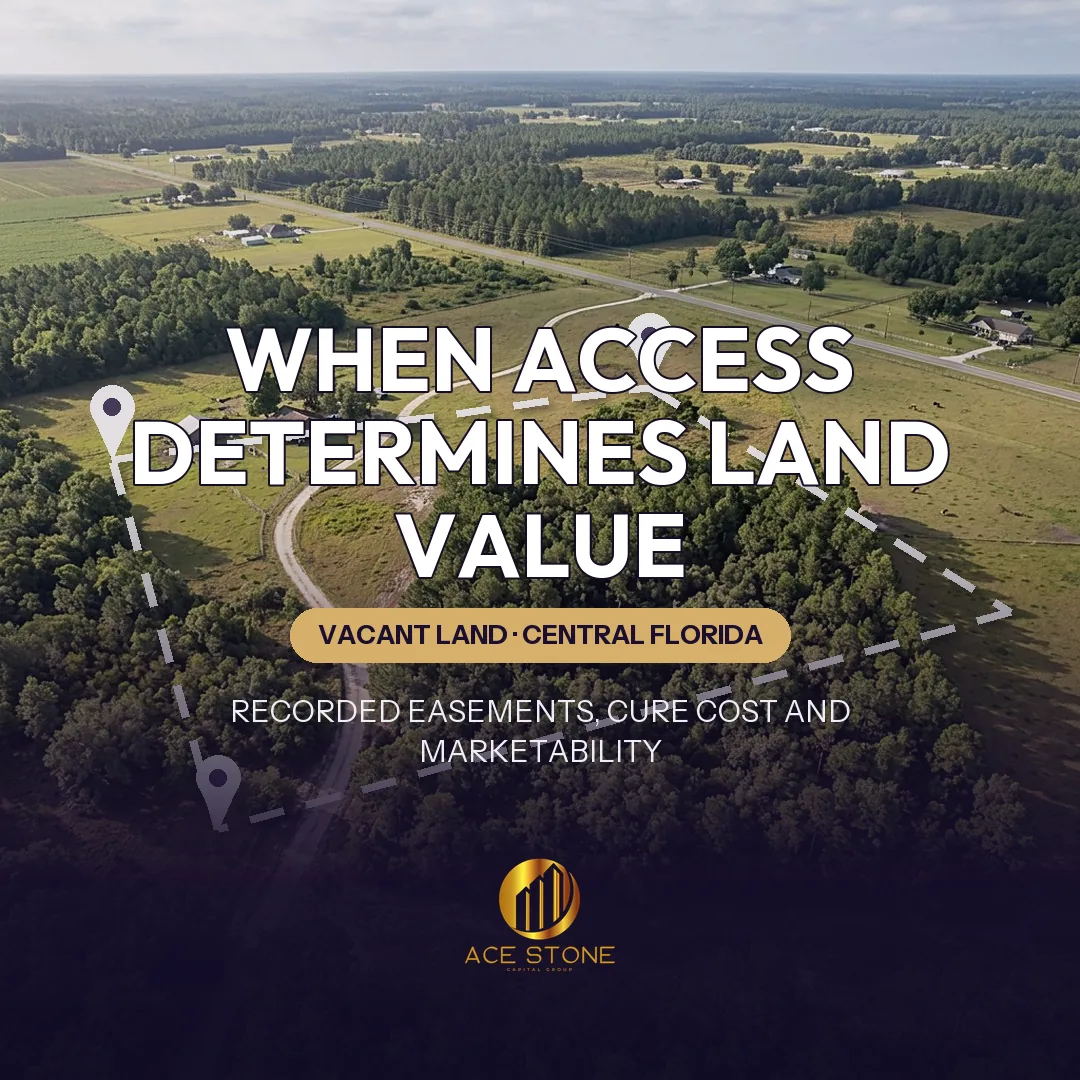
Representative imagery of the asset type and market — not a photograph of the subject property.
Case Context
This acquisition profile examines AceStone Capital Group's underwriting method for a parcel of this type. Specific properties, owners, and pricing are not identified. The subject profile is a wooded Central Florida parcel of attractive size and location that sits behind other privately held properties, reached in practice by a narrow track crossing land the owner does not control. The parcel presents well on a map. The entire acquisition turns on whether it has legal access, and if not, whether that can be cured.
Parcel Profile
The subject is a rectangular interior parcel with mature pine and oak cover, gently undulating terrain, and no frontage on any dedicated public right-of-way. A sand track enters from a county road several hundred feet away, crosses at least one intervening ownership, and terminates at the parcel boundary. There is no visible improvement on the subject and no evidence of recent use beyond occasional recreational access.
The distinction is the core of the case. Physical access is the ability to drive to the parcel today. Legal access is an enforceable, recorded right to do so that runs with the land and binds successors. A well-worn track is physical access and proves nothing about legal rights; a recorded easement across a neighboring parcel is legal access even if the route is currently impassable. Parcels are routinely marketed on the strength of physical access alone, and the difference between the two conditions can represent the majority of the parcel's practical value.
Title and Recorded-Easement Review
Diligence begins with a title search on the subject and, where necessary, on the intervening parcels. The review looks for an express recorded easement appurtenant to the subject, any easement created by a prior common-ownership subdivision, references in the chain to a right of way, plats that dedicate or reserve access, and any prescriptive or implied claim supported by the record. Recorded instruments are read for their scope: width, permitted uses, whether utilities may be installed within the corridor, maintenance obligations, and whether the right is limited to a specific grantee rather than running with the land.
Where no recorded easement exists, remedies are evaluated in order of cost and certainty. Negotiating an express easement from the adjoining owner is the cleanest path and is priced as a real acquisition of a property right, including consideration, survey, legal drafting and recording. Acquiring a strip of the intervening parcel outright is sometimes cheaper than a perpetual easement and eliminates future disputes. Statutory or judicial remedies for a landlocked parcel exist in Florida but carry counsel cost, an uncertain timeline, and an outcome that cannot be relied upon at underwriting. Each path is scored for probability, cost and time.
Utility and Emergency Access
Access is not only vehicular. A useful corridor must also carry utilities, and an easement drafted for ingress and egress alone may not permit the installation of electric, water or communications infrastructure. Corridor width must satisfy the local fire code and emergency access standards for whatever use is contemplated, and the county's driveway or access permit requirements at the connection to the public road must be confirmed. A ten-foot recreational easement is not a development access corridor.
The commercial consequence of an access defect is realized at resale. Institutional lenders generally require insured legal access, and a title underwriter will except to access where the record does not support it. Without insurable access the buyer pool collapses to cash purchasers of adjoining land, and the parcel prices as an assemblage candidate rather than a development or homesite parcel. That constraint should be reflected at acquisition, not discovered at disposition.
Development-Yield Implications
Where access can be secured, yield analysis proceeds normally: zoning and permitted density, wetland and floodplain deductions common to Central Florida parcels, soil suitability where septic is contemplated, well feasibility, and the cost of constructing an access road to county standards including base, drainage and any culvert at the connection. Where access cannot be secured, no yield analysis is meaningful, because there is no lawful way to deliver the product.
Acquisition-Basis Adjustment
Basis is adjusted in three tiers. Where insured legal access exists of adequate width and scope, the parcel is priced on ordinary land fundamentals. Where access is defective but curable at a definable cost and timeline, the full cure cost, corridor construction cost and carry through the cure period are deducted, and a further discount is applied for the probability the cure fails. Where access is uncertain and the counterparty controlling the corridor is unwilling to negotiate, the parcel is priced only as an assemblage or hold, if it is priced at all. No pricing or return figures are represented on this page.
Walk-Away Conditions
The analysis terminates where no recorded easement exists and the controlling adjoining owner declines to grant one, where the available corridor cannot satisfy fire access or utility installation, where the cost to cure exceeds the value the cure creates, or where the seller's expectation reflects unencumbered parcels with public road frontage.
Key Takeaways
A parcel without reliable, insurable legal access can lose most of its practical value regardless of acreage or location. Verify the record before valuing the acreage. Owners of interior or access-constrained parcels can review the firm's approach on the land acquisition desk.
What This Case Shows
A structured example of how AceStone Capital Group sources, underwrites, and structures off-market land acquisitions in Central Florida. For broader context, see our active acquisition markets and the land acquisition framework behind every position.
Have a Property to Sell?
Receive a written offer or a clear pass within 1–2 business days.