
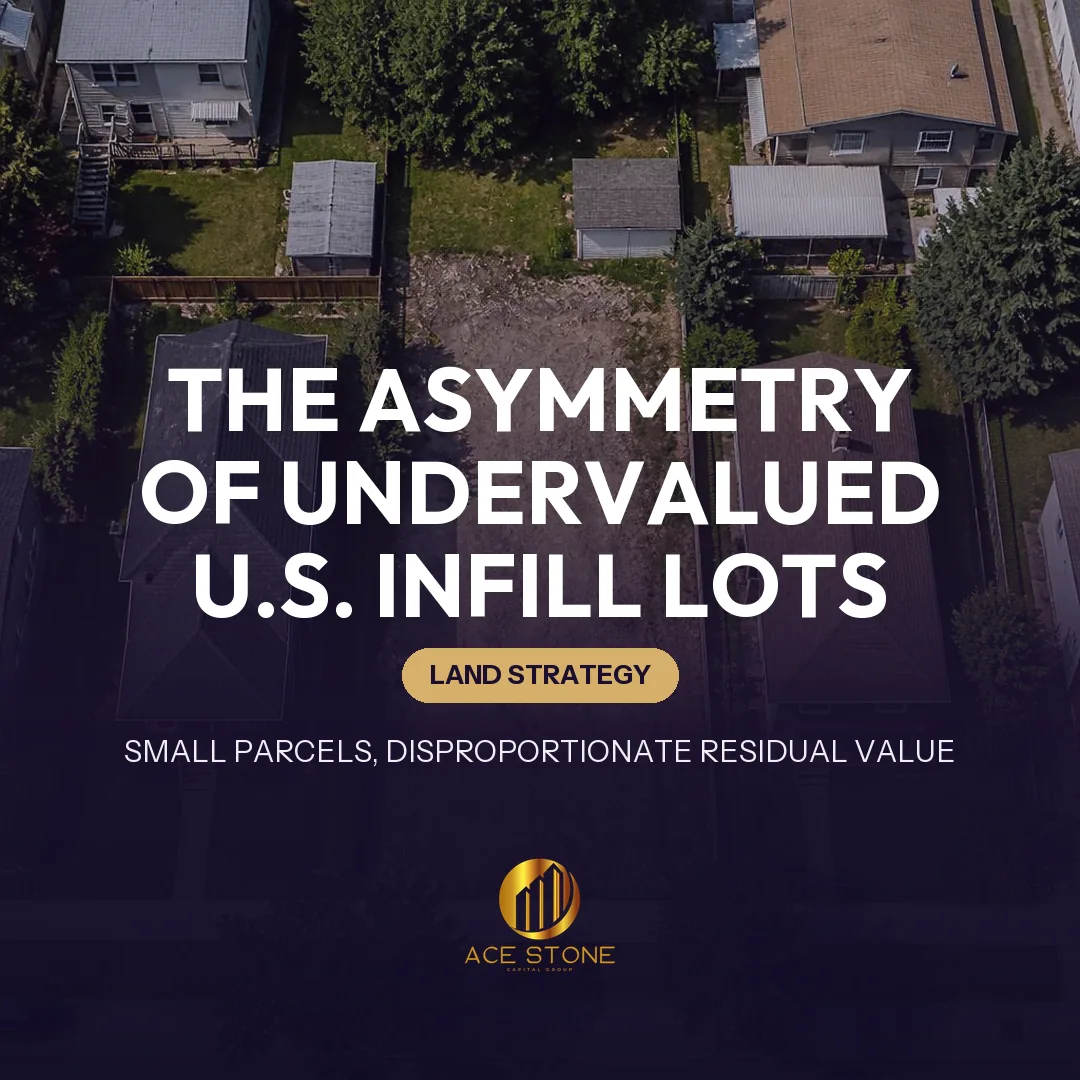
The Asymmetry of Undervalued U.S. Infill Lots
Infill lots in growing metros represent one of the last pockets of structural mispricing in domestic real estate.
Defining the Asymmetry
An asymmetric investment is one where the downside is bounded and the upside is disproportionate. Infill lots — vacant parcels within established municipal boundaries, surrounded by existing development — exhibit this profile when acquired at the right basis. The floor is set by comparable land sales and intrinsic utility value. The ceiling is defined by builder demand, population growth, and the physical impossibility of creating new infill supply.
Why Infill Lots Are Mispriced
The mispricing stems from fragmented ownership. Thousands of infill parcels are held by out-of-state owners, estates, absentee investors, and individuals who purchased during prior development cycles. These owners often lack current market intelligence, are burdened by carrying costs, and are motivated by liquidity rather than price optimization. The result is a persistent gap between intrinsic value and transaction price — the textbook definition of an exploitable inefficiency.
Applied exampleSee how this played out in Selling a Vacant Lot When You Live Out of State — a land acquisition in Multi-State.
The Growth Multiplier
In markets adding population — Cape Coral, Fort Myers, Port Charlotte, Ocala, and dozens of similar Sun Belt cities — infill lots benefit from a compounding dynamic. As surrounding lots are built out, remaining vacant parcels become scarcer. Scarcity, combined with continued demand from builders and end-users, drives price acceleration that exceeds linear appreciation models. Early-basis investors capture the convexity.
Risk Profile
The primary risks are municipal (zoning changes, assessment spikes) and market-level (demand slowdown). Both are analyzable and hedgeable through diversification across micro-markets. Compared to improved property — which carries tenant risk, maintenance risk, insurance risk, and depreciation — raw land's risk profile is materially simpler.
Applied exampleSee how this played out in How Cape Coral's Utility Expansion Affects Land Values — a land acquisition in Cape Coral, FL.
Execution Through AceStone
We identify infill lots where ownership fragmentation creates pricing inefficiency, underwrite each parcel against builder demand and comparable sales, and control the contract. Capital partners receive exclusive access to parcels that meet their allocation criteria — with full underwriting transparency and no pooled-capital structure.
AceStone's Take
AceStone Capital Group publishes this analysis as a private U.S. acquisition firm operating directly in off-market land markets. For related context, see our active acquisition markets or how capital partners engage through our exclusive capital model.
Applied Examples
Related Case Studies
Transaction examples that apply the framework described above.