
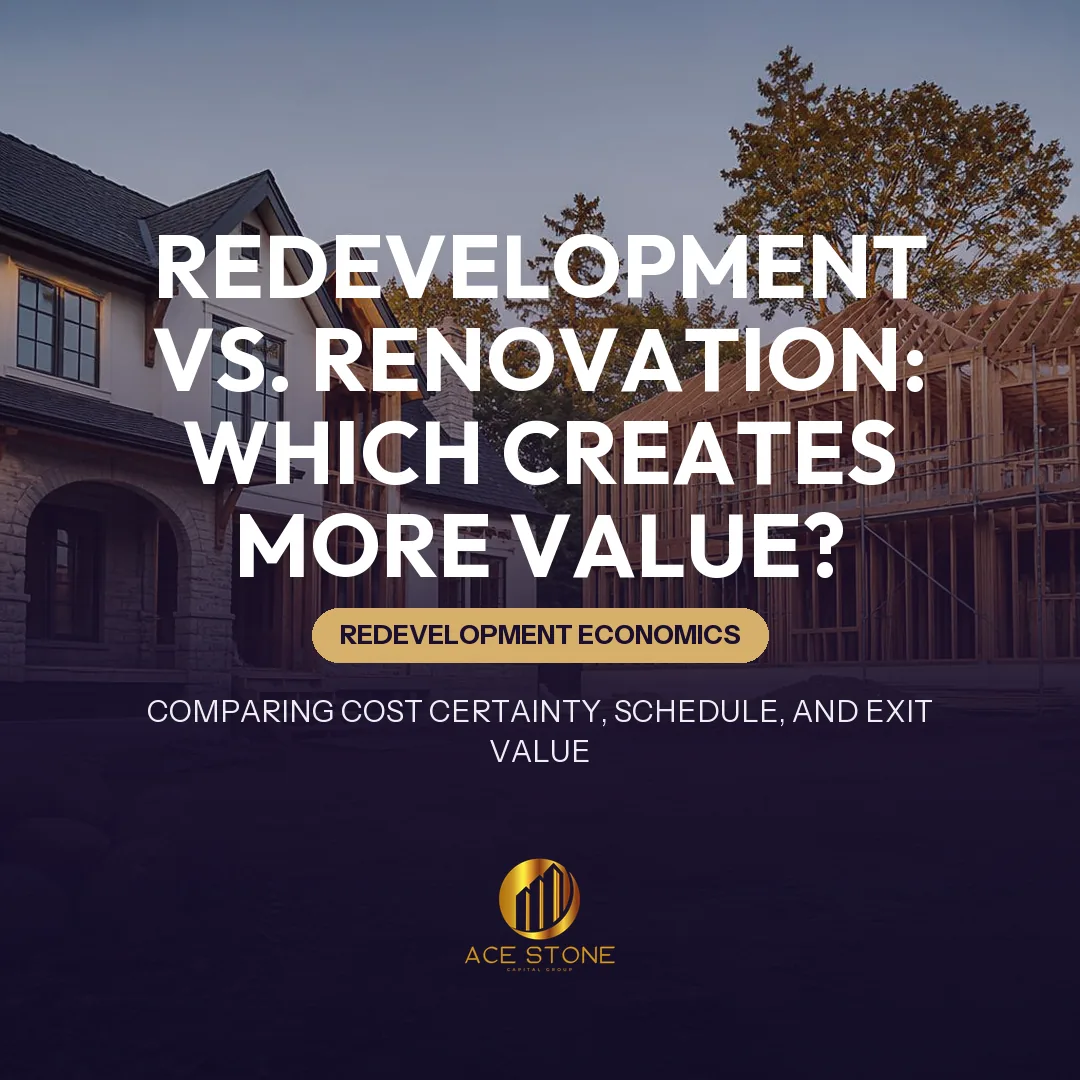
Redevelopment vs. Renovation: Which Creates More Value?
A highest-and-best-use framework for determining when demolition outperforms improvement — and when the reverse is true.
The choice between replacing a structure and improving it is a capital allocation decision, not an aesthetic one. This framework sets out the conditions under which each creates more value.
Executive Summary
Redevelopment and renovation are competing uses of the same capital against the same parcel, and the correct choice is determined by which produces greater value net of cost and risk. Renovation preserves existing structure and typically shortens the schedule, but its returns deteriorate rapidly once the required scope becomes structural — reconfiguration, systems replacement, envelope work, and footprint change converge on new-construction cost while retaining the compromises of the original design. Redevelopment carries demolition cost and a longer cycle but delivers a product matched precisely to current demand, with no legacy constraint. The decision framework rests on four tests: the structural share of required scope, the ceiling the comparable set imposes on a renovated product, the delta between the renovated exit and the replacement exit, and the risk profile each path presents.
Framing the Decision Correctly
The question is not whether the existing residence can be improved — nearly any residence can. The question is which use of capital against this parcel produces the greatest value net of cost, time, and risk. That is a highest-and-best-use determination, and it is indifferent to the sentiment attached to the existing structure.
Framing the decision this way avoids the most common error in the analysis: treating the existing improvement as sunk value to be preserved. It is not value; it is a constraint. Preserving it has a cost measured in every compromise the original design imposes on the finished product.
An existing structure is not value to be protected. It is a constraint whose cost must be quantified.
The Structural Share Test
The most reliable early indicator is the proportion of required scope that is structural rather than cosmetic. Finishes, fixtures, and surfaces are efficient to replace. Load-bearing reconfiguration, foundation work, re-massing, full envelope replacement, and complete mechanical, electrical, and plumbing renewal are not — and once several of them are required together, renovation cost trends toward new-construction cost.
Applied exampleSee how this played out in Selling a Vacant Lot When You Live Out of State — a land acquisition in Multi-State.
| Required scope | Cost behavior | Effect on the renovation case |
|---|---|---|
| Finishes, fixtures, surfaces | Efficient and predictable | Strongly supports renovation |
| Kitchen and bath reconfiguration within existing walls | Moderate, contained | Supports renovation |
| Full systems replacement (MEP) | Substantial, disruptive | Weakens the case; often triggers code upgrades |
| Envelope, roof structure, window openings | Substantial | Weakens the case materially |
| Load-bearing reconfiguration or re-massing | High and variable | Approaches new-build cost with legacy constraints retained |
| Footprint expansion or foundation work | High, with concealed-condition exposure | Generally indicates redevelopment |
When Demolition Creates Greater Value
Redevelopment is indicated when the parcel's residual land value is positive after full delivery cost and required margin, and when the program the market rewards cannot be achieved within the existing structure at a defensible cost.
- The land residual supports acquisition and delivery with margin intact.
- The target program requires footprint, massing, or level configuration the existing structure cannot accommodate.
- Systems, envelope, and structure would all require renewal — renovation cost converges on replacement cost.
- The comparable set supports the replacement price band with closed new-construction sales in the immediate submarket.
- The lot's dimensions materially exceed what the current improvement utilizes.
- Buyer resistance is to the improvement rather than the address.
When Renovation Makes More Sense
Renovation is indicated when the structure's fundamentals are sound and the required scope is predominantly cosmetic or contained, or when regulatory conditions make demolition impractical.
The grandfathering point is frequently decisive and frequently missed. Where an existing structure enjoys legal non-conforming status that a new build could not replicate, demolition can permanently reduce the parcel's buildable capacity. That analysis belongs in diligence, before either path is selected.
- The floor plan is fundamentally compatible with contemporary expectations.
- Envelope, roof structure, and foundation are sound and documented.
- Historic designation, overlay restrictions, or demolition review make replacement discretionary or prohibited.
- The comparable ceiling is close to the renovated exit — replacement value would exceed what the submarket has proven.
- Capital velocity is the binding constraint and the shorter cycle is worth the lower absolute margin.
- Non-conforming but legally grandfathered conditions — setback, coverage, or height — would be lost on rebuild.
Applied exampleSee how this played out in How Cape Coral's Utility Expansion Affects Land Values — a land acquisition in Cape Coral, FL.
Construction Economics Compared
The cost structures differ in character as well as magnitude. Renovation budgets carry concealed-condition risk that cannot be fully eliminated by inspection — conditions behind finishes are only knowable once opened, and change orders in renovation projects are both more frequent and less predictable than in new construction.
New construction, by contrast, prices a known scope against a defined program. Its risks are schedule and escalation rather than discovery. Contingency should be sized to the type of risk each path presents rather than applied as a uniform percentage.
Concealed
Renovation's dominant cost risk — conditions discovered after work begins
Escalation
Redevelopment's dominant cost risk — pricing movement across a longer cycle
Different
Risk types, not risk magnitudes — each requires distinct contingency treatment
Highest and Best Use in Practice
Applied to a specific parcel, the highest-and-best-use test is executed by modeling both paths to their respective exits and comparing net value and risk. The renovated exit is capped by what the submarket has paid for renovated inventory of that vintage; the replacement exit is capped by what it has paid for new construction. The delta between those two ceilings, less the incremental cost of the redevelopment path, is the value redevelopment creates.
Applied exampleSee how this played out in Inherited Land in Florida: What You Need to Know — a land acquisition in Florida.
| Input | Renovation path | Redevelopment path |
|---|---|---|
| Exit ceiling | Renovated comparables of similar vintage | New-construction comparables in the immediate submarket |
| Hard cost | Scope-based, with concealed-condition contingency | Per-square-foot program cost plus demolition and abatement |
| Schedule | Shorter; disruption risk from discovery | Longer; permit and construction cycle |
| Carry | Lower absolute exposure | Higher absolute exposure over a longer term |
| Regulatory exposure | Permit-level; code triggers on major scope | Demolition review, overlay, and envelope compliance |
| Residual constraint | Legacy layout and structure retained | None — program designed to current demand |
Neighborhood Conditions
Two composite conditions illustrate how the same framework produces opposite conclusions.
Condition A — an established luxury corridor with several closed new-construction sales in the trailing year, generous legacy lots, and a mid-century residence requiring full systems renewal, envelope work, and a main-level primary suite that the existing massing cannot accommodate. The structural share of scope is high, the comparable set supports the replacement band, and the land residual is positive. Redevelopment is indicated.
Condition B — a designated historic district with demolition review, strong renovated-comparable depth, and a sound structure with an intact envelope requiring finish-level work and a contained kitchen reconfiguration. Replacement would trigger discretionary approval, the renovated ceiling is near at hand, and existing setback non-conformity would be lost on rebuild. Renovation is indicated.
Developer Return, Capital Deployment, and Risk
Marginal cases are usually resolved by capital considerations rather than by construction analysis. Renovation deploys less capital over a shorter period and returns it faster, which favors developers whose constraint is equity turnover. Redevelopment concentrates more capital for longer and produces greater absolute margin per unit, which favors developers with capacity and a cost of capital that tolerates the duration.
Return per unit of time, adjusted for the risk each path carries, is the appropriate comparison. A renovation producing a smaller margin in half the cycle can outperform a redevelopment on a capital-efficiency basis while underperforming it on headline return — and for a developer running multiple projects annually, capital efficiency is generally the binding metric.
In marginal cases the construction analysis rarely decides. The cost of capital does.
Key Takeaways
- 1Once required scope becomes predominantly structural, renovation cost converges on new construction while the exit remains capped.
- 2The correct test is highest and best use of the parcel, not the condition of the existing improvement.
- 3Renovation typically wins where the layout is fundamentally sound, the envelope is intact, and the comparable ceiling is close at hand.
- 4Redevelopment typically wins where the land residual is positive, the program cannot be achieved within the existing footprint, and the comparable set supports the replacement price band.
- 5Renovation carries concealed-condition risk; redevelopment carries schedule and cost-escalation risk. They are different risks, not different magnitudes.
- 6Capital velocity often decides marginal cases: renovation returns capital faster; redevelopment concentrates more margin per unit.
Final Thoughts
The redevelopment-versus-renovation decision is resolved by evidence, not preference. Quantify the structural share of required scope, model both paths to their respective comparable ceilings, verify the regulatory conditions that could remove one path entirely, and then apply the developer's actual cost of capital and construction capacity. Executed that way, the decision becomes repeatable across a portfolio rather than re-argued on every site — and the parcels where redevelopment genuinely creates more value become identifiable well before an offer is made.
Applied Examples
Related Case Studies
Transaction examples that apply the framework described above.
- Residential RedevelopmentHow Luxury Teardown Opportunities Create Value for Developers11 min read
- Acquisition StrategyHow Developers Evaluate Teardown Opportunities12 min read
- Market IntelligenceLuxury Infill Development Trends10 min read
Further context: luxury teardown properties, residential land acquisition, and commercial development sites.