Residential Infill Lot Acquisition: Pricing a Builder-Ready Site in Phoenix
A Phoenix infill parcel underwritten on residual land value — why a technically buildable lot is not automatically an economically attractive one.
This acquisition profile examines asset strategy, underwriting method, transaction structure, and value-creation considerations. Counterparty and pricing details are not disclosed.
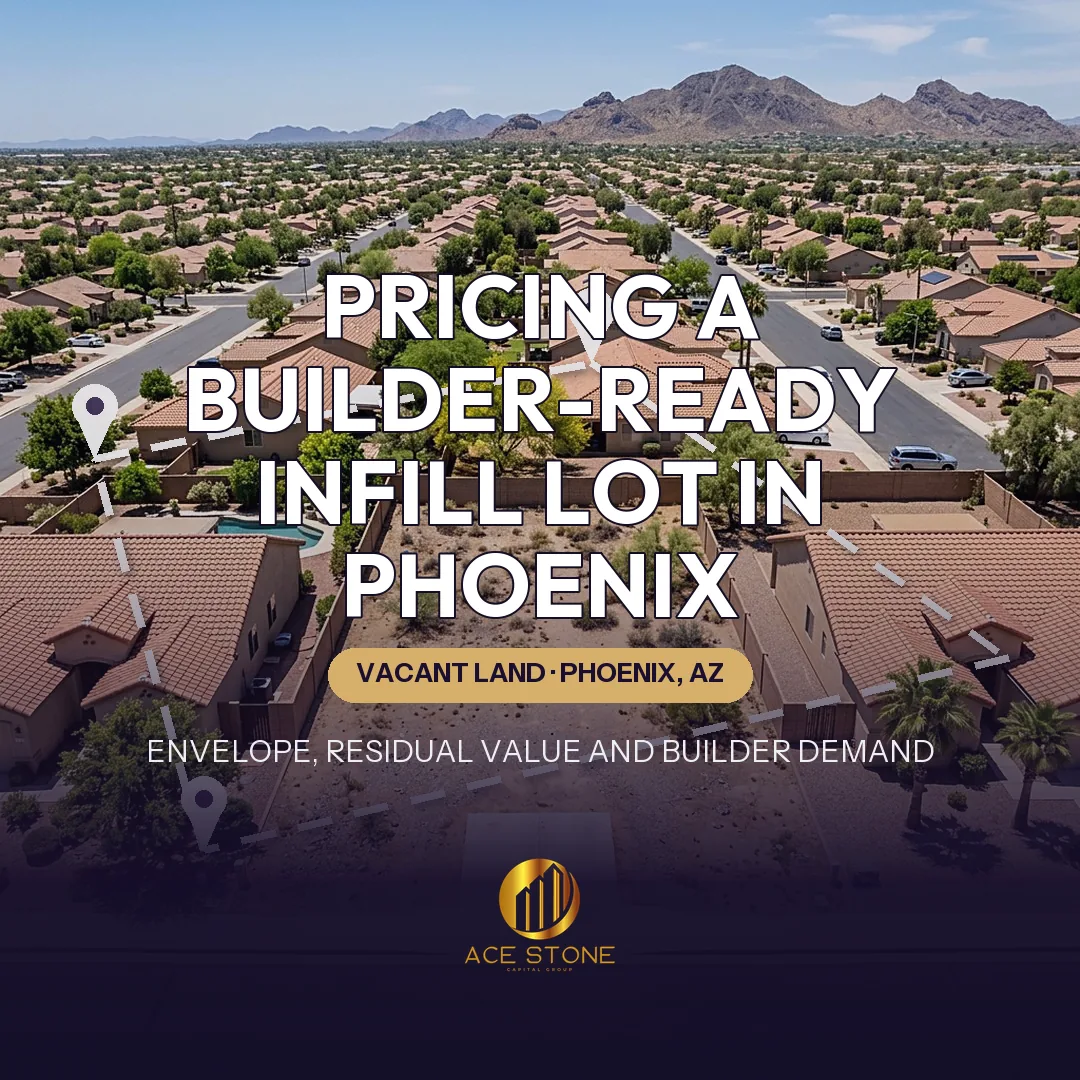
Representative imagery of the asset type and market — not a photograph of the subject property.
Case Context
This acquisition profile examines AceStone Capital Group's underwriting method for a parcel of this type. Specific properties, owners, and pricing are not identified. The subject profile is a single vacant residential parcel inside an established Phoenix neighborhood where the surrounding blocks were built out decades ago and only a handful of unbuilt lots remain. The question the analysis answers is narrow and commercially decisive: is this lot merely buildable under the code, or is it a site a production or semi-custom builder would actually want to own at a price that clears their return threshold?
Parcel Profile
The subject is a rectangular interior lot on a paved public street with curb, gutter and an existing driveway apron from a prior structure that was removed. Frontage is modest relative to depth, which is typical for the platting era of the surrounding subdivision. The lot sits flat, with desert-adapted volunteer vegetation, a partially collapsed perimeter block wall on one side line, and remnant concrete near the street. Adjacent parcels on both sides carry occupied single-family residences, and the block face is fully improved apart from the subject.
Zoning review begins with the base residential district and the specific dimensional standards it imposes: minimum lot area, minimum lot width at the building line, maximum lot coverage, maximum height, and required front, side and rear setbacks. In Phoenix, an older platted lot can be legally nonconforming as to width or area while remaining a lawful building site, and that distinction changes the permitting path materially. The review confirms whether the parcel is a lot of record, whether any prior lot split or combination affects its status, and whether an overlay, historic designation or neighborhood-specific standard applies to the block.
Buildable-Envelope Analysis
Dimensional standards are then converted into an actual envelope. Front and rear setbacks are subtracted from depth, side setbacks from width, and any recorded easement is removed from the remainder. What survives is the two-dimensional footprint available for a residence, garage and required parking or maneuvering area. Height limits and coverage ratios then determine how much floor area that footprint can support across one or two stories. This step routinely reveals that a lot marketed on gross square footage supports a smaller home than the neighborhood's recent construction, and a builder will price the site on the home they can build, not on the acreage line in the listing.
A preliminary title review identifies recorded utility, drainage and public-utility easements, along with any shared-access or irrigation rights common to older Phoenix plats. Easements at the rear are usually immaterial; a wide side easement can be decisive because it compresses the envelope where a garage or driveway must go. Physical review covers the condition of the existing apron, the state of the perimeter wall (repair or replacement is a real number, not a rounding error), the presence of buried debris or an abandoned septic component from a removed structure, and grading relative to the street for drainage compliance.
Utility Availability
Because the block face is otherwise built out, water, sewer, electric and gas are typically available in the right-of-way. Availability is not the same as connection: the analysis confirms sewer line depth and whether a gravity connection is possible, the location and size of the water tap, whether an existing service can be reused or must be abandoned and re-permitted, and what utility fees and meter charges apply. Where a prior structure was removed, prior service points are verified rather than assumed, because a capped or abandoned service can require replacement at full cost.
Comparable analysis uses closed vacant-lot sales in the immediate and adjoining subdivisions, adjusted for width, depth, envelope, utility status, corner or interior position, and street exposure. Active asking prices are read as an indicator of seller expectation and inventory depth, not as evidence of value. In thin infill markets a single optimistic listing can sit unsold for a year while closed sales trade well below it, and treating that listing as a comparable imports someone else's error into the basis.
Residual Land Value and Builder Demand
The controlling method for a builder-ready infill lot is residual land value. Recent closed sales of newly constructed homes on comparable lots establish a supportable finished value. From that figure the analysis deducts direct construction cost at the specification the neighborhood actually supports, site work and utility connection, permits and impact fees, financing carry over an expected build and sale period, sales and closing costs, and the builder's required margin for the risk taken. What remains is the residual — the maximum a rational builder can pay for the dirt. Where the neighborhood's finished values cannot carry current Phoenix construction costs at the envelope permitted, the residual compresses toward zero regardless of how attractive the location appears.
Acquisition Basis
AceStone's basis is set below the residual, not at it. The discount reflects entitlement and permitting uncertainty, the cost of curing site conditions, the possibility that a survey reduces the envelope, and the holding period until a builder is transacting. No purchase price, margin or return figure is represented here; the point of the framework is the ordering of the logic. Basis follows from what can profitably be built, and every input that reduces the envelope or raises the cost of building reduces the basis proportionally.
Key Risks
The principal risks are an envelope smaller than the neighborhood's competitive product, a survey that relocates a side line or reveals encroachment from a neighboring wall or structure, a sewer connection that requires a pump rather than gravity, buried debris from the prior improvement, and a construction cost environment that moves faster than finished values. Each of these is quantifiable in diligence, which is why they are priced rather than discovered after closing.
Walk-Away Conditions
The analysis terminates where the envelope cannot support a residence competitive with the block's recent construction, where an unrecorded encroachment cannot be resolved, where the seller's expectation is anchored to asking prices rather than closed sales, or where residual value at current cost does not clear a defensible basis with a margin for error.
Key Takeaways
The value of an infill lot is determined by what can profitably be built on it, not by what neighboring vacant lots are asking. Envelope, cost and finished value set the ceiling; title condition and site work set the deductions. Landowners evaluating a direct sale can review acquisition parameters on the land acquisition desk.
What This Case Shows
A structured example of how AceStone Capital Group sources, underwrites, and structures off-market land acquisitions in Phoenix, AZ. For broader context, see our active acquisition markets and the land acquisition framework behind every position.
Have a Property to Sell?
Receive a written offer or a clear pass within 1–2 business days.