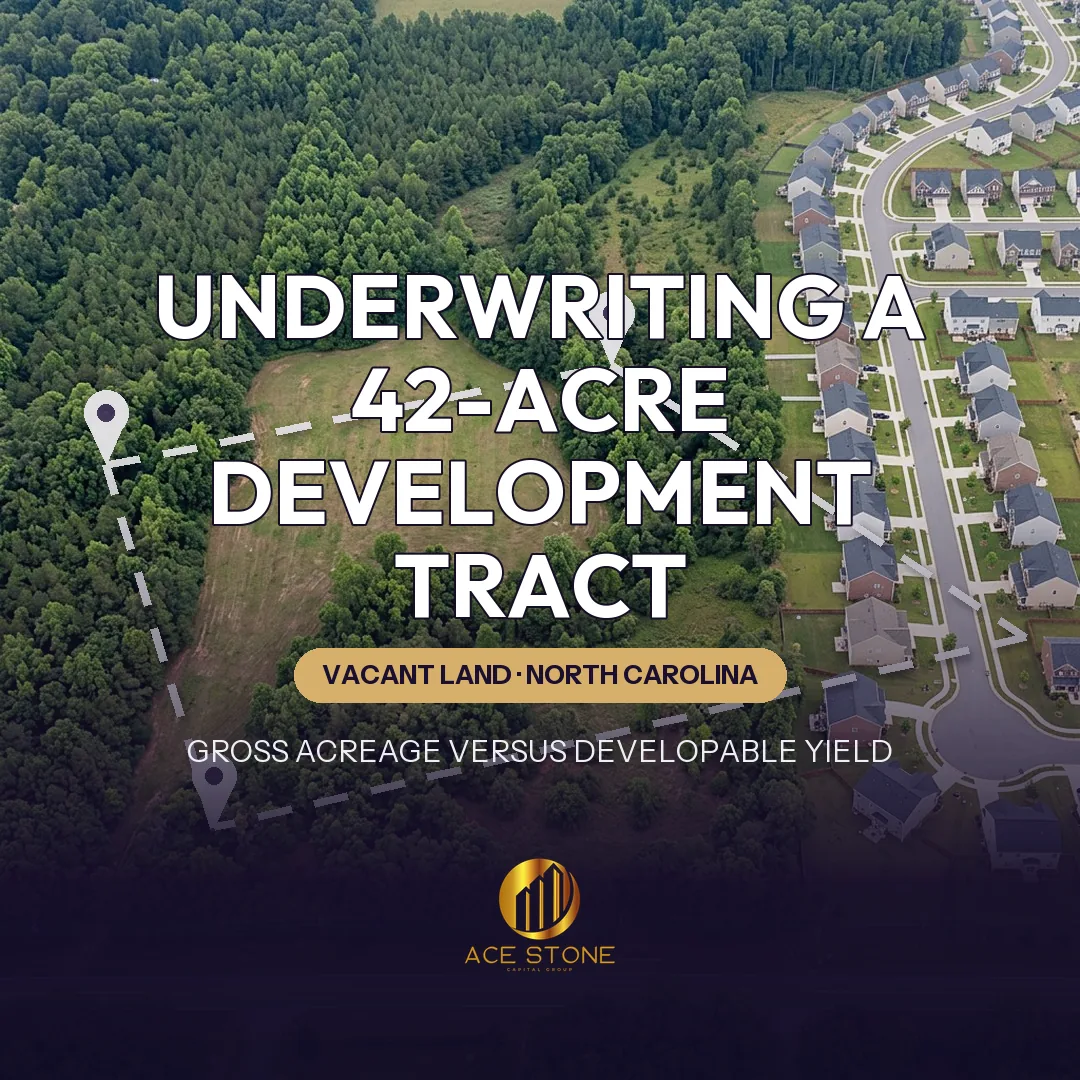
Large-Tract Land Acquisition: Underwriting 42 Acres for Residential Development in North Carolina
A 42-acre North Carolina tract underwritten on developable yield rather than gross acreage — the distinction that determines large-tract value.
This acquisition profile examines asset strategy, underwriting method, transaction structure, and value-creation considerations. Counterparty and pricing details are not disclosed.
Representative imagery of the asset type and market — not a photograph of the subject property.
Case Context
This acquisition profile examines AceStone Capital Group's underwriting method for a parcel of this type. Specific properties, owners, and pricing are not identified. The subject profile is a 42-acre undeveloped tract positioned near an expanding suburban growth corridor in North Carolina, within reach of recent subdivision activity and a widened arterial. The analysis exists to separate two numbers that are routinely conflated in large-tract pricing: gross acreage, and the acreage that can actually be converted into saleable lots.
Parcel Profile
The tract is an irregular assemblage of former agricultural and timbered land with several hundred feet of frontage on a two-lane state-maintained road. Interior topography rolls from the road frontage down toward a drainage feature at the rear third of the property. Portions are in mature hardwood, portions in planted pine, and a cleared area near the frontage carries the remains of a farm access track. No structures of value remain on the site.
The ownership profile is a long-held family tract, now held by multiple heirs with differing objectives and no interest in pursuing entitlement themselves. That profile matters commercially because it defines what the seller values: a clean, defined process and a counterparty capable of underwriting the tract without requiring the owner to fund studies, engineering or rezoning work in advance.
Gross Versus Usable Acreage
The first analytical step is to reduce gross acreage to a usable figure. Deductions typically include jurisdictional wetlands and their required buffers, riparian and stream buffers under state rules, floodplain, slopes too steep to develop economically, required open space and recreation set-asides under the local ordinance, land consumed by internal roads and rights-of-way, and area allocated to stormwater management facilities. On a rolling North Carolina tract with a rear drainage feature, the cumulative reduction from gross to net developable is frequently substantial, and it is the single largest driver of value dispersion between two tracts of identical size.
A preliminary desktop review uses National Wetlands Inventory mapping, soil survey hydric indicators, FEMA flood mapping and topographic data to identify probable jurisdictional features. Desktop work informs pricing but does not conclude it; a field delineation by a qualified consultant, and where appropriate a jurisdictional determination, establishes the regulated boundary. Stream buffers are treated as hard deductions because in most affected North Carolina basins they cannot be built through, and permitted impacts carry mitigation cost and schedule.
Zoning, Density and Entitlement Path
Zoning review establishes the base district, the permitted residential density, minimum lot dimensions, open-space requirements and whether a conditional district or planned development is required to achieve a competitive lot mix. The county or municipal comprehensive plan and any small-area plan indicate whether the desired density is consistent with adopted policy — the single strongest predictor of entitlement outcome. Utility capacity commitments, allocation policy and any moratorium are confirmed at this stage rather than assumed from the presence of a nearby main.
Access analysis covers the adequacy of the existing frontage for a permitted subdivision entrance, sight distance along the state road, likely driveway permit conditions, and whether a turn lane, taper or road improvement will be required as a condition of approval. Where a second point of access is required by the fire code or ordinance for the lot count contemplated, the cost and feasibility of securing it — including any off-site easement — is priced before the tract is priced.
Infrastructure and Site-Development Cost
Yield is meaningless without the cost of achieving it. The analysis builds a preliminary infrastructure budget: clearing and grubbing, mass grading against the site's topography, internal road construction, water and sewer extension including any off-site main or pump station, stormwater ponds or infiltration systems, erosion control, dry utilities, and engineering, survey and permitting fees. Rolling terrain raises grading and road cost per lot; a long utility extension can consume the entire spread between raw and finished lot value.
Development-Yield Analysis
Net developable acreage, permitted density and the required lot dimensions combine into a preliminary lot count and product mix. That count is then tested against builder demand: which builders are active in the submarket, what lot widths they are buying, at what absorption pace, and whether they take down finished lots in phases. A yield that is technically achievable but sits outside every active builder's product specification has no buyer, and therefore no value.
Comparable-Land Analysis
Comparables are drawn from closed sales of tracts at similar entitlement stages within the corridor, normalized to price per developable acre or per approved lot rather than per gross acre. Raw, rezoned and fully engineered tracts trade in distinct bands, and mixing them produces a meaningless average. Finished-lot takedown pricing from active builder contracts, where observable, anchors the top of the value chain and allows the residual to be worked backward.
Acquisition Basis
Basis is derived by taking the supportable finished-lot value, deducting site-development cost, entitlement and engineering cost, carrying and financing cost across the entitlement and construction schedule, and a return commensurate with the risk of an unapproved tract. The residual is then discounted for approval probability and schedule uncertainty. No figures are represented here. The structural point is that the tract is priced on approved, developable, saleable output — and that gross acreage never appears in the calculation except as a starting point for deductions.
Key Risks and Walk-Away Conditions
The dominant risks are a delineation that removes more acreage than the desktop review indicated, utility allocation that is unavailable or capped, a rezoning that draws organized opposition, off-site road improvements imposed at approval, and grading cost that escalates with terrain. The analysis terminates where net developable acreage cannot support a lot count that clears infrastructure cost, where legal or utility access cannot be secured, or where seller expectations are anchored to a price per gross acre that ignores the deductions the site imposes.
Key Takeaways
Large-tract value is a function of usable, entitled, developable yield — not gross acreage. Owners of large holdings evaluating a direct sale can review the firm's approach on the land acquisition desk.
What This Case Shows
A structured example of how AceStone Capital Group sources, underwrites, and structures off-market land acquisitions in North Carolina. For broader context, see our active acquisition markets and the land acquisition framework behind every position.
Have a Property to Sell?
Receive a written offer or a clear pass within 1–2 business days.