
Back
    Residential Jacksonville, FL March 2026

    Duplex Acquisition: Vacant Value-Add Property, Jacksonville

    A analysis of a fully vacant Jacksonville duplex requiring work on both sides, and how rehabilitation and lease-up risk are priced into basis.

    This acquisition profile examines asset strategy, underwriting method, transaction structure, and value-creation considerations. Counterparty and pricing details are not disclosed.

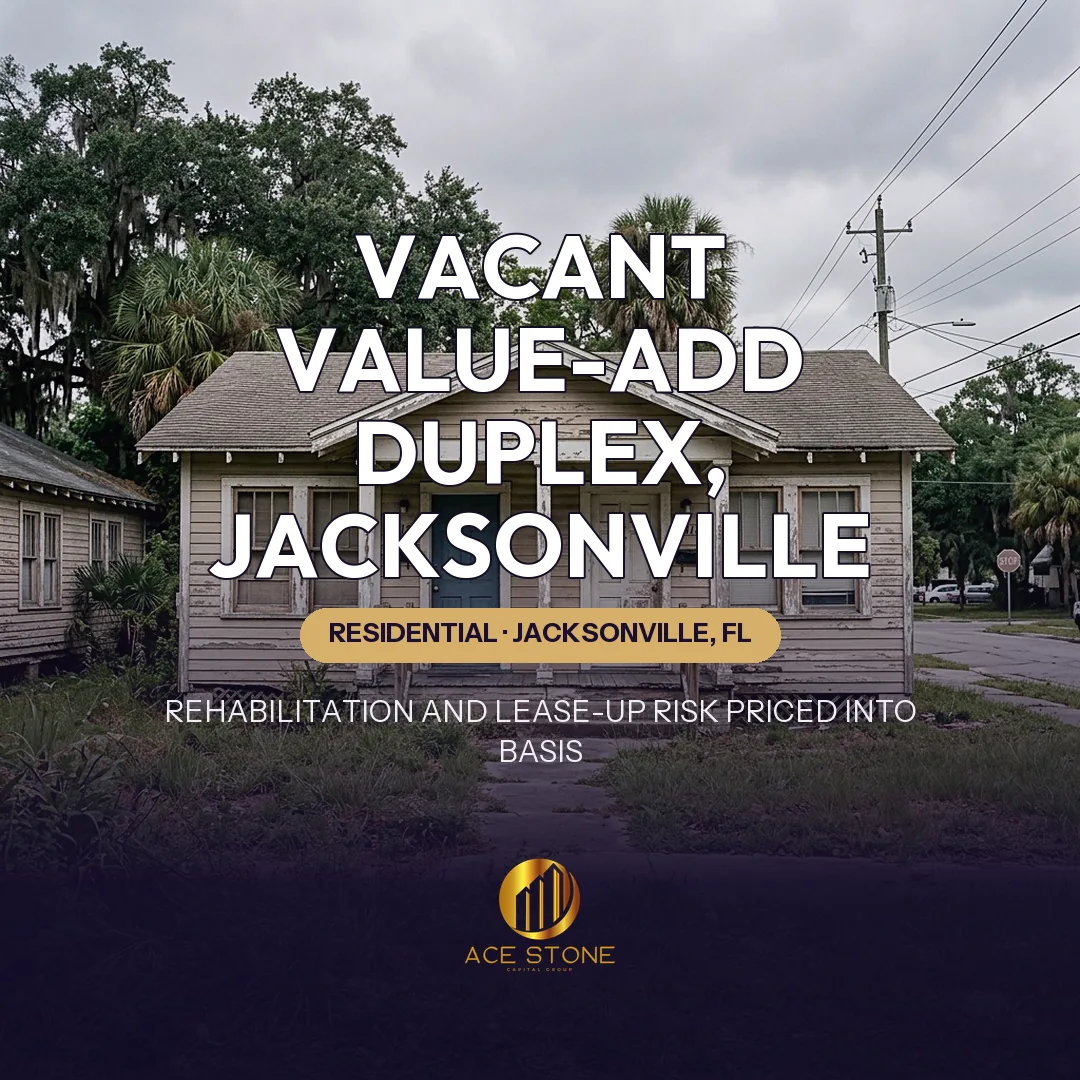
    Older but structurally sound vacant duplex in a Jacksonville neighborhood.
    Representative imagery of the asset type and market — not a photograph of the subject property.

    Case Context

    This acquisition profile examines a fully vacant two-unit property in Jacksonville requiring rehabilitation before either side can be leased. It sets out AceStone Capital Group's underwriting methodology; specific counterparties and pricing are not identified.

    Acquisition Profile

    A vacant duplex removes tenant constraints from the analysis and replaces them with execution risk. There is no in-place income to anchor value, no lease to inherit, and no occupied-unit access limitation during diligence or construction. Every dollar of projected revenue is prospective, which means the entire valuation rests on the accuracy of the rehabilitation scope and the credibility of the lease-up assumption.

    Applied exampleSee how this played out in Selling an Inherited Property in Florida — a residential acquisition in Florida.

    Physical Condition Review

    Inspection is unrestricted and therefore expected to be complete. The review covers roof covering and decking condition, framing and any evidence of prior water intrusion or wood-destroying organism activity typical of the Florida climate, foundation and slab condition, electrical service capacity and panel type, supply and drain plumbing material and condition, air-handling and condensing equipment per unit, window and door integrity, and the state of interior finishes after a period of non-occupancy.

    Shared Versus Separate Infrastructure

    Two-unit buildings differ sharply in how systems are divided, and the distinction has direct operating consequences. Separate electrical meters, separate water service, separate mechanical systems, and separate water heaters allow utility cost to sit with the tenant and isolate a failure to a single unit. Shared service means the owner carries utilities, allocation disputes are structural rather than occasional, and any interruption affects both sides. Where service is shared, the cost and feasibility of separating it is scoped and priced during diligence rather than deferred.

    Applied exampleSee how this played out in Cash Offers vs. Traditional Listings: What Sellers Should Know — a residential acquisition in National.

    Rehabilitation Scope and Budget

    The scope is built line by line per unit and per building system, separated into life-safety and compliance items, capital items with defined remaining life, and cosmetic items that support the target rent. Contingency is carried explicitly rather than embedded, and sequencing is planned so that both units are not simultaneously out of service longer than necessary. A vacant building allows the two sides to be completed in parallel, which shortens total downtime but concentrates capital outlay into a single period.

    Lease-Up and Carrying Cost

    Carrying cost accrues from closing through the second unit's rent commencement and includes taxes, vacant-dwelling insurance, which is typically priced above a tenant-occupied policy, utilities during construction, security, and lawn maintenance. Lease-up time is drawn from observed absorption for comparable Jacksonville two-unit product and is applied per unit rather than to the building as a whole.

    Applied exampleSee how this played out in Why Out-of-State Owners Sell to Direct Buyers — a residential acquisition in Multi-State.

    Stabilized Economics

    Stabilized income is set from leased comparables at the finish level the rehabilitation will actually deliver. Stabilized expenses include Duval County tax on the post-transfer basis, a landlord dwelling policy, per-unit maintenance and turn reserve, management at two doors, and an economic vacancy allowance reflecting realistic annual downtime rather than perfect occupancy.

    Basis Analysis

    Acquisition basis equals stabilized value less rehabilitation cost, less carrying cost through stabilization, less an execution risk allowance reflecting the possibility of scope expansion after walls are opened. Because none of the revenue is contractual at acquisition, the risk allowance in a vacant profile is wider than it would be for an occupied building with equivalent physical needs.

    Risk Factors

    Key risks are scope expansion during construction, contractor availability and pricing in an active market, permit and inspection timing with the local authority, insurance cost while vacant, and the possibility that achievable rent at completion is below the level assumed at underwriting.

    Key Takeaway

    Vacancy creates repositioning flexibility only when rehabilitation and lease-up risk are correctly priced. The absence of tenants is an advantage in execution and a liability in underwriting, and the basis must reflect both.

    Conclusion

    Vacant value-add duplexes reward disciplined scoping and punish optimistic assumptions. The framework above reflects AceStone Capital Group's underwriting posture on assets of this profile.

    What This Case Shows

    A structured example of how AceStone Capital Group sources, underwrites, and structures off-market residential acquisitions in Jacksonville, FL. For broader context, see our active acquisition markets or initiate a direct-sale review for a similar property.

    Have a Property to Sell?

    Receive a written offer or a clear pass within 1–2 business days.

    Request a Cash Offer