
Back
    Residential Jacksonville, FL July 2026

    Value-Add Portfolio Acquisition: Seven Under-Rented Homes in Jacksonville

    A Jacksonville analysis testing whether below-market rents across seven homes represent a realistic, timely and economically justified value-add path.

    This acquisition profile examines asset strategy, underwriting method, transaction structure, and value-creation considerations. Counterparty and pricing details are not disclosed.

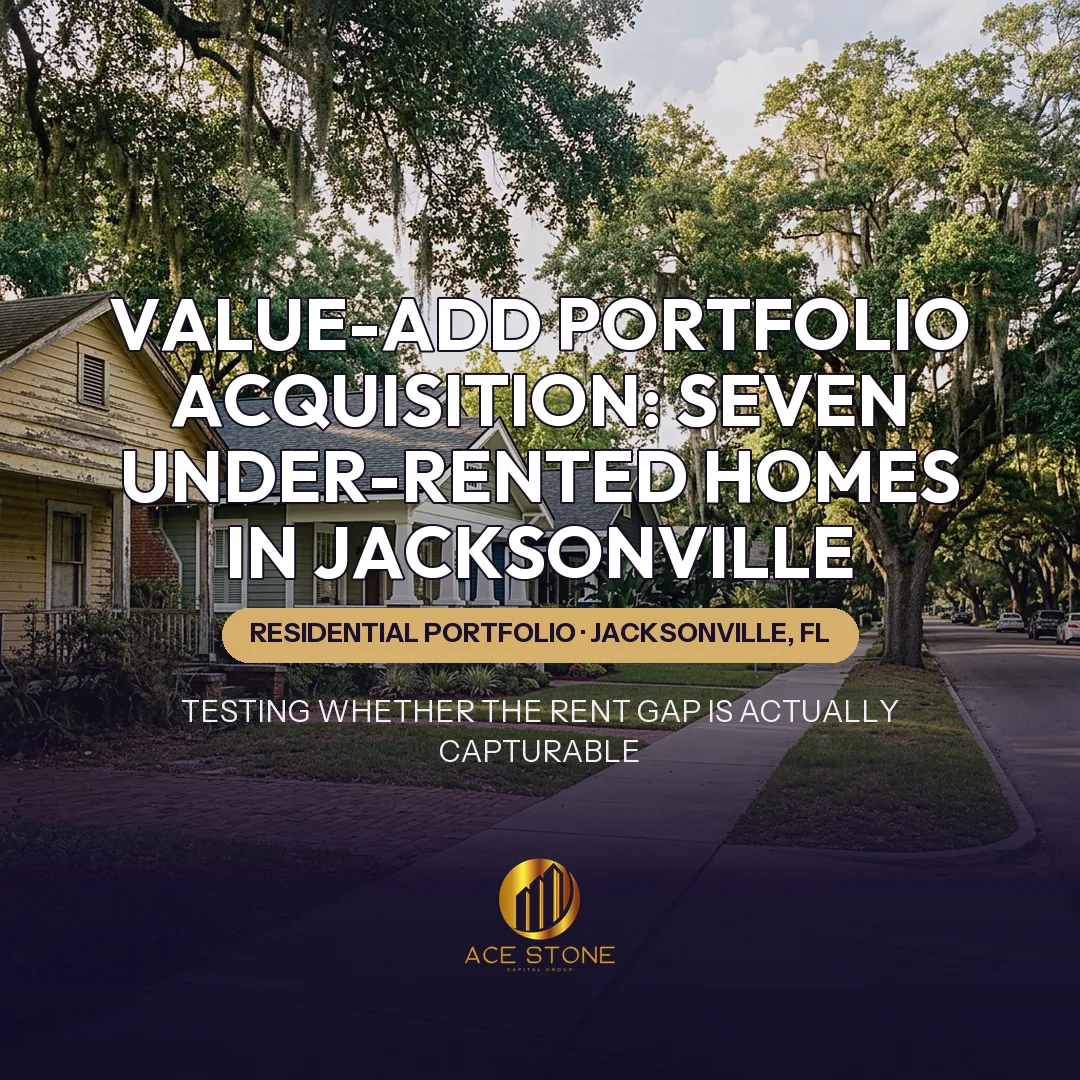
    Established Jacksonville neighborhood showing renovated and older housing stock side by side.
    Representative imagery of the asset type and market — not a photograph of the subject property.

    Case Context

    This acquisition profile examines a seven-home Jacksonville rental portfolio in which in-place rents sit below demonstrated market levels. It sets out AceStone Capital Group's underwriting methodology. Specific counterparties and pricing are not identified.

    Establishing the Rent Gap

    The first task is proving the gap exists. Market rent is established from executed leases on comparable homes within the same submarket, adjusted for bedroom count, square footage, condition, yard and parking, and lease date — not from asking rents or aspirational listings. A gap demonstrated against signed comparables is an underwriting input; a gap inferred from asking prices is not.

    Applied exampleSee how this played out in Selling an Inherited Property in Florida — a residential acquisition in Florida.

    Why Rents Sit Below Market

    Below-market rent has causes, and the cause determines whether the gap is capturable. Long-tenured tenants renewed without increases, an owner prioritizing stability over yield, condition that suppresses achievable rent, or a submarket that has moved faster than the owner's renewal practice all produce a gap that can be closed. A gap caused by floor plan, location, or functional deficiency generally cannot.

    Path to Market Rent

    Capturing the gap requires a schedule, not an assumption. Each lease is mapped to its expiration, and each home is assigned an approach: incremental increase at renewal, staged increase across two cycles, or turnover with renovation. Renovation scope is priced per home with contingency, and each turn carries vacancy loss, make-ready time, and leasing cost.

    Applied exampleSee how this played out in Cash Offers vs. Traditional Listings: What Sellers Should Know — a residential acquisition in National.

    Retention and Turnover Trade-Off

    Pushing a paying long-term tenant to full market rent frequently triggers a turn whose total cost — vacancy, make-ready, leasing, and re-tenanting risk — exceeds several years of the increase pursued. Underwriting compares the retention case and the turnover case for every home rather than assuming that market rent is always the correct target.

    Operating Expense Reality

    Higher rent does not arrive alone. Jacksonville expense analysis covers Duval County tax reassessment on transfer, insurance in a coastal-influenced market with roof-age eligibility constraints, maintenance on aged housing stock, and management fees calculated on the higher revenue base. Net gain, not gross rent gain, is what supports basis.

    Applied exampleSee how this played out in Why Out-of-State Owners Sell to Direct Buyers — a residential acquisition in Multi-State.

    Risks Identified

    Risks include tenant loss exceeding forecast, renovation scope discovered after possession, market rent softening before the schedule completes, contractor availability, and the classic error of underwriting day-one market rent on a portfolio whose leases expire over eighteen months.

    Key Takeaway

    Below-market rent only creates value when the path to achieving market rent is realistic, timely, and economically justified. Absent that path, the gap is a description of the asset, not an opportunity.

    Conclusion

    Value-add underwriting is schedule discipline applied to a rent thesis. This analysis reflects AceStone Capital Group's underwriting method; no specific transaction is described.

    What This Case Shows

    A structured example of how AceStone Capital Group sources, underwrites, and structures off-market residential acquisitions in Jacksonville, FL. For broader context, see our active acquisition markets or initiate a direct-sale review for a similar property.

    Have a Property to Sell?

    Receive a written offer or a clear pass within 1–2 business days.

    Request a Cash Offer