
Back
    Residential Jacksonville, FL April 2026

    Estate Multifamily Acquisition: Six-Unit Building, Jacksonville

    An acquisition profile examining a Jacksonville six-unit building held through an estate, where fragmented records and deferred maintenance had to be reconstructed into a credible basis.

    This acquisition profile examines asset strategy, underwriting method, transaction structure, and value-creation considerations. Counterparty and pricing details are not disclosed.

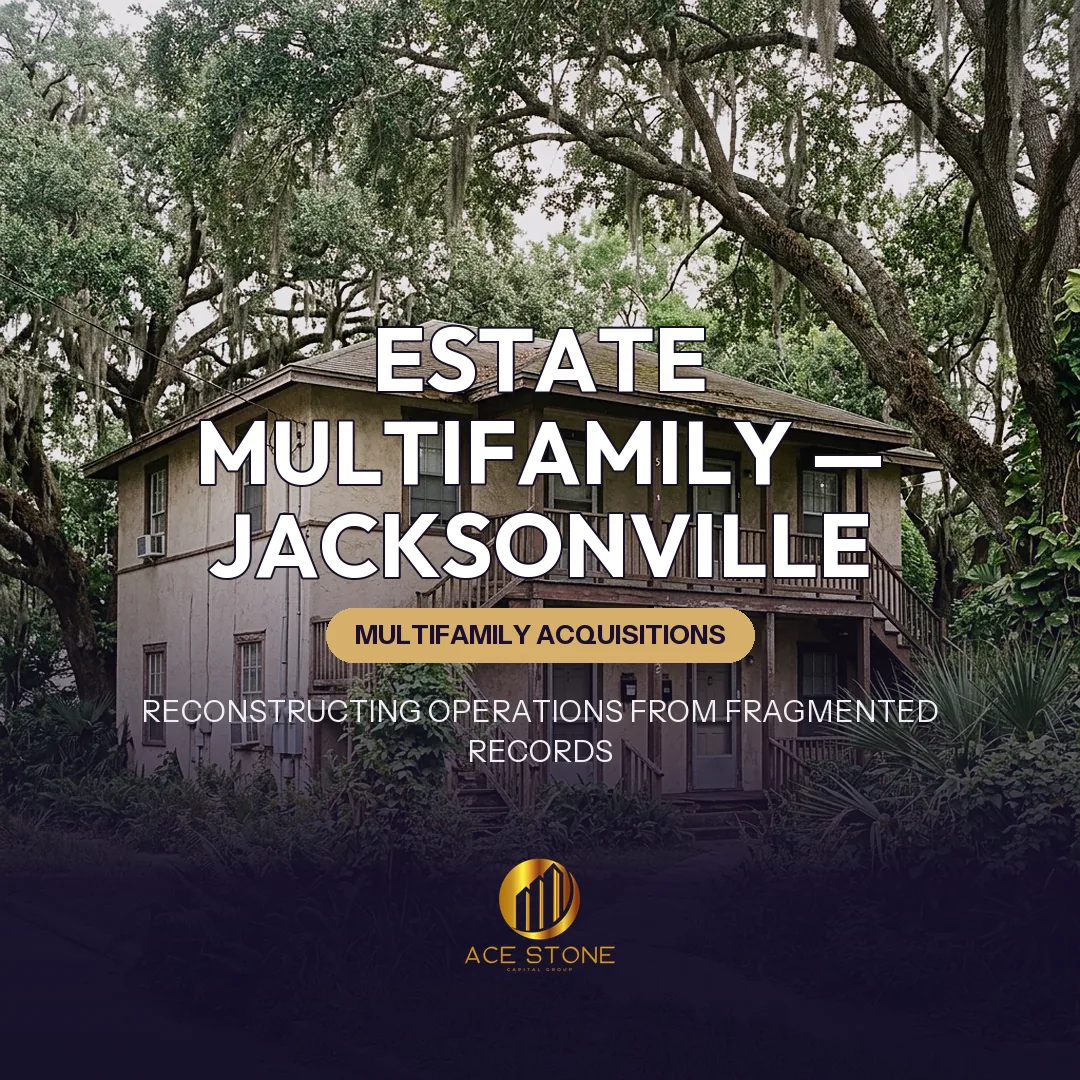
    Older six-unit Jacksonville apartment building framed by mature vegetation.
    Representative imagery of the asset type and market — not a photograph of the subject property.

    Case Context

    This acquisition profile examines a six-unit residential building in Jacksonville that passed to heirs who did not intend to continue operating it. It sets out AceStone Capital Group's underwriting methodology; specific counterparties and pricing are not identified.

    Ownership Transition

    Estate ownership introduces requirements that have nothing to do with the real estate. Authority to convey must be established through the probate record, personal representative appointment, or trust documentation. Where multiple heirs hold interests, alignment among them is a condition of transacting at all, and the sequencing of that alignment usually determines the timeline more than diligence does.

    Applied exampleSee how this played out in Selling an Inherited Property in Florida — a residential acquisition in Florida.

    Fragmented Operating Records

    Records in this profile are typically incomplete: some leases present and others missing, payment records kept informally or held by a decedent who managed personally, and no continuous expense history. The absence of records is treated as an information problem to be solved with primary evidence, not as a defect that justifies an arbitrary discount.

    Reconstructing Operations

    Operations are rebuilt from independent sources: county tax records for assessment and payment history, utility account histories for owner-paid services, insurance declarations, bank deposit patterns where available, and direct verification with occupants regarding term and rent through estoppel where the estate authorizes contact. Each source cross-checks the others, and items that cannot be corroborated are carried as risk rather than as income.

    Applied exampleSee how this played out in Cash Offers vs. Traditional Listings: What Sellers Should Know — a residential acquisition in National.

    Existing Tenancies

    Tenants in an estate-held building frequently occupy under expired written leases, oral agreements, or month-to-month arrangements formed over many years. Each tenancy is characterized individually: who occupies, on what terms, at what rent, with what deposit, and with what payment record. Deposit liabilities are a particular concern, because funds may not have been segregated or documented during the transition.

    Physical Condition and Deferred Maintenance

    Extended illness, absence or transition typically produces deferred maintenance concentrated in items an active owner would have addressed: roof, gutters and drainage, exterior paint and wood condition in a humid climate, air-handling equipment, water heaters, and interior finishes at units that have not turned in years. Condition is scoped by inspection and translated into a dated capital schedule rather than a single allowance.

    Applied exampleSee how this played out in Why Out-of-State Owners Sell to Direct Buyers — a residential acquisition in Multi-State.

    Insurance, Tax and Expense Review

    Insurance is re-quoted as a non-owner-occupied multifamily policy in a coastal-exposed county, where roof age and construction class drive both price and availability. Property tax is re-underwritten to a post-transfer basis. Utilities, pest and lawn service, management at a market rate, and per-unit reserves are added, since none of these were likely priced under family operation.

    Establishing a Credible Basis

    Basis is constructed from corroborated in-place income plus a discounted reversion to documented market rents, net of normalized expenses, less the capital schedule and the carry required to execute it. Where corroboration is thin, the conservative reading is used. The objective is a figure the buyer can defend from evidence, not a figure derived from the estate's expectation or from the absence of contrary information.

    Structuring Around the Estate

    Structure accommodates the estate's circumstances: a diligence window that runs in parallel with probate or trust administration where permissible, an as-is purchase with no repair obligation on the heirs, no requirement to vacate occupied units, and a closing date tied to the availability of authority to convey rather than to an arbitrary deadline. Title review anticipates heirship, lien and open-permit issues typical of long-held estate property.

    Risk Factors

    Principal risks are delayed or contested authority to convey, undocumented tenancy terms and deposits, title curative requirements, open or expired permits, capital scope expansion at units that have not turned in years, insurance availability, and post-transfer tax reassessment.

    Key Takeaway

    Estate multifamily is an evidence problem before it is a pricing problem. A credible basis comes from reconstructing operations out of primary records and physical inspection, then structuring a transaction that fits the estate's constraints. Heirs evaluating a comparable exit can review parameters on the multifamily acquisitions desk.

    Conclusion

    Legacy buildings held through an ownership transition can be acquired cleanly where authority, tenancy and condition are each established on their own evidence. The framework above reflects AceStone Capital Group's underwriting posture on assets of this profile.

    What This Case Shows

    A structured example of how AceStone Capital Group sources, underwrites, and structures off-market residential acquisitions in Jacksonville, FL. For broader context, see our active acquisition markets or initiate a direct-sale review for a similar property.

    Have a Property to Sell?

    Receive a written offer or a clear pass within 1–2 business days.

    Request a Cash Offer