
Back
    Residential Charlotte, NC March 2026

    Occupied Multifamily Acquisition: Five-Unit Property, Charlotte

    A underwriting review of a fully occupied Charlotte five-unit property with legacy leases — and why full occupancy is not the same as strong performance.

    This acquisition profile examines asset strategy, underwriting method, transaction structure, and value-creation considerations. Counterparty and pricing details are not disclosed.

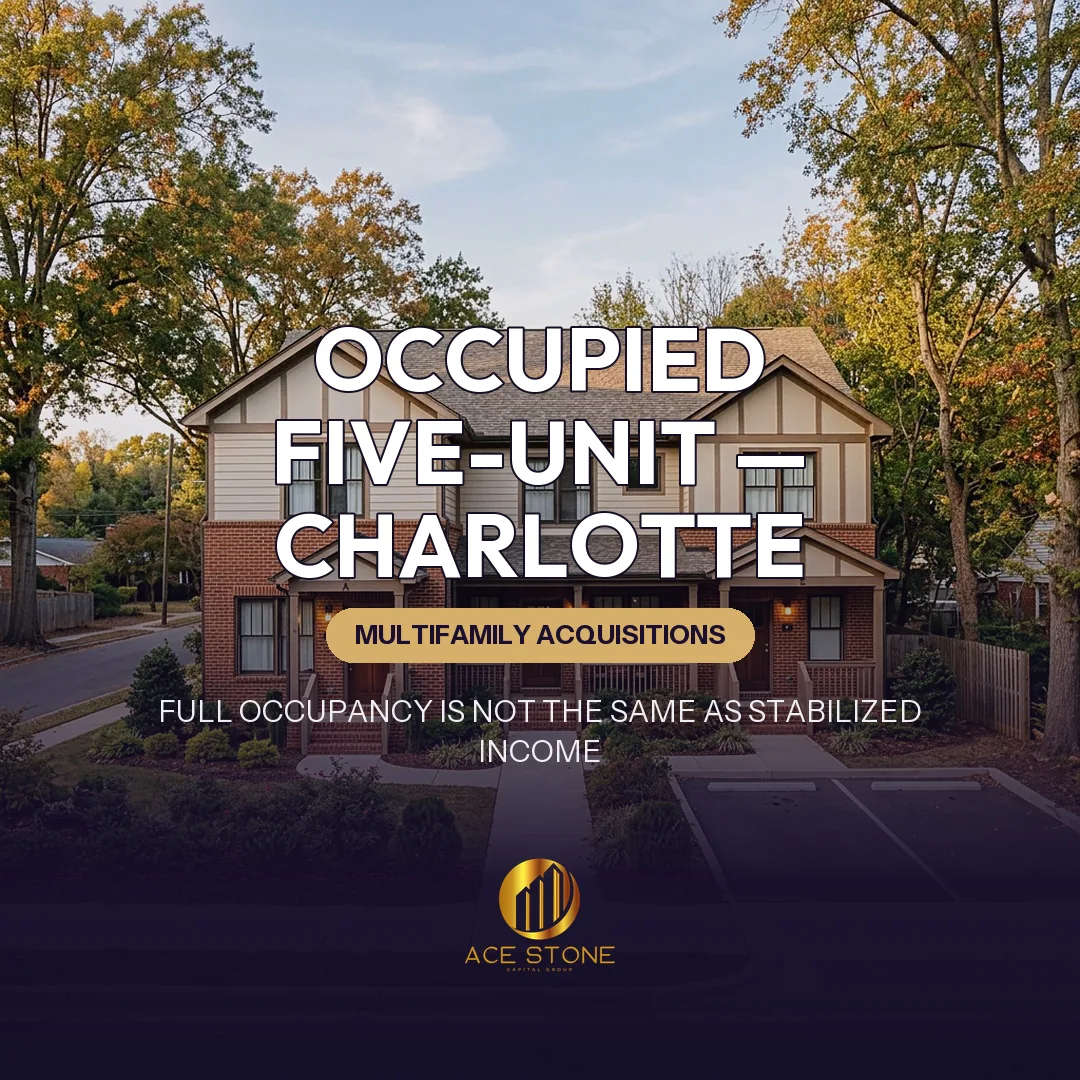
    Occupied five-unit apartment building on a Charlotte street.
    Representative imagery of the asset type and market — not a photograph of the subject property.

    Case Context

    This acquisition profile examines a fully occupied five-unit residential property in Charlotte where several leases reflect rents established years earlier. It sets out AceStone Capital Group's underwriting methodology; specific counterparties and pricing are not identified.

    Why Full Occupancy Is Not a Conclusion

    One hundred percent occupancy is often presented as evidence of asset quality. It is more accurately a data point about pricing: a building leased below market will always fill quickly. Occupancy tells the buyer that demand exists at the current rent level. It says nothing about whether that rent level is the market level, whether collections match the contractual schedule, or whether the tenancies would survive a reset.

    Applied exampleSee how this played out in Mixed-Occupancy Portfolio Acquisition: Stabilized and Vacant Homes in Charlotte — a residential acquisition in Charlotte, NC.

    Lease Review and Expiration Profile

    Every executed lease is reviewed for term, expiration date, renewal and escalation language, notice requirements, deposit handling under North Carolina law, and any addenda. Expiration dates are then mapped as a schedule. A building where all five leases expire in the same quarter carries a very different risk profile from one where expirations are staggered, even at identical rents.

    Collections Versus Contract Rent

    The rent roll states what tenants owe. The deposit record states what they paid. Underwriting uses the second. Chronic partial payment, recurring late payment, or informal reductions not reflected in the lease all reduce effective income and are identified by reconciling the payment ledger against the contractual schedule for the trailing period available.

    Applied exampleSee how this played out in New-Construction Duplex Acquisition: Growth-Corridor Delivery, Charlotte — a residential acquisition in Charlotte, NC.

    In-Place Rent Versus Market Rent

    Achievable rent is established from leased comparables filtered for unit size, bedroom count, parking, laundry, and finish level. The gap between in-place and market rent is then classified: a gap attributable to owner passivity can be closed at renewal or turnover at low cost; a gap attributable to inferior condition can only be closed by spending capital. Underwriting the second as though it were the first is the central error this profile exists to illustrate.

    Tenant History and Retention

    Tenant tenure, payment record, and renewal history indicate how the existing base will respond to a rent reset. Long-tenured, reliably paying tenants at below-market rents present a genuine trade-off: a reset captures income but risks turnover, and turnover carries vacancy, turn cost and re-leasing time. That trade-off is modeled rather than assumed away in either direction.

    Applied exampleSee how this played out in Selling an Inherited Property in Florida — a residential acquisition in Florida.

    Operating Expense Review

    Expenses are normalized to professional operation: market management, a maintenance and turnover allowance consistent with unit age, per-unit reserves, owner-paid utilities and common-area services, re-quoted insurance, and property tax re-underwritten on a post-transfer basis rather than carried forward at the seller's current assessment.

    Current NOI Versus Stabilized NOI

    Two figures are maintained throughout. Current net operating income reflects actual collections against normalized expenses. Stabilized net operating income reflects documented market rents against the same expense base. The difference is not free value; it is the value available after the cost of turnover, the downtime associated with it, and the time required to work through the expiration schedule.

    Stabilization Timing

    Timing is governed by the lease expiration schedule, not by the buyer's preference. Rents cannot be reset before terms expire, and resetting all units simultaneously concentrates turnover risk. A realistic stabilization horizon in this profile spans multiple renewal cycles, and the carry across that horizon is deducted from the value of the rent gap.

    Risk Factors

    The material risks are underwriting exclusively from market rent, turnover clustering after a reset, condition items surfacing at turn that were concealed by continuous occupancy, deposit liabilities that were not properly held, post-transfer tax reassessment, and a comparable set drawn from renovated product that the subject units do not match.

    Key Takeaway

    Occupancy is an input, not a verdict. The distinction that determines value is between income the property produces today and income it could produce after a defined, costed and time-bound stabilization process. Owners of comparable assets can review parameters on the multifamily acquisitions desk.

    Conclusion

    A fully occupied building with legacy leases is priced on collections plus a discounted, scheduled reversion — never on market rent applied to every unit from day one. The framework above reflects AceStone Capital Group's underwriting posture on assets of this profile.

    What This Case Shows

    A structured example of how AceStone Capital Group sources, underwrites, and structures off-market residential acquisitions in Charlotte, NC. For broader context, see our active acquisition markets or initiate a direct-sale review for a similar property.

    Have a Property to Sell?

    Receive a written offer or a clear pass within 1–2 business days.

    Request a Cash Offer