
Case Context
This acquisition profile examines a newly completed two-unit property in a Charlotte growth corridor. It sets out AceStone Capital Group's underwriting methodology; specific counterparties and pricing are not identified.
An acquisition profile examining a newly completed Charlotte duplex, and why reduced physical risk does not eliminate rent, basis, lease-up, or operating risk.
This acquisition profile examines asset strategy, underwriting method, transaction structure, and value-creation considerations. Counterparty and pricing details are not disclosed.
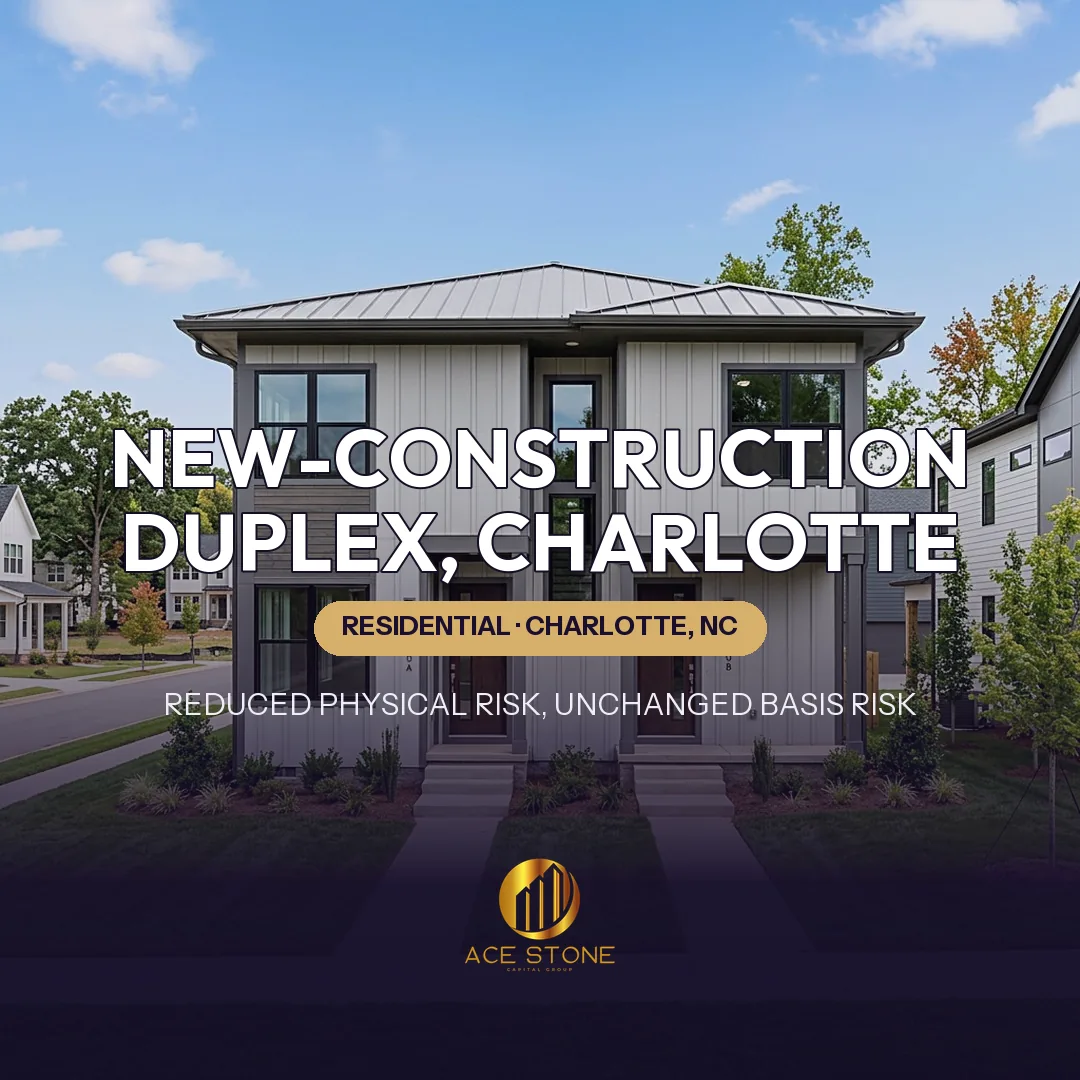
This acquisition profile examines a newly completed two-unit property in a Charlotte growth corridor. It sets out AceStone Capital Group's underwriting methodology; specific counterparties and pricing are not identified.
New-delivery duplex product removes most of the physical uncertainty that dominates older two-unit underwriting. What it does not remove is basis risk. A newly built asset is priced at or near replacement cost by definition, which means there is no discount to absorb an error in the rent assumption, and no deferred-maintenance discount to be recovered through execution.
Applied exampleSee how this played out in Mixed-Occupancy Portfolio Acquisition: Stabilized and Vacant Homes in Charlotte — a residential acquisition in Charlotte, NC.
Diligence confirms the certificate of occupancy for each unit, the permit history and final inspection sign-offs, the as-built alignment with approved plans, and any outstanding conditions of approval. Construction quality is assessed independently rather than assumed from newness: framing and envelope detailing, roof installation, mechanical sizing and commissioning, grading and drainage away from the structure, and whether the two units are on genuinely separate electrical, water, and mechanical service.
Warranty coverage is verified rather than presumed. The review establishes what structural, systems, and workmanship coverage exists, its remaining duration, whether it transfers to a subsequent owner, what the claim process requires, and the financial standing of the party standing behind it. Transferable coverage genuinely defers early capital expenditure; non-transferable coverage does not, and the reserve schedule must reflect the difference.
Applied exampleSee how this played out in Occupied Multifamily Acquisition: Five-Unit Property, Charlotte — a residential acquisition in Charlotte, NC.
A newly delivered building has no trailing statements. There is no collection history, no turnover history, no seasonal expense pattern, and no evidence of how the specific unit type performs in leasing. Every revenue and expense line is therefore modelled from external evidence — competing new product, submarket absorption data, and vendor quotes — and carries wider uncertainty than the same line would on a seasoned asset.
Rent is set from newly delivered comparable product rather than from the broader rental stock, because finish level and efficiency support a premium that older buildings do not command. Lease-up is modelled on observed absorption for new deliveries in the corridor, net of concessions being offered by competing product. Underwriting immediate stabilized occupancy on an unleased new building is the most common error in this profile.
Applied exampleSee how this played out in Selling an Inherited Property in Florida — a residential acquisition in Florida.
Property tax on new construction is a specific trap: the assessment in place at closing may still reflect land or partial improvement value and will reset once the completed structure is assessed. The underwriting carries the fully assessed post-completion figure, not the current bill. Insurance benefits from new construction pricing but must still be quoted rather than estimated, particularly where the corridor carries wind or hail exposure.
The asset competes for tenants against older duplexes in the same submarket that operate at a lower basis. The premium new product commands in rent must be tested against the premium it requires in price. Where the rent premium is narrower than the basis premium, the newer asset produces a lower yield in exchange for lower near-term capital risk, and the buyer should be explicit that this is the trade being made.
The principal risks are absorption risk if additional new supply delivers into the same corridor, rent concessions compressing effective revenue during lease-up, post-completion tax reassessment, latent construction defects surfacing after warranty expiration, and a basis at replacement cost that leaves limited margin if submarket rents soften.
New construction reduces certain physical risks but does not eliminate rent, basis, lease-up, or operating risk. A building with no history requires more assumption discipline, not less.
Newly delivered duplex product suits buyers who value predictable near-term capital needs and accept a tighter entry basis. The analysis above reflects AceStone Capital Group's underwriting posture. Specific properties, counterparties, and pricing are not identified.
What This Case Shows
A structured example of how AceStone Capital Group sources, underwrites, and structures off-market residential acquisitions in Charlotte, NC. For broader context, see our active acquisition markets or initiate a direct-sale review for a similar property.
Receive a written offer or a clear pass within 1–2 business days.
Request a Cash OfferContinue Reading
Additional residential acquisitions structured through the same underwriting and closing framework.