
Back
    Residential Cincinnati, OH August 2026

    Two-Duplex Acquisition: Four Rental Units, Cincinnati

    A analysis of two Cincinnati duplexes acquired in one coordinated transaction, and why a four-unit package is still underwritten property by property.

    This acquisition profile examines asset strategy, underwriting method, transaction structure, and value-creation considerations. Counterparty and pricing details are not disclosed.

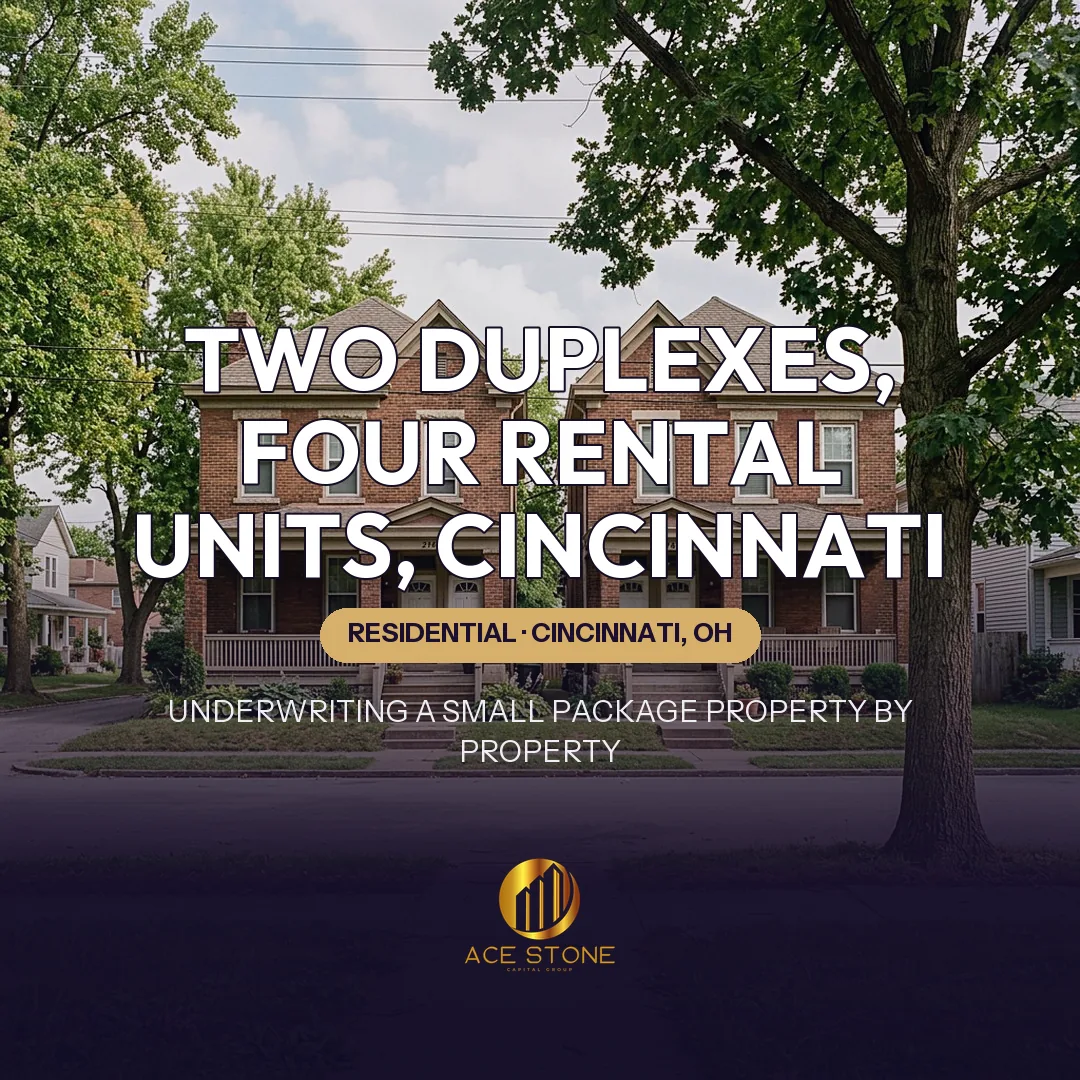
    Two architecturally similar duplex buildings side by side on a Cincinnati street.
    Representative imagery of the asset type and market — not a photograph of the subject property.

    Case Context

    This acquisition profile examines two duplexes held by the same owner in Cincinnati and contemplated as a single coordinated transaction. It sets out AceStone Capital Group's underwriting methodology; specific counterparties and pricing are not identified.

    Acquisition Profile

    Four doors across two parcels sits at the boundary between single-asset and portfolio underwriting. It is small enough that every unit can be examined individually and large enough that a seller and a careless buyer will both be tempted to discuss it as one blended number. The framework applied here underwrites each building to a standalone conclusion first, then tests what coordination adds or costs.

    Applied exampleSee how this played out in Why Out-of-State Owners Sell to Direct Buyers — a residential acquisition in Multi-State.

    Property A — Unit Mix and Condition

    The first building is assessed on its own file: unit sizes and bedroom counts, in-place rents against submarket comparables, lease terms and expirations, occupancy status per side, roof and mechanical age, basement and foundation condition typical of the local housing stock, service separation between the two units, and the make-ready scope each unit would require at turnover. From this, a standalone value and a standalone risk profile are established.

    Property B — Unit Mix and Condition

    The second building receives an identical but independent review. Differences in vintage, street, school assignment, parking configuration, and system condition are recorded rather than averaged. Where one building carries materially older mechanical equipment, a shorter remaining roof life, or weaker rent comparables, that difference belongs in its own valuation and not in a blended figure applied across four doors.

    Applied exampleSee how this played out in Why Infill Lots Are Outperforming in Growth Corridors — a residential acquisition in U.S. Growth Markets.

    Standalone Valuation Before Aggregation

    Each building is priced to the value it could support if purchased alone. Only after two independent conclusions exist is the package examined. This ordering is the entire discipline of small-package underwriting: it makes visible whether the aggregate price is the sum of two supportable values or a single number that one building is carrying on behalf of the other.

    Portfolio-Level Income and Concentration

    Aggregated, four doors produce a more stable revenue profile than two, because a single vacancy represents a smaller share of total income. That benefit is partially offset by geographic concentration: two buildings in the same submarket share one employment catchment, one school assignment, one insurance exposure, and one local supply and demand cycle. Diversification within a package of this size is limited and should not be overstated.

    Applied exampleSee how this played out in The Migration Effect: How Population Shifts Drive Lot Demand — a residential acquisition in U.S. Growth Markets.

    Management Density

    Four units in close proximity produce genuine operational efficiency — one vendor set, batched maintenance visits, shared turn inventory, and a management fee structure that improves with door count. These efficiencies are modelled explicitly in the operating budget rather than assumed, because they only materialize if the buildings are close enough for a single crew to service economically.

    Title and Closing Coordination

    Two parcels mean two title commitments, two lien searches, and potentially different vesting if the buildings were acquired at different times or under different entities. Diligence is sequenced so that curative work on both chains begins immediately, and the agreement contemplates what happens if one parcel cannot be cleared in time — repricing the package rather than silently removing an asset and degrading the remaining basis.

    Is One Building Masking the Other?

    The central test in any package is whether aggregate figures conceal a weak asset. A strong building with stable tenancy and recent systems can absorb a weaker building's vacancy, capital needs, or inferior location within a blended presentation. Comparing each standalone valuation against its share of the package price answers the question directly, and a material divergence is grounds to reprice rather than to accept the average.

    Risk Factors

    Key risks are asset-level divergence obscured by aggregation, concentrated submarket exposure, simultaneous capital events if both buildings share a vintage, title curative delay on either parcel jeopardizing a coordinated close, and expense assumptions that credit management efficiency the geography does not actually support.

    Key Takeaway

    Even a small four-unit package should be underwritten property by property before being judged as one portfolio. Aggregation is a structuring convenience, not an analytical method.

    Conclusion

    Two-building packages offer real execution and management efficiency when both assets independently clear. The analysis above reflects AceStone Capital Group's underwriting posture. Specific properties, counterparties, and pricing are not identified.

    What This Case Shows

    A structured example of how AceStone Capital Group sources, underwrites, and structures off-market residential acquisitions in Cincinnati, OH. For broader context, see our active acquisition markets or initiate a direct-sale review for a similar property.

    Have a Property to Sell?

    Receive a written offer or a clear pass within 1–2 business days.

    Request a Cash Offer