
Back
    Residential Cleveland, OH February 2026

    Small Multifamily Acquisition: Partially Occupied Fourplex, Cleveland

    A underwriting review of a Cleveland fourplex with two occupied units, one vacant unit and one unfinished unit — and why the rent roll alone could not price it.

    This acquisition profile examines asset strategy, underwriting method, transaction structure, and value-creation considerations. Counterparty and pricing details are not disclosed.

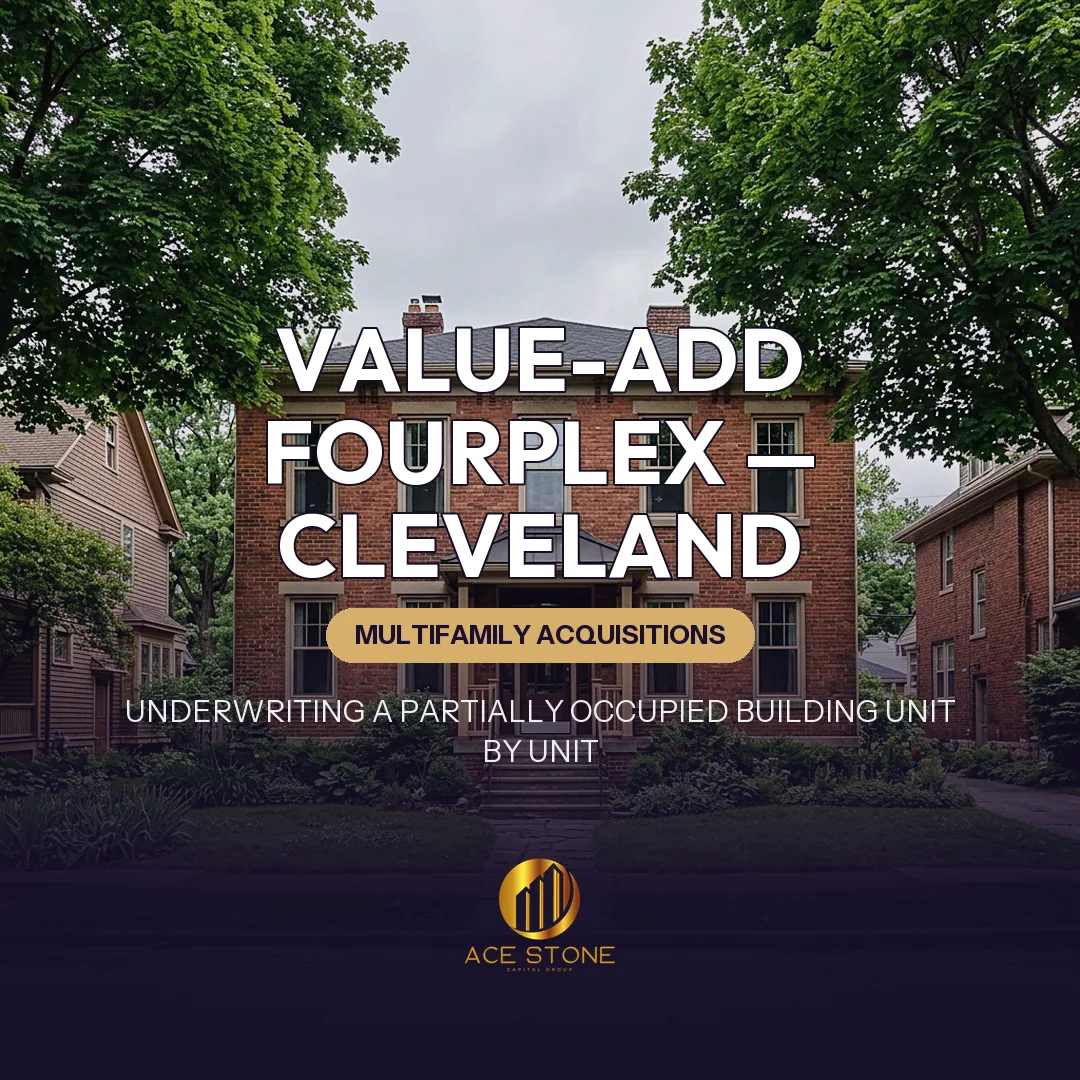
    Classic brick fourplex apartment building on a Cleveland residential street.
    Representative imagery of the asset type and market — not a photograph of the subject property.

    Case Context

    This acquisition profile examines how AceStone Capital Group underwrites a partially stabilized four-unit residential building in the Cleveland market. Specific properties, counterparties, and pricing are not identified. The subject profile is a two-story brick fourplex in an established east-side neighborhood: two units occupied under existing tenancies, one unit vacant and requiring renovation, and one unit left partially finished by ownership.

    Property Profile

    A fourplex of this vintage typically presents a single roof structure, one or two heating plants serving multiple units, a shared main electrical service with individual unit panels, and a common basement housing water heaters and laundry. The building envelope, the mechanical plant, and the individual unit interiors age on different schedules, which is why a single condition grade for the property is unhelpful. The correct unit of analysis is each apartment on its own, plus the building systems that serve all four.

    Applied exampleSee how this played out in Selling an Inherited Property in Florida — a residential acquisition in Florida.

    Occupancy and In-Place Rent

    Two of the four units produce contractual income. Diligence on those units covers the executed leases, remaining term, deposit ledgers, payment history rather than stated rent, any concessions or informal side arrangements, and whether the tenancies are written or month-to-month. Stated rent and collected rent diverge frequently in owner-operated small multifamily; the collection record, not the rent roll summary, establishes the in-place figure that can be capitalized.

    Vacant and Unfinished Units

    The vacant unit and the unfinished unit are economically distinct. A vacant unit in rentable condition requires turn work and a lease-up interval. An unfinished unit requires completion of construction, likely permit closure or inspection, and a materially longer path to income. Underwriting them identically would understate cost and time on one and overstate risk on the other. Each is scoped separately, with the unfinished unit reviewed for whether prior work was permitted and whether it can be inspected and completed without opening broader code exposure.

    Applied exampleSee how this played out in Cash Offers vs. Traditional Listings: What Sellers Should Know — a residential acquisition in National.

    Achievable Market Rent

    Achievable rent is established from leased comparables in the same submarket — not asking rents, and not the owner's expectation for a finished unit. The comparable set is filtered by unit size, bedroom count, parking availability, heat responsibility, and finish level, because a rent premium attaches to renovation only where the renovation is actually performed. In-place rents on the two occupied units are then compared against that evidence to size the reversion available at natural turnover.

    Building Systems and Deferred Maintenance

    Physical review addresses roof age and remaining service life, masonry and tuckpointing condition, window condition, the age and configuration of heating equipment, whether units are separately metered for gas and electric, supply-line material and any remaining galvanized runs, sewer lateral condition, and foundation and basement moisture. In Cleveland's climate, heating configuration and envelope condition are not cosmetic questions — they drive both capital cost and the operating expense the owner will carry.

    Applied exampleSee how this played out in Why Out-of-State Owners Sell to Direct Buyers — a residential acquisition in Multi-State.

    Operating Expense Review

    Trailing expenses from an owner-operated fourplex are typically incomplete. Property taxes are re-underwritten to a post-transfer basis rather than carried forward at the current assessment. Insurance is re-quoted as a non-owner-occupied multifamily policy. Owner-paid utilities, common-area electricity, water and sewer, snow and lawn service, and a realistic management and maintenance load are added even where the seller absorbed them personally. Reserves are underwritten per unit rather than as a residual.

    Stabilization Cost and Timeline

    Stabilization cost is the sum of the vacant-unit turn, the unfinished-unit completion, and any building-system item that must be addressed before or shortly after closing. Timeline is set from observed contractor availability and observed marketing periods for comparable Cleveland product, not from an assumption of immediate occupancy. Both the cost and the carry during the interval are deducted from stabilized value, because both are real and both are borne by the buyer.

    Current Income Versus Stabilized Income

    The property produces roughly half its potential gross revenue today. A seller reasonably points to stabilized potential; a buyer capitalizing that potential without deducting completion cost, turn cost, downtime, tax reset and insurance repricing is paying today for value that does not yet exist. Conversely, capitalizing only current income ignores demonstrable capacity in the two non-producing units. Basis is built from stabilized income net of re-underwritten expenses, discounted by the cost and duration of reaching that state.

    Risk Factors

    The material risks are renovation scope expanding once walls are opened in the unfinished unit, permit or inspection exposure on prior unpermitted work, rent overestimation on units with no recent leasing history, post-transfer tax reassessment, a heating or roof item advancing from deferred to immediate, and the possibility that one of the two occupied units turns during the stabilization window and extends the lease-up period.

    Key Takeaway

    A partially stabilized fourplex cannot be valued as though it were already stabilized. Underwriting proceeds unit by unit, prices the specific work and time required to convert non-producing space into income, and holds basis discipline against a stabilized figure that is reduced — not inflated — by the path required to reach it. Owners evaluating a comparable exit can review parameters on the multifamily acquisitions desk.

    Conclusion

    Partially occupied small multifamily assets are frequently sound acquisitions precisely because reported income understates capacity, but only where the conversion path is scoped, costed and time-bound. The framework above reflects AceStone Capital Group's underwriting posture on assets of this profile.

    What This Case Shows

    A structured example of how AceStone Capital Group sources, underwrites, and structures off-market residential acquisitions in Cleveland, OH. For broader context, see our active acquisition markets or initiate a direct-sale review for a similar property.

    Have a Property to Sell?

    Receive a written offer or a clear pass within 1–2 business days.

    Request a Cash Offer