
Back
    Residential Cleveland, OH April 2026

    Duplex Acquisition: Thirty-Year Family Ownership, Cleveland

    A analysis of a long-held Cleveland two-family property, where ownership-history diligence carries as much weight as physical underwriting.

    This acquisition profile examines asset strategy, underwriting method, transaction structure, and value-creation considerations. Counterparty and pricing details are not disclosed.

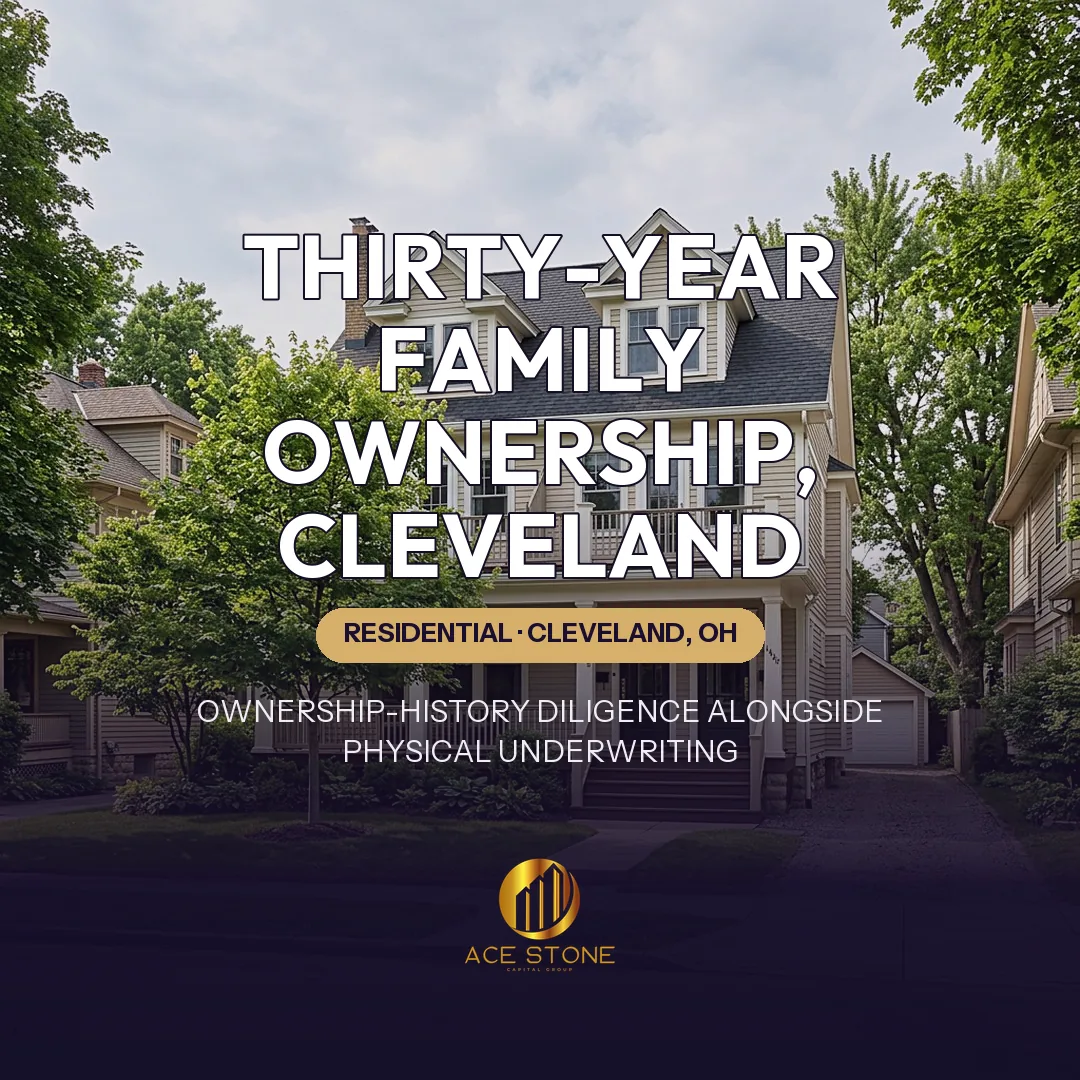
    Classic two-family house on a mature residential street in Cleveland.
    Representative imagery of the asset type and market — not a photograph of the subject property.

    Case Context

    This acquisition profile examines a two-family property in Cleveland held by the same family for roughly three decades. It sets out AceStone Capital Group's underwriting methodology; specific counterparties and pricing are not identified.

    Ownership Situation

    Multi-decade family ownership produces a characteristic file: informal management, tenants who may have been in place for many years, rents that were never systematically reviewed, maintenance performed personally or through long-standing local trades without written records, and a decision to sell driven by age, relocation, or estate planning rather than by asset performance. Sellers in this position typically prioritize simplicity, certainty, and the absence of listing preparation over maximizing a headline number.

    Applied exampleSee how this played out in Selling an Inherited Property in Florida — a residential acquisition in Florida.

    Title and Ownership-History Diligence

    Thirty years of ownership can accumulate title complexity: transfers between family members, an interest passing through probate, a surviving-spouse conveyance, a satisfied mortgage never released of record, a mechanic's lien from a long-past repair, or a boundary condition created by an undocumented improvement. Title work in this profile begins early because curative timelines, not physical diligence, most often determine whether a coordinated closing is achievable.

    Lease and Records Review

    Legacy tenancies may be documented by an expired written lease, a month-to-month arrangement, or nothing at all. Where documentation is incomplete, the buyer reconstructs the tenancy from deposit records, payment history, and direct confirmation, and underwrites the tenancy at the legal status it can actually evidence. Estoppel confirmation is used to establish rent, deposit balance, and the absence of side agreements before the tenancy is relied upon in valuation.

    Applied exampleSee how this played out in Cash Offers vs. Traditional Listings: What Sellers Should Know — a residential acquisition in National.

    Rent Position

    Rents on long-held two-family properties in this market are commonly well below submarket levels because renewals were flat for years. As with any below-market position, the gap is credited only to the extent it can be closed at reasonable cost within a defined period, and only where the unit's physical condition supports the target rent without renovation that has not yet been scoped.

    Physical-Condition Review

    Older Cleveland two-family housing stock carries a specific inspection agenda: roof covering and remaining life, masonry and tuckpointing condition, original or partially updated electrical service, supply plumbing material and any remaining galvanized or lead service line, boiler or furnace age and configuration, basement moisture and foundation condition, window condition, and the presence of materials common to the building's era that require specific handling during renovation.

    Applied exampleSee how this played out in Why Out-of-State Owners Sell to Direct Buyers — a residential acquisition in Multi-State.

    Deferred Capital Expenditure

    Deferred capital in a long-held building is usually not neglect but sequencing: an owner who lived with a functioning system did not replace it. The buyer's task is to convert remaining service life into a funding schedule. Items at or beyond expected life are treated as near-term capital rather than reserve, and are reflected in basis rather than deferred into an optimistic operating budget.

    Seller Simplicity Versus Retail Preparation

    The seller's practical alternatives are a prepared retail sale requiring repairs, vacancy in at least one unit, staging, showings around long-tenured tenants, and an uncertain timeline, or a direct disposition on as-is terms. The comparison that matters to the seller is net proceeds after preparation cost, carry, and commission against a certain figure with no preparation, not gross price against gross price.

    Risk Factors

    The principal risks are title curative delay, undocumented tenancies proving to have terms less favourable than assumed, capital needs exceeding the scope visible at inspection in a building of this vintage, and expense re-underwriting materially exceeding the owner's historical spend because personal labour was never costed.

    Key Takeaway

    Long-held properties require ownership-history diligence and physical underwriting in equal measure. The building's condition determines the price; the title chain determines whether the transaction can close at all.

    Conclusion

    Multi-decade family holdings are among the most straightforward sellers to work with and among the most document-intensive files to clear. The framework above reflects AceStone Capital Group's methodology. Specific properties, counterparties, and pricing are not identified.

    What This Case Shows

    A structured example of how AceStone Capital Group sources, underwrites, and structures off-market residential acquisitions in Cleveland, OH. For broader context, see our active acquisition markets or initiate a direct-sale review for a similar property.

    Have a Property to Sell?

    Receive a written offer or a clear pass within 1–2 business days.

    Request a Cash Offer