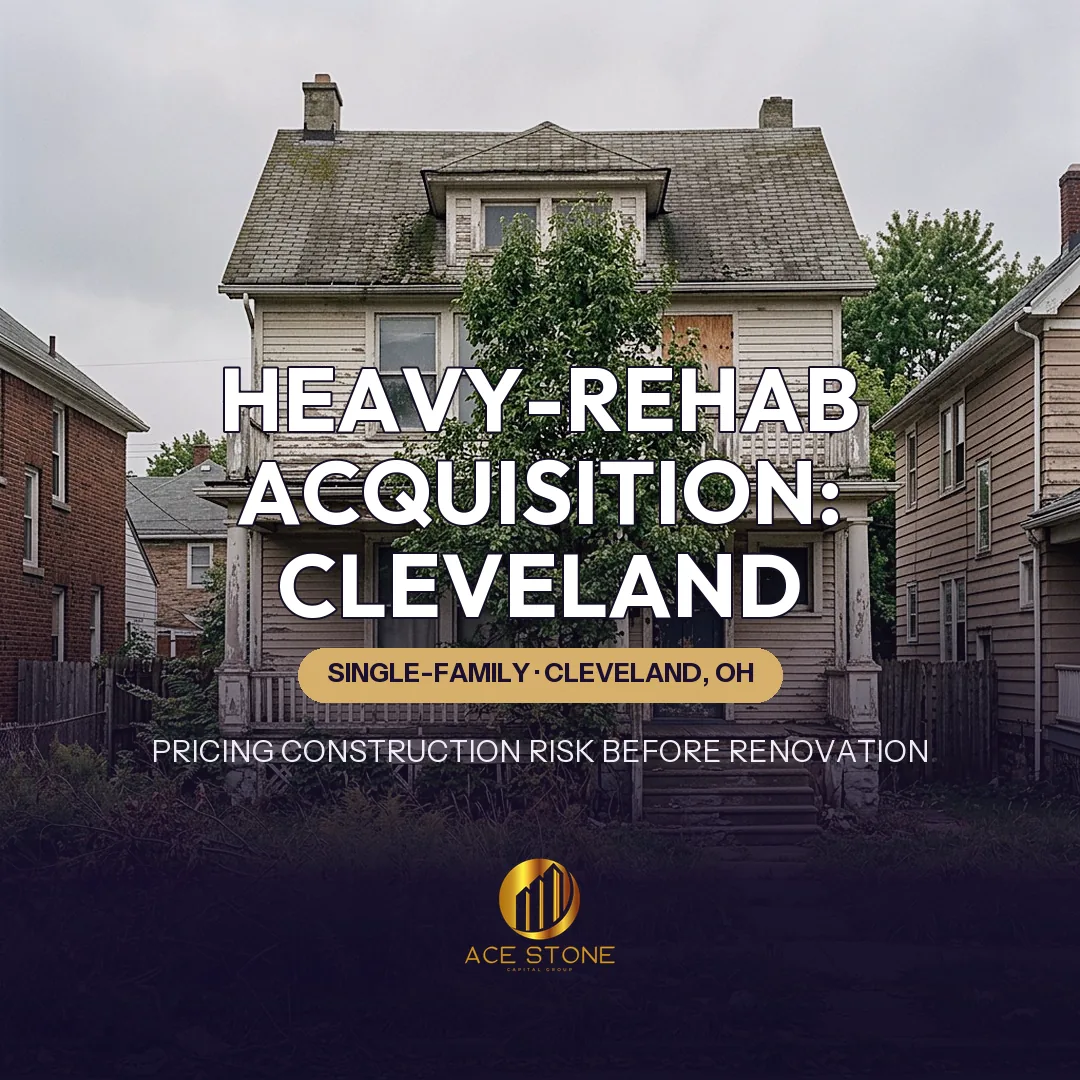
Heavy-Rehab Single-Family Acquisition: Pricing Construction Risk in Cleveland
A analysis of a vacant Cleveland house requiring more than cosmetic work, and how an as-is basis is set before renovation is assumed to create value.
This acquisition profile examines asset strategy, underwriting method, transaction structure, and value-creation considerations. Counterparty and pricing details are not disclosed.
Representative imagery of the asset type and market — not a photograph of the subject property.
Case Context
This acquisition profile examines how AceStone Capital Group underwrites a vacant detached single-family home in the Cleveland market that requires materially more than cosmetic renovation. Specific properties, counterparties, and pricing are not identified. The subject profile is an early-twentieth-century two-story frame house, vacant for an extended period, with visible exterior deterioration and unknown interior mechanical condition.
Property Profile
The subject is a detached three- or four-bedroom house of roughly 1,400 to 1,800 square feet on a narrow urban lot with a full unfinished basement and, commonly for the stock, a detached garage in poor condition. Original construction includes wood framing, a masonry or block foundation, plaster interior finishes, and a stair layout that constrains modern reconfiguration. Homes of this vintage in the market frequently retain original knob-and-tube segments, galvanized supply lines, and a gravity or early forced-air heating footprint.
Heavy-rehab files invert the normal order of analysis. The visible price is low, which invites the assumption that almost any renovation budget still leaves room. The discipline is to establish a defensible as-is basis first — what the property is worth in its current state to a buyer who assumes all of the unknowns — and only then to test whether a renovation program creates value on top of that basis. A low headline price is not a margin of safety when the cost above it is unbounded.
Building Systems and Structural Review
The review is systematic and item-by-item. Roof: covering age, decking condition, and evidence of active leakage. Foundation: masonry deterioration, mortar failure, lateral movement, and water entry at the perimeter. Electrical: service size, panel type, presence of original wiring, and whether a full rewire is required. Plumbing: supply material, drain and stack condition, and sewer lateral integrity. HVAC: whether a system exists and functions at all, and what distribution the layout permits. Windows: original single-glazed units, sash condition, and whether replacement is cosmetic or performance-driven. Each item is classified as measurable, estimable with a range, or unbounded pending exploratory work.
Water is the dominant destructive variable in long-vacant northern housing stock. Roof and gutter failure, frozen or burst supply lines, and grading that directs runoff toward the foundation produce cumulative damage that is only partly visible: plaster staining and ceiling collapse are observable, while sill and joist rot, mold within wall cavities, and subfloor deterioration typically are not until demolition. Interior finishes are assumed to be a full replacement in this profile; the question is what condition the structure behind them is in.
Permitting and Carrying Costs
A renovation at this depth is permitted work, not maintenance. Scope review anticipates building, electrical, plumbing, and mechanical permits, inspection sequencing, and any point-of-sale or occupancy requirements applicable in the jurisdiction. Permitting timelines extend the schedule, and the schedule drives carry: taxes, insurance on a vacant structure at vacancy-rated pricing, utilities during construction, securing the property, and capital cost across the hold. Carry is modeled against a realistic duration including inspection waits, not against an optimistic construction-only calendar.
Contingency on a heavy rehab is not a rounding percentage applied at the end. It is sized to the specific unknowns catalogued during the condition review: unopened wall cavities, an unscoped sewer lateral, a foundation with visible but unmeasured movement, unverified framing behind failed plaster. Where the number of unbounded items is high, the correct response is either exploratory work before commitment or a contingency large enough that the basis absorbs an adverse outcome without the transaction failing.
Renovated Comparable Sales and Value Sensitivity
Finished value is established from closed sales of comparable homes in the same neighborhood that actually delivered the intended finish level, not from aspirational pricing in adjacent submarkets. Cleveland value gradients change street by street, so the comparable radius is deliberately tight. The finished-value conclusion is then stress-tested: what the project looks like if finished value comes in below the comparable mean, if the renovation runs over schedule, and if both occur together. A program that only works at the top of the comparable range and on schedule is not a program with margin.
Acquisition Basis
Basis is finished value, less full renovation scope at contracted rates, less contingency sized to catalogued unknowns, less carry across a realistic duration, less selling and closing cost, less a return commensurate with construction risk. What remains is what the property supports as-is. In heavy-rehab files that figure is frequently below the asking price, and frequently below what a buyer who omitted contingency and carry would calculate. The gap between those two numbers is where construction losses originate.
Key Risks
The material risks are scope expansion after demolition, structural findings that were not observable pre-closing, contractor availability extending duration and carry, permit or inspection delays, finished value compressing in a narrow neighborhood comparable set, and materials or labor cost movement across a long build. These risks compound rather than offset, which is why they are priced jointly rather than individually.
Walk-Away Conditions
The analysis discontinues where structural or foundation movement cannot be bounded without exploratory work the seller will not permit, where the sewer lateral or service infrastructure carries municipal replacement exposure of indeterminate size, where finished value in the immediate comparable set does not support the total cost stack with contingency, or where the only path to a workable outcome requires assuming best-case cost and best-case duration simultaneously.
Key Takeaways
A low acquisition price does not make uncontrolled construction risk acceptable. Heavy-rehab acquisitions are priced around the width of the uncertainty band, not around the midpoint of a repair estimate. Where the band cannot be narrowed by diligence, it must be narrowed by basis — or the file is declined. Owners of comparable properties can review parameters on the residential property acquisitions desk.
Conclusion
Distressed housing stock in established northern markets can be a legitimate source of acquisitions, but only for a buyer who prices unknowns rather than deferring them to the construction phase. The framework above reflects AceStone Capital Group's underwriting posture on assets of this profile.
What This Case Shows
A structured example of how AceStone Capital Group sources, underwrites, and structures off-market residential acquisitions in Cleveland, OH. For broader context, see our active acquisition markets or initiate a direct-sale review for a similar property.
Have a Property to Sell?
Receive a written offer or a clear pass within 1–2 business days.