Tenant-Occupied Single-Family Acquisition: Evaluating an Existing Lease in Columbus
A analysis of an individually owned Columbus rental house sold with the tenant in place, and why the lease is underwritten alongside the building.
This acquisition profile examines asset strategy, underwriting method, transaction structure, and value-creation considerations. Counterparty and pricing details are not disclosed.
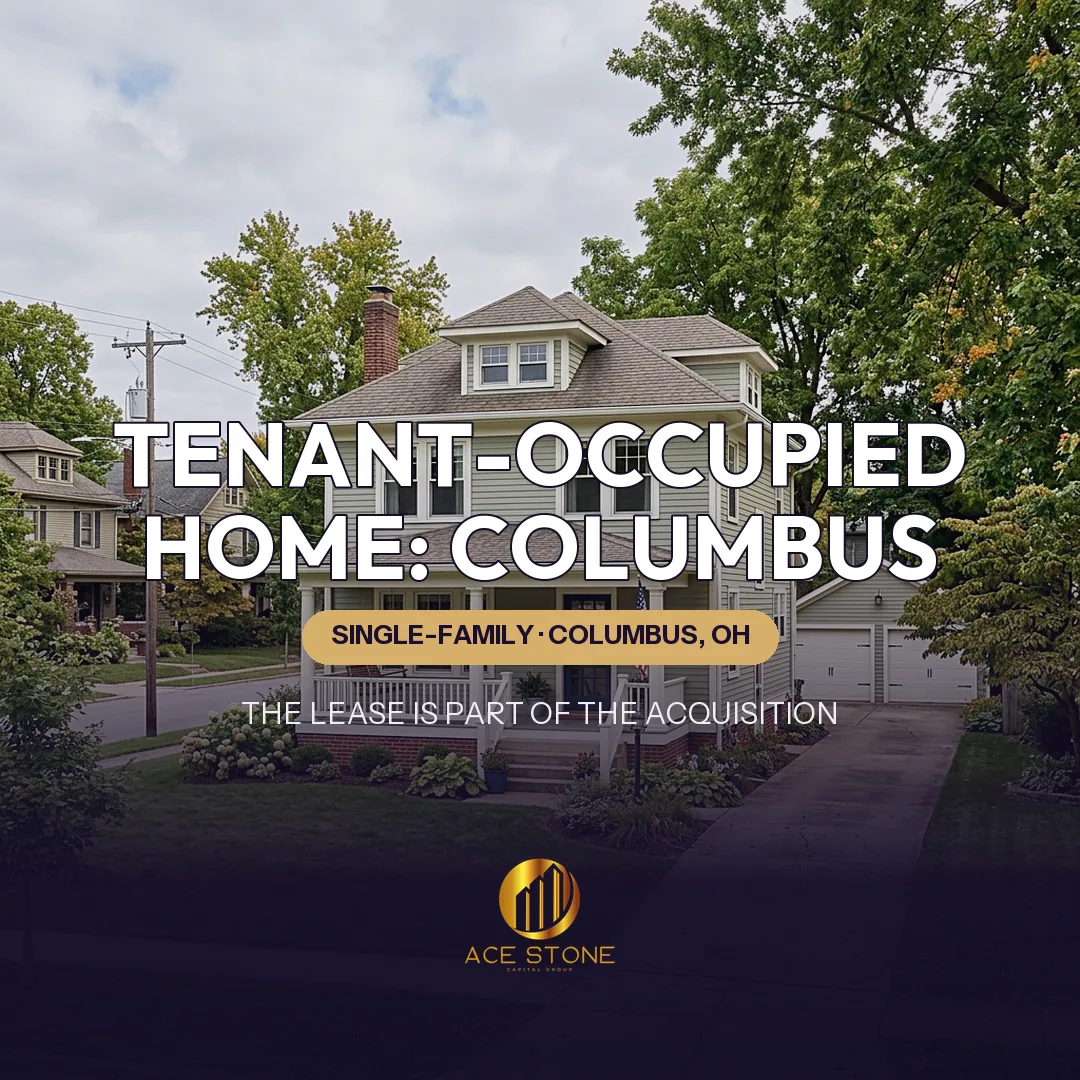
Representative imagery of the asset type and market — not a photograph of the subject property.
Case Context
This acquisition profile examines how AceStone Capital Group underwrites a single detached rental house in the Columbus market that is offered for sale with an existing tenant in occupancy. Specific properties, counterparties, and pricing are not identified. The subject profile is a two-story frame house in an established Franklin County neighborhood, held by an individual owner rather than an institution, with one lease in place.
Property Profile
The subject is a detached three-bedroom home of roughly 1,300 to 1,500 square feet with a full basement, forced-air heating, a driveway and detached garage, and mature trees on a standard interior lot. Ohio housing stock of this era commonly carries a mix of original and replaced systems, and the basement is the primary diagnostic space: it reveals foundation condition, moisture history, mechanical age, and the extent of any prior plumbing or electrical work.
The seller owns one rental house rather than a portfolio. Record-keeping is typically informal: rent may be collected by transfer or check without a ledger, maintenance may be performed personally, and expenses may be commingled with household spending. The sale is motivated by management fatigue or a decision to exit a single-asset position, not by property performance. That means the presented economics are neither audited nor deliberately misleading — they are simply incomplete, and the underwriting must reconstruct them.
Lease and Occupancy Review
The executed lease is reviewed in full: parties, term commencement and expiration, contractual rent, escalation or renewal provisions, holdover terms, pet and utility responsibilities, maintenance obligations allocated to the tenant, and any addenda or side agreements. Payment history is reconstructed from bank deposits rather than from a summary. Security deposit amount and its handling are confirmed, because the deposit transfers as a liability at closing under Ohio practice and must appear in settlement. Any concession, rent credit, or informal arrangement not reflected in the document is treated as real.
Long-tenured tenants of individual owners are frequently below market, sometimes materially, because the owner valued stability over escalation. The gap between contractual rent and achievable rent is established from leased comparables in the same submarket at the same bedroom count and finish level — not from listing asks. That gap is real value, but it is not available today. It becomes available only at lease expiration, and only if the tenant vacates or accepts an increase, and only after any turnover scope is completed and re-let.
Property Condition
Condition review under an occupied tenancy is constrained by access rights and notice requirements, so it is scheduled rather than improvised. Priorities are roof age and remaining life, foundation and basement moisture, furnace and water-heater age, electrical service capacity and panel type, supply plumbing material, window condition, and grading and drainage around the structure. Tenant-reported deferred items are cross-checked against observation; a well-kept interior does not indicate a sound envelope, and a worn interior does not indicate structural deficiency.
Presented expenses from an individual owner rarely reflect an investment operating basis. Franklin County property tax is re-underwritten to a post-transfer assessment posture rather than carried forward at the seller's figure. Insurance is re-quoted as a landlord dwelling policy. Maintenance performed personally by the owner is added back at contracted labor rates. Turnover reserve, vacancy allowance, and management — whether third-party or self-performed — are included as costs even where the seller absorbed them invisibly. The result is a normalized expense base, which is usually higher than the one presented.
Existing Versus Stabilized Economics
Two economic pictures are built and kept separate. The first is current: contractual in-place rent against the normalized expense base, for the remaining lease term. The second is stabilized: achievable market rent against the same expense base, available only after expiration and after the cost and downtime of turnover. Capitalizing the stabilized figure at acquisition credits the seller for value the buyer has not yet created and has not yet paid to create. Underwriting the current figure alone ignores a real and reachable upside. Basis is set from the current figure, with the stabilized figure informing how much execution risk is acceptable, not how much price is.
Acquisition Basis
Basis is constructed from in-place economics, discounted for deferred capital items identified in the condition review, and cross-checked against comparable detached sales in the submarket sold both tenanted and vacant. Tenanted sales typically transact at a discount to owner-occupant sales, because the buyer pool narrows to investors. That discount is a market fact and belongs in the analysis on both sides — it constrains what can be paid, and it constrains what the property will fetch if it is later resold while occupied.
Key Risks
The material risks are non-renewal creating unplanned vacancy, payment behavior deteriorating after transfer, a deposit or lease term that does not survive scrutiny, post-transfer tax reassessment, a deferred capital item surfacing shortly after closing, and achievable market rent falling short of the comparable set. Access limitations during diligence amplify each of these, so any unobserved area carries a reserve.
Walk-Away Conditions
The analysis discontinues where the lease cannot be produced in executed form, where payment history cannot be evidenced, where the security deposit cannot be accounted for, where access for inspection is refused entirely, or where normalized expenses plus deferred capital eliminate the spread between in-place economics and a disciplined basis.
Key Takeaways
When a house is sold with a tenant in place, the lease is part of the asset. It is reviewed, verified, and priced with the same discipline as the roof and the furnace. Future rent that requires a vacancy, a renovation, and a lease-up to realize is not income today and should not be capitalized as though it were. Owners of comparable assets can review parameters on the residential property acquisitions desk.
Conclusion
Tenant-occupied detached rentals are frequently sound acquisitions precisely because their reported economics understate their capacity — but only where the path from current to stabilized is documented, costed, and time-bound. The framework above reflects AceStone Capital Group's underwriting posture on assets of this profile.
What This Case Shows
A structured example of how AceStone Capital Group sources, underwrites, and structures off-market residential acquisitions in Columbus, OH. For broader context, see our active acquisition markets or initiate a direct-sale review for a similar property.
Have a Property to Sell?
Receive a written offer or a clear pass within 1–2 business days.