Pre-Foreclosure Single-Family Acquisition: Time-Sensitive Closing in Las Vegas
A analysis of a Las Vegas detached home approaching a foreclosure deadline, and why a compressed timeline changes execution rather than underwriting.
This acquisition profile examines asset strategy, underwriting method, transaction structure, and value-creation considerations. Counterparty and pricing details are not disclosed.
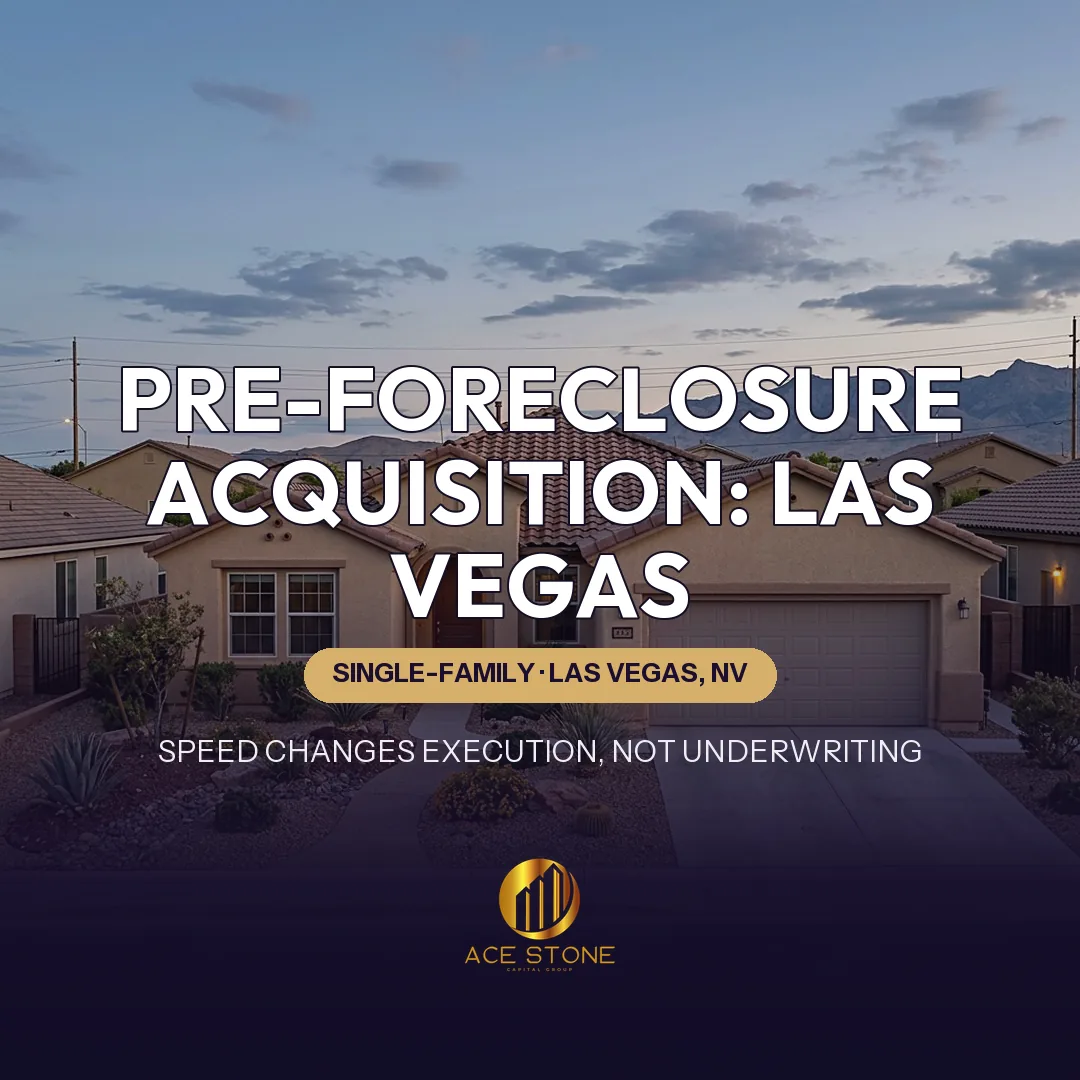
Representative imagery of the asset type and market — not a photograph of the subject property.
Case Context
This acquisition profile examines how AceStone Capital Group evaluates a detached single-family residence in the Las Vegas market where the owner is approaching a scheduled foreclosure date. Specific properties, counterparties, and pricing are not identified. The subject profile is a single-story stucco home in an established suburban Clark County subdivision, owner-occupied, with a first mortgage in default and a trustee sale date on the calendar.
Property Profile
The subject is a detached residence of roughly 1,500 to 1,700 square feet on a modest desert-landscaped lot, three bedrooms and two baths, attached two-car garage, tile roof, and a single packaged cooling system. Construction era places the home in a period where original plumbing, electrical panel, and mechanical equipment are typically at or beyond expected service life unless previously replaced. Lot orientation, wall condition, and the absence of a pool or with one present materially change both the repair scope and the buyer pool at resale.
The owner is not seeking a marketing process. The objective is a defined closing before the trustee sale date, with certainty that the transaction will actually fund. A conventional listing introduces financing contingencies, appraisal risk, inspection renegotiation, and a marketing period that the calendar does not accommodate. What the owner is buying from a direct counterparty is execution certainty; what the counterparty must not do in exchange is abandon underwriting.
Initial Underwriting Challenge
A compressed timeline concentrates two distinct problems. The first is ordinary: establishing as-is value and repair exposure on a home that has likely received limited maintenance during a period of financial stress. The second is transactional: confirming that the payoff figure, junior liens, accrued fees, and trustee costs can all be satisfied from the proceeds, and that the title company can clear and record inside the available window. Either problem alone is routine. Together they compress the sequence in which diligence normally runs, so the work must be parallelized rather than shortened.
Condition review focuses on items that carry the widest cost variance: roof underlayment and tile condition, the age and refrigerant type of the cooling equipment, evidence of slab movement or plumbing leaks under a post-tension slab, electrical panel type and recall status, and water damage in kitchens and baths. Deferred landscaping and wall repair are cosmetic and cheap to quantify. Mechanical and slab items are not, and a fast timeline does not permit those to be assumed away. Where an interior walkthrough cannot be completed in time, the unobserved scope is carried as an explicit reserve rather than treated as zero.
Comparable-Sale Analysis
Value is established from recent closed sales of comparable detached homes in the immediate subdivision and adjoining ones, adjusted for living area, lot size, garage configuration, pool presence, and finish level. Distressed or trustee-sale comparables are examined separately and are not blended into a retail conclusion. Active and pending listings are used to read current direction and absorption, not to set value. The output is two figures: an as-is conclusion in current condition and a renovated conclusion supported by comparable sales that actually delivered that finish level.
Title work is the critical path. The preliminary report is ordered immediately and reviewed for the first-position payoff and accrued default interest, any second mortgage or home-equity line, HOA assessments and enforcement liens, judgment liens, tax liens, mechanic's liens, and recorded trustee costs. Written payoff demands are obtained rather than estimated, because verbal figures routinely omit fees. Where a junior lienholder must accept less than the recorded balance, that consent is treated as an open condition, not an assumption. HOA transfer and estoppel figures in Nevada communities are confirmed in writing.
Acquisition Basis
Basis is constructed downward from the as-is value conclusion: less quantified repair scope, less unobserved-condition reserve, less closing and carry cost, less a margin for execution risk sized to the compression of the timeline. The total of verified payoffs and liens is then tested against that basis. Where the encumbrance total exceeds a disciplined basis, the correct outcome is not a higher price — it is a different structure or no transaction. Urgency changes the sequence of work and the tolerance for open diligence items. It does not change the price the property supports.
Execution Considerations
Execution planning covers escrow instructions drafted for a firm funding date, a title company with capacity to clear the file inside the window, wire timing that accounts for banking cutoffs, coordination with the trustee or servicer to confirm the sale date and any postponement mechanics, and document execution logistics if the owner is unavailable locally. Every step that depends on a third party is identified early, because a single unresponsive lienholder can consume the entire remaining timeline.
Key Risks
The material risks are an undisclosed junior lien surfacing late, a payoff figure increasing with accrued fees between demand and funding, the trustee sale proceeding on schedule despite a pending transaction, interior condition materially worse than exterior observation suggested, and mechanical or slab exposure larger than the reserve. Each is priced or conditioned, never absorbed silently.
Walk-Away Conditions
The analysis discontinues where verified encumbrances exceed a disciplined basis and no lienholder will negotiate, where title cannot be cleared within the available window, where inspection reveals structural or slab movement whose remediation cannot be bounded, or where the timeline requires waiving diligence on items with unbounded cost. Declining a time-pressured file is a normal outcome, not a failure of the process.
Key Takeaways
Seller urgency is a legitimate reason to change how a transaction is executed — parallel diligence, firm funding dates, disciplined coordination with title and lienholders. It is never a reason to underwrite the property less carefully. Owners evaluating a direct sale can review the underlying framework on the residential property acquisitions desk.
Conclusion
Pre-foreclosure files are won on execution and lost on assumptions. A counterparty that can move quickly and still hold its basis is useful to an owner facing a deadline; one that moves quickly by skipping work is not. The framework above reflects AceStone Capital Group's underwriting posture on assets of this profile.
What This Case Shows
A structured example of how AceStone Capital Group sources, underwrites, and structures off-market residential acquisitions in Las Vegas, NV. For broader context, see our active acquisition markets or initiate a direct-sale review for a similar property.
Have a Property to Sell?
Receive a written offer or a clear pass within 1–2 business days.