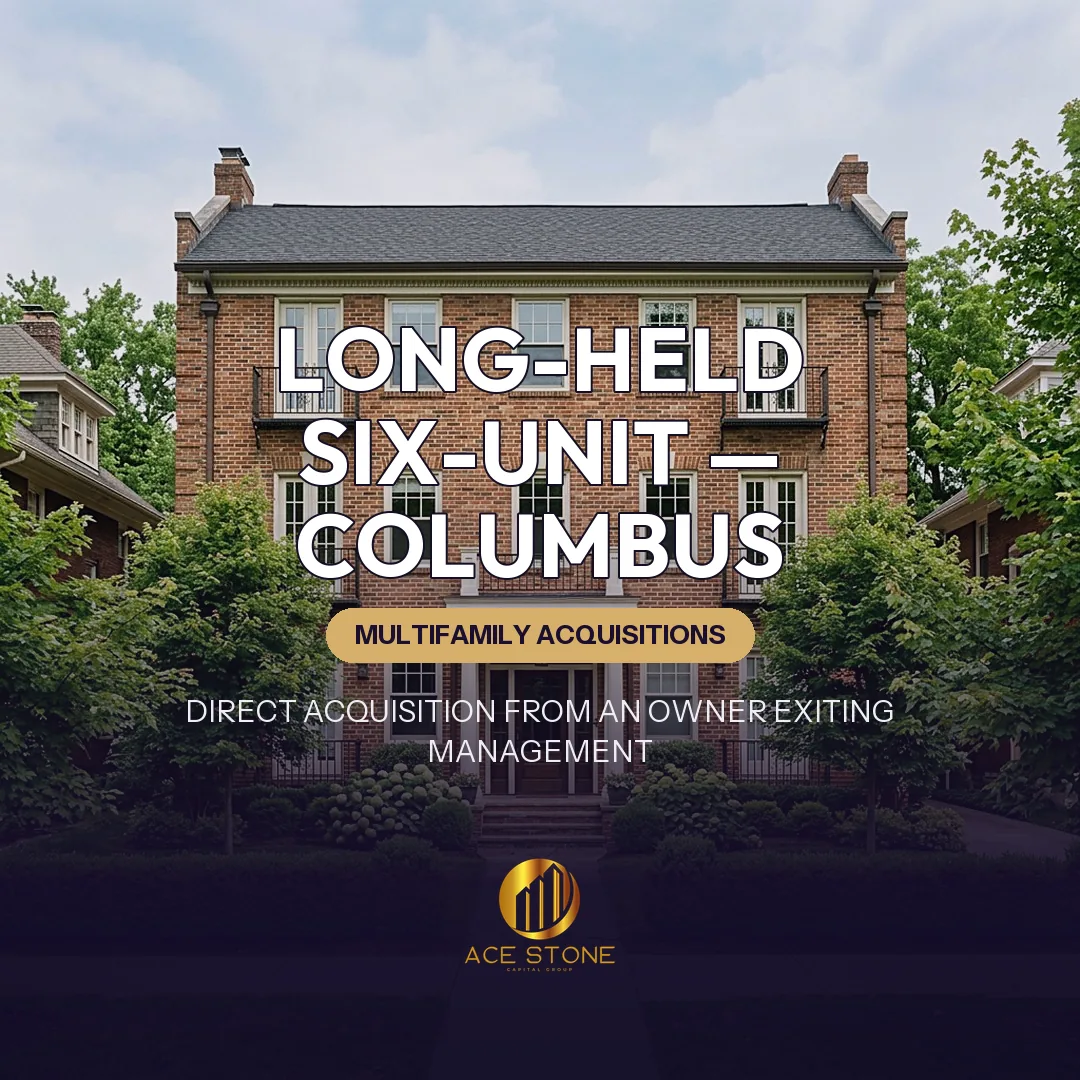
An acquisition profile examining a long-held Columbus six-unit building where the owner wanted out of active management, several rents sat below market, and maintenance had been handled informally.
This acquisition profile examines asset strategy, underwriting method, transaction structure, and value-creation considerations. Counterparty and pricing details are not disclosed.
Representative imagery of the asset type and market — not a photograph of the subject property.
Case Context
This acquisition profile examines a six-unit residential building in Columbus held by the same owner for many years. It sets out AceStone Capital Group's underwriting methodology; specific counterparties and pricing are not identified. The premise is a common one: the owner wanted to stop managing the property and did not want to prepare the building for a conventional listing.
Ownership Situation and Seller Objective
The objective in this profile is exit from operations rather than maximization of headline price through a preparation-and-listing process. That objective shapes structure. A seller in this position values a defined closing timeline, an as-is acquisition without repair negotiation, and no requirement to vacate units, clean out common areas, or stage the building. Those terms have value to the seller and are priced honestly rather than presented as a concession.
Diligence begins with whatever lease documentation exists: executed leases, renewals, month-to-month conversions, deposit records, and the rent history behind each unit. Long ownership tends to produce a recognizable pattern — flat renewals with stable tenants, informal adjustments, and occasional unwritten arrangements. That pattern explains how the rents drifted below market and indicates how the existing tenancies are likely to respond to any reset.
Below-Market Rent Analysis
A rent gap is not value by itself. Value exists only where the gap can be closed within a defined period, at a defined cost, without destroying the occupancy that supports the building in the interim. The analysis distinguishes a gap caused by owner passivity — closable at renewal or natural turnover — from a gap caused by physical inferiority, which requires capital to close. Only the first can be underwritten at low cost.
Where maintenance has been handled informally, the absence of invoices is not evidence of absence of work; it is evidence of an unreconstructed record. Physical review substitutes for the missing paper: roof, gutters and drainage, masonry, window condition, heating equipment age and configuration, electrical service capacity and panel condition, plumbing supply and waste lines, basement moisture, and unit-level finish condition. Anything an owner-operator would have repaired informally is checked directly rather than assumed.
Operating Expense Normalization
Owner-operated buildings almost always under-report expenses because the owner performed labor personally and did not price it. Normalization adds a market management load, a market maintenance and turnover allowance, per-unit reserves, common-area utilities, and re-underwritten property tax on a post-transfer basis. Insurance is re-quoted rather than carried forward. The output is an expense ratio the property will actually carry under professional operation, not the ratio it appeared to carry under owner labor.
Where the seller cannot produce institutional-quality statements, the operating picture is reconstructed from primary evidence: bank deposit patterns against the rent roll, county tax records, utility account histories, insurance declarations, and the physical inspection. Each independent source cross-checks the others. Underwriting proceeds on what can be corroborated, and unverifiable items are treated as risk rather than as income.
Acquisition Structure
The structure that fits this seller is a direct as-is purchase with tenants in place, a defined diligence window, no repair negotiation after inspection, and a fixed closing date. Estoppel collection and lease-file assembly occur inside the diligence window rather than as a condition the seller must satisfy in advance. Certainty and simplicity are the deliverables; they are underwritten as part of the basis, not offered without cost.
Risk Factors
Principal risks are undocumented tenancy terms surfacing after closing, deposit liabilities that were never segregated, deferred maintenance concentrated in mechanical systems, post-transfer tax reassessment, tenant turnover clustering during the reset period, and a reversion schedule that assumes faster rent normalization than the local renewal environment supports.
Current Operations Versus Stabilized Operations
Two figures are carried side by side throughout: what the building produces today under existing leases and informal operation, and what it produces under professional management at documented market rents. Basis is set against the second figure discounted for the time, cost and tenant-retention risk of getting there. The distance between the two is the entire analytical content of a long-held small multifamily acquisition.
Key Takeaway
A building operated independently for many years can be underwritten reliably, but only by reconstructing operations from primary evidence rather than accepting a summary schedule. Owners considering a comparable exit can review terms on the multifamily acquisitions desk.
Conclusion
Long-held six-unit properties frequently trade on structure rather than on price alone, because the seller's objective is exit from operations. The framework above reflects AceStone Capital Group's underwriting posture on assets of this profile.
What This Case Shows
A structured example of how AceStone Capital Group sources, underwrites, and structures off-market residential acquisitions in Columbus, OH. For broader context, see our active acquisition markets or initiate a direct-sale review for a similar property.
Have a Property to Sell?
Receive a written offer or a clear pass within 1–2 business days.