
Back
    Residential Tampa, FL March 2026

    Multifamily Acquisition: Eight-Unit Apartment Property, Tampa

    A analysis of an older Tampa eight-unit property where insurance, roof age and near-term capital expenditure — not headline rent — governed the acquisition basis.

    This acquisition profile examines asset strategy, underwriting method, transaction structure, and value-creation considerations. Counterparty and pricing details are not disclosed.

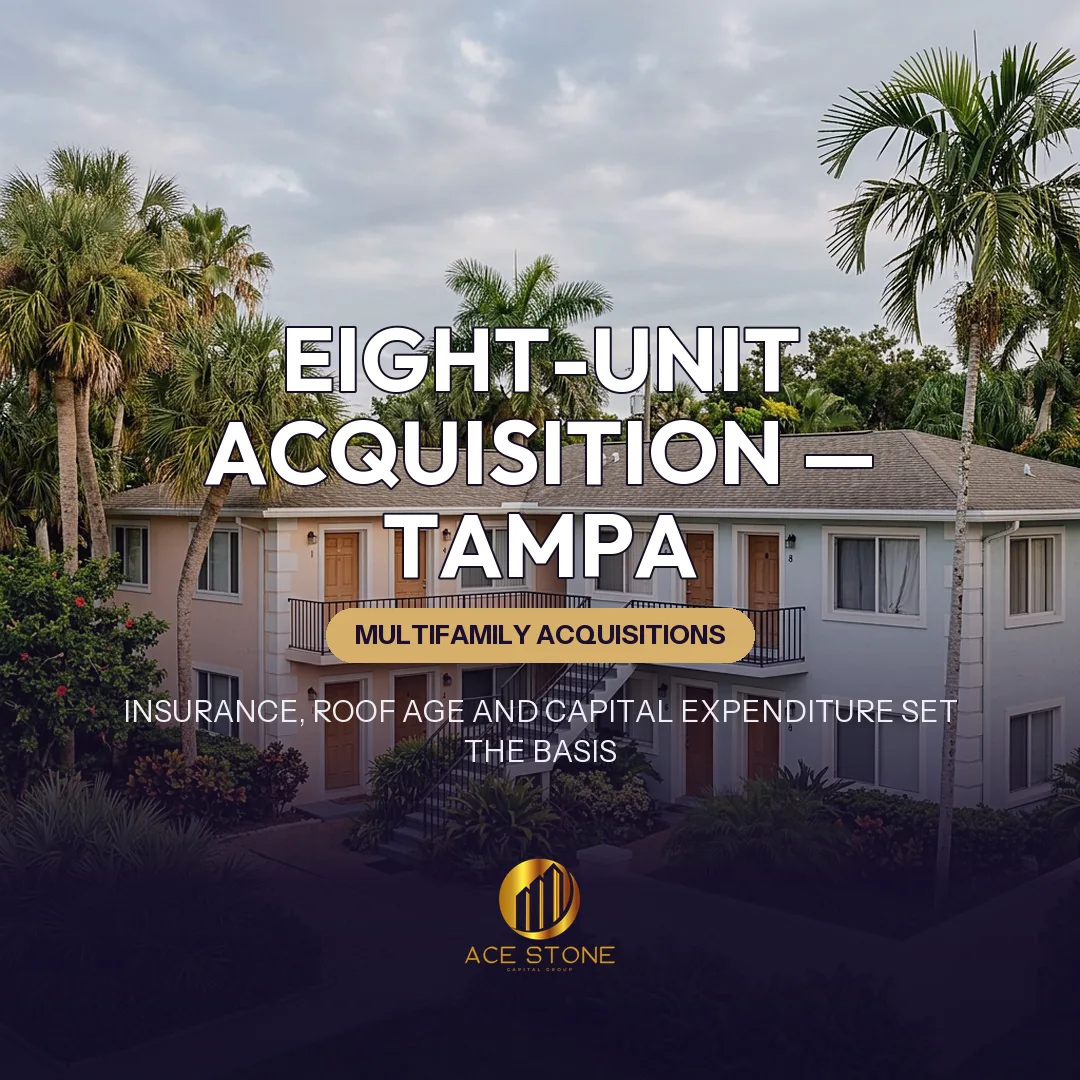
    Low-rise eight-unit Florida apartment property with palms.
    Representative imagery of the asset type and market — not a photograph of the subject property.

    Case Context

    This acquisition profile examines an older eight-unit apartment property in the Tampa market. It sets out AceStone Capital Group's underwriting methodology; specific counterparties and pricing are not identified. The analytical premise is that headline rental income is the least informative variable in a coastal-market building of this age.

    Property Profile

    The subject profile is a single-story or two-story walk-up of eight units in a masonry or concrete-block structure typical of the submarket's older stock. Buildings of this construction age well structurally but carry roof, mechanical and electrical systems that reach the end of their service lives on predictable schedules. Unit mix, parking ratio, laundry configuration, and whether units are individually metered all bear directly on both revenue and expense.

    Applied exampleSee how this played out in Duplex Acquisition: Owner-Occupied Two-Unit Property, Tampa — a residential acquisition in Tampa, FL.

    Occupancy and Rental Income

    Rent-roll diligence covers executed leases, remaining terms, expiration clustering, deposit ledgers, concession history, and — most importantly — collections rather than stated rent. Vacancy is examined by unit rather than as a building-level percentage, since a persistently vacant unit usually indicates a physical or configuration problem that a portfolio-level vacancy factor conceals.

    Roof, HVAC and Building Systems

    Roof age and documented remaining service life are underwritten explicitly, because in a wind-exposed Florida market roof condition affects insurability as well as capital cost. Each air-handling and condensing unit is aged individually. Electrical review covers service capacity, panel type, and whether any unit retains obsolete equipment. Plumbing review covers supply material, waste-line condition, and water-heater age. These are itemized as a dated capital schedule, not summarized as a single allowance.

    Applied exampleSee how this played out in Code-Violation Single-Family Acquisition: Resolving Property-Level Risk in Tampa — a residential acquisition in Tampa, FL.

    Insurance and Flood Exposure

    Insurance is quoted, not estimated. In this market the quote depends on roof age and covering type, construction class, wind mitigation features, flood zone designation, and elevation. A property that is otherwise sound can fail underwriting purely on insurance cost or availability, and a roof replacement can change the premium materially. Flood zone classification is verified from the current FEMA mapping rather than from the seller's representation, and elevation certificate availability is confirmed.

    Property Taxes and Operating Expenses

    Property tax is re-underwritten on a post-transfer assessment basis rather than carried forward. Operating expenses are rebuilt from primary sources: utility account histories for owner-paid services, landscaping and pest contracts, common-area electricity, management at a market rate, and a maintenance and turnover allowance appropriate to the age of the units rather than to the seller's trailing figures.

    Applied exampleSee how this played out in Selling an Inherited Property in Florida — a residential acquisition in Florida.

    Near-Term Capital Expenditure

    Capital items are separated into three tranches: work required before or immediately at closing to preserve insurability and habitability, work required within the first operating period, and work that can be sequenced over the hold. Only the first two are deducted from basis directly; the third is reserved. Confusing these tranches is the most common source of mispricing in older coastal multifamily.

    Physical-Condition Risk

    Condition risk in this profile concentrates in the roof assembly, the mechanical plant, any evidence of prior water intrusion, and the electrical service. Each is scoped by a qualified inspection rather than by visual estimate. Where a system's remaining life cannot be established with confidence, it is underwritten at the conservative end of its range rather than at the seller's representation.

    Basis Analysis

    Basis is constructed from achievable stabilized income net of re-underwritten expenses — including the actual insurance quote and the post-transfer tax figure — then reduced by the near-term capital schedule and the carry associated with performing it. The result is cross-checked against comparable eight-unit sales in the submarket and against replacement cost. Where the three references disagree materially, the disagreement is investigated rather than averaged.

    Risk Factors

    The material risks are insurance repricing or non-renewal, roof condition proving worse than inspected, storm exposure during the hold, tax reassessment on transfer, capital scope expansion once mechanical work begins, and rent assumptions that do not survive an increase in submarket supply.

    Key Takeaway

    In an older coastal multifamily building, insurance and capital expenditure are underwriting inputs of the same rank as rent. A basis built on rental income alone will not survive the first insurance renewal or the first roof cycle. Owners of comparable assets can review parameters on the multifamily acquisitions desk.

    Conclusion

    Converting physical, operating, insurance and location-specific variables into a single realistic acquisition basis is the entire discipline in this profile. The framework above reflects AceStone Capital Group's underwriting posture on assets of this profile.

    What This Case Shows

    A structured example of how AceStone Capital Group sources, underwrites, and structures off-market residential acquisitions in Tampa, FL. For broader context, see our active acquisition markets or initiate a direct-sale review for a similar property.

    Have a Property to Sell?

    Receive a written offer or a clear pass within 1–2 business days.

    Request a Cash Offer