
Back
    Residential Tampa, FL February 2026

    Distressed Rental Portfolio: Acquiring Below Stabilized Value in Tampa

    A Tampa analysis separating operational distress from permanent asset impairment across a rental portfolio with deteriorated performance.

    This acquisition profile examines asset strategy, underwriting method, transaction structure, and value-creation considerations. Counterparty and pricing details are not disclosed.

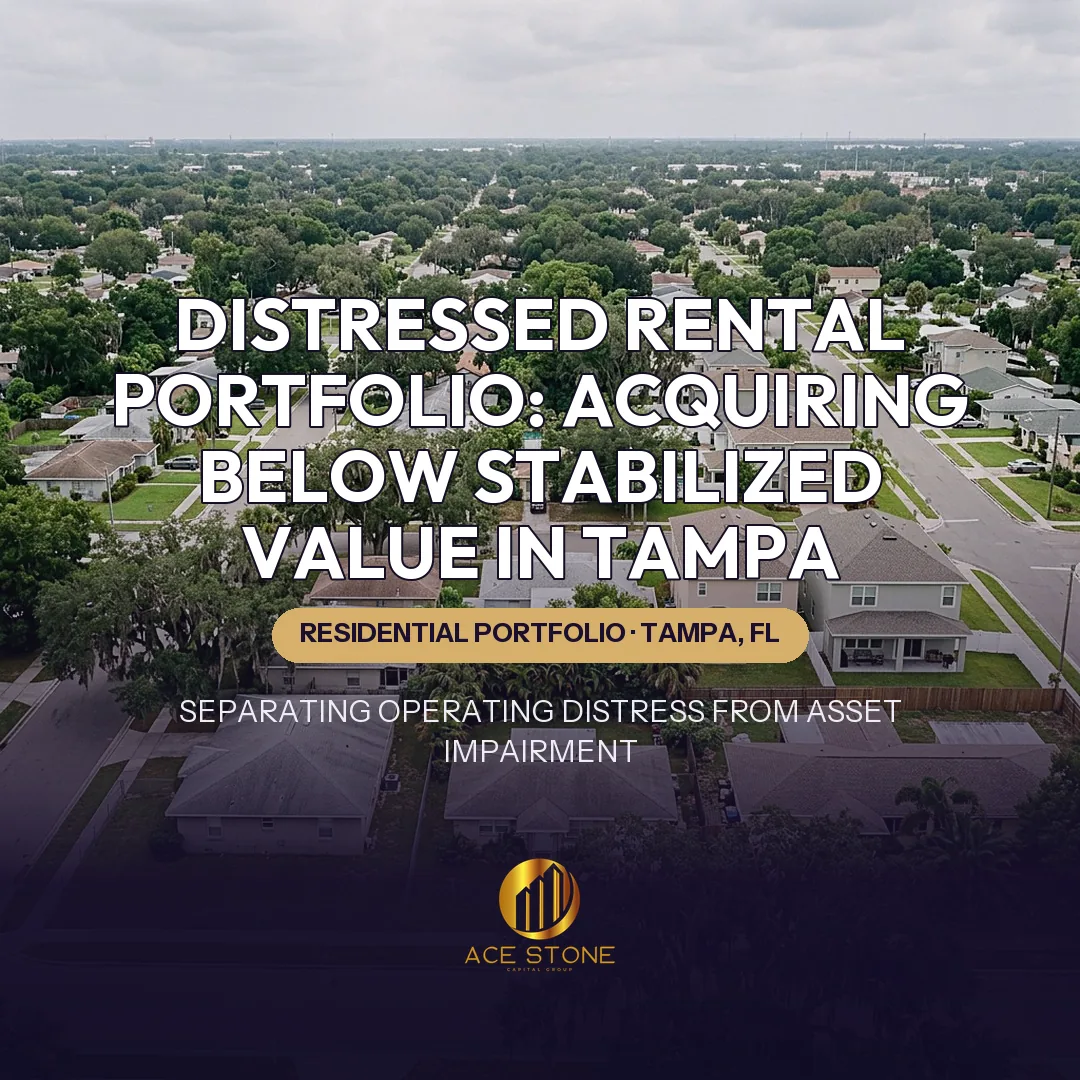
    Aerial view of an established Tampa residential neighborhood with mixed older and newer rental housing.
    Representative imagery of the asset type and market — not a photograph of the subject property.

    Case Context

    This acquisition profile sets out AceStone Capital Group's acquisition method. It examines a Tampa-area rental portfolio in which the physical assets remain viable but operations have deteriorated. Specific properties, counterparties, and pricing are not identified.

    Ownership and Operating Situation

    Operational decline in a small rental portfolio usually has an identifiable cause: an owner's health event, a management company transition handled poorly, deferred reinvestment during a period of rising expenses, or an absentee owner relying on an unsupervised local contact. The distinguishing feature of this profile is that revenue underperformance is administrative in origin rather than structural.

    Applied exampleSee how this played out in Multifamily Acquisition: Eight-Unit Apartment Property, Tampa — a residential acquisition in Tampa, FL.

    Diagnostic Framework

    The analysis first establishes which conditions are reversible with capital and competent management, and which are permanent. Reversible items include vacancy caused by slow turns, rents left unadjusted for several renewal cycles, unenforced lease terms, unbilled utility recovery, and cosmetic condition suppressing rentability. Permanent items include functional obsolescence, unremediable environmental issues, chronic flood exposure, incurable location deficiencies, and structural failure that exceeds the value of the improvement.

    Property-Level Analysis

    Each home is inspected against a defined scope: roof age and condition, HVAC and electrical service adequacy, plumbing supply and drainage material, moisture intrusion and remediation history relevant to Gulf Coast humidity, elevation and flood-zone designation, and permit history for any prior unpermitted work. Condition findings are converted into a per-property rehabilitation budget with contingency rather than a portfolio allowance.

    Applied exampleSee how this played out in Code-Violation Single-Family Acquisition: Resolving Property-Level Risk in Tampa — a residential acquisition in Tampa, FL.

    Stabilization Path

    Stabilization is modeled property by property with a realistic sequence: vacate or retain existing tenancy, complete scoped work, market and lease, then hold through a full renewal cycle. Each step carries duration, cost, and vacancy loss. A portfolio whose stabilization path extends well beyond a reasonable execution window carries timing risk that must be reflected in basis rather than in optimism about the terminal value.

    Insurance and Carry

    In coastal Florida markets, insurance is an underwriting variable of first order rather than a line item. Premium availability, deductible structure, roof-age eligibility rules, and wind mitigation credits can determine whether a stabilized home is economically operable at all. Carry during the stabilization window — taxes, insurance, utilities, security, and management — is priced explicitly.

    Applied exampleSee how this played out in Selling an Inherited Property in Florida — a residential acquisition in Florida.

    Risks Identified

    Principal risks are underestimated rehabilitation scope, contractor availability, insurance repricing at transfer, tenant-related legal timelines where possession is required, and the possibility that below-market rents reflect genuine submarket ceilings rather than management failure.

    Key Takeaway

    A troubled portfolio is not automatically distressed real estate. Professional underwriting separates fixable operating inefficiencies from structural asset problems, and only the former justifies acquiring below stabilized value with confidence.

    Conclusion

    The discount available in an operationally distressed portfolio is earned through execution, not assumed at signing. This analysis reflects AceStone Capital Group's underwriting method; no specific transaction is described.

    What This Case Shows

    A structured example of how AceStone Capital Group sources, underwrites, and structures off-market residential acquisitions in Tampa, FL. For broader context, see our active acquisition markets or initiate a direct-sale review for a similar property.

    Have a Property to Sell?

    Receive a written offer or a clear pass within 1–2 business days.

    Request a Cash Offer