
Back
    Residential Phoenix, AZ February 2026

    Build-to-Rent Portfolio Acquisition: Twenty-Four Homes in Phoenix

    A modelled underwriting review of a concentrated twenty-four home build-to-rent community in Phoenix, and how standardization changes the analysis.

    This acquisition profile examines asset strategy, underwriting method, transaction structure, and value-creation considerations. Counterparty and pricing details are not disclosed.

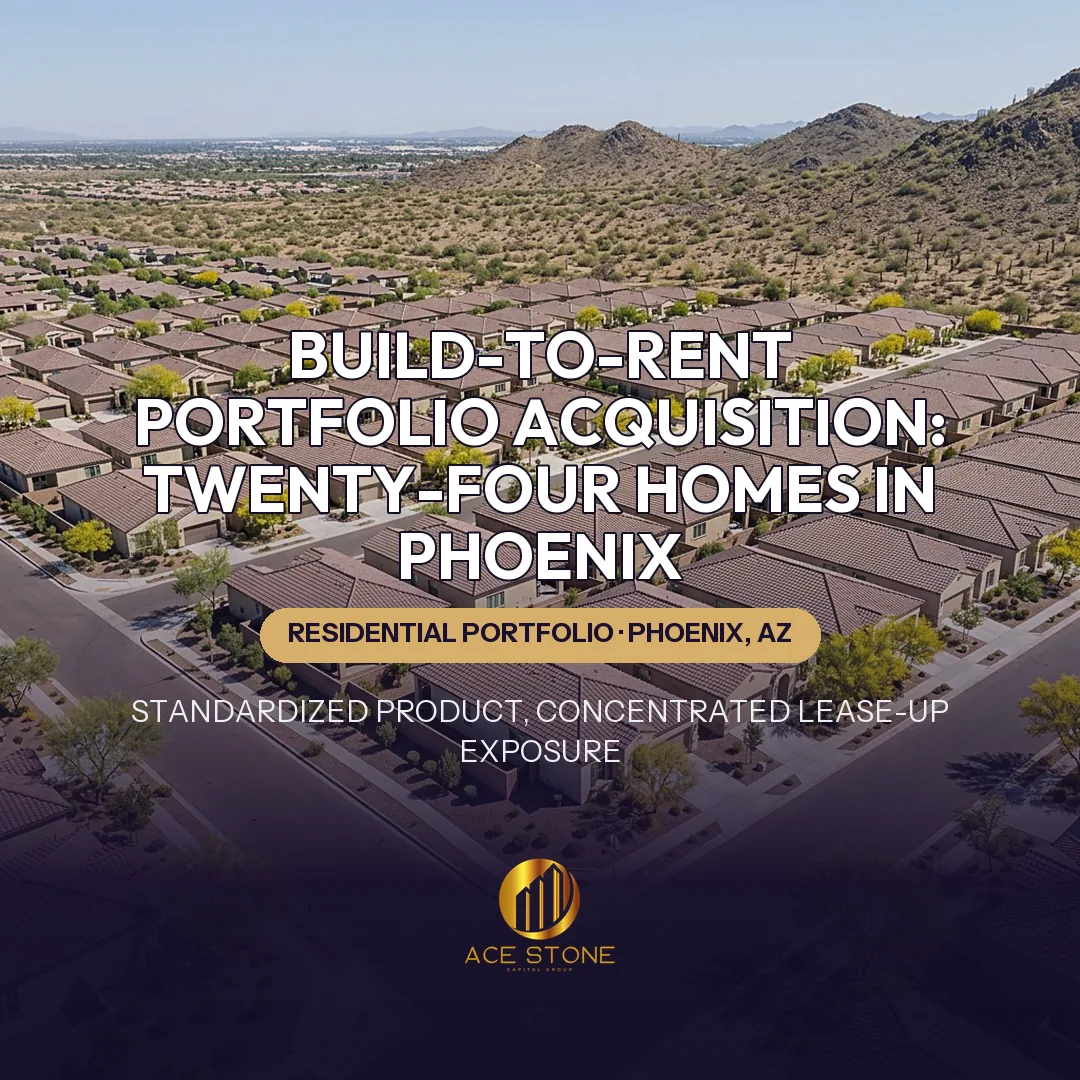
    Aerial view of a modern build-to-rent single-family rental community in the Phoenix metropolitan area.
    Representative imagery of the asset type and market — not a photograph of the subject property.

    Case Context

    This acquisition profile examines a purpose-built rental community of twenty-four homes in the Phoenix metropolitan area. It sets out AceStone Capital Group's underwriting methodology; specific counterparties and pricing are not identified.

    Acquisition Profile

    Build-to-rent product differs structurally from aggregated scattered-site rentals. The homes share a single delivery vintage, two or three floor plans, common specification levels for roofing, mechanical systems, flooring and appliances, and a contiguous or near-contiguous footprint. The underwriting question shifts from reconciling eight different assets to testing whether one repeated asset was priced, leased, and specified correctly.

    Applied exampleSee how this played out in Multifamily Acquisition: Mixed-Occupancy Eightplex, Phoenix — a residential acquisition in Phoenix, AZ.

    Standardization and Operating Efficiency

    Uniform specification produces measurable operating advantages: consolidated maintenance inventory, predictable turn scopes and turn costs, one vendor set, and staffing density that a scattered portfolio cannot match. Warranty coverage on structures, roofs and installed systems can also defer a meaningful share of early capital expenditure, provided the warranty terms, transferability, and remaining coverage periods are verified in diligence rather than assumed.

    Rent and Absorption Analysis

    Rent comparables for build-to-rent product are drawn from competing purpose-built communities and from the upper band of detached scattered-site rentals, not from apartment product. Where a community is not yet fully stabilized, lease-up pace, concession levels in the surrounding submarket, and seasonality of Phoenix leasing demand drive the near-term revenue path. Underwriting stabilized rent from day one on an unstabilized community is the most common valuation error in this asset type.

    Applied exampleSee how this played out in Selling an Inherited Property in Florida — a residential acquisition in Florida.

    Operating Expense Review

    Expense analysis covers Maricopa County property tax treatment and reassessment after transfer, insurance in a market exposed to hail and extreme heat cycles, water and landscape costs under desert irrigation, HOA structure where the community sits inside a master association, and management fee levels achievable at twenty-four contiguous doors versus a dispersed portfolio.

    Concentration and Liquidity

    Geographic concentration is the counterweight to operational efficiency. Twenty-four homes in one community share one employment catchment, one school assignment, one insurance profile, and one supply pipeline. The offset is exit liquidity: standardized, concentrated rental communities appeal to a defined institutional buyer universe, which can narrow the pricing spread at disposition relative to a scattered package.

    Applied exampleSee how this played out in Cash Offers vs. Traditional Listings: What Sellers Should Know — a residential acquisition in National.

    Risks Identified

    Key risks include unstabilized lease-up assumptions, new-delivery supply competing in the same submarket, warranty scope narrower than represented, post-completion tax reassessment materially above the builder's carrying assessment, and the absence of a multi-year operating history against which to test expense assumptions.

    Key Decision Points

    The decisive questions are whether the achievable rent band is demonstrated rather than projected, whether the discount to replacement cost is sufficient to absorb lease-up variance, and whether concentration in a single Phoenix submarket is consistent with the acquiring mandate's exposure limits.

    Key Takeaway

    Standardization can reduce operational complexity, but concentration, lease-up assumptions, and pricing still require disciplined underwriting. A newer portfolio is a different risk profile, not a lower one.

    Conclusion

    Purpose-built rental portfolios reward buyers who verify the operating case rather than crediting the construction case. This analysis reflects that framework.

    What This Case Shows

    A structured example of how AceStone Capital Group sources, underwrites, and structures off-market residential acquisitions in Phoenix, AZ. For broader context, see our active acquisition markets or initiate a direct-sale review for a similar property.

    Have a Property to Sell?

    Receive a written offer or a clear pass within 1–2 business days.

    Request a Cash Offer