
Back
    Residential Tampa, FL February 2026

    Duplex Acquisition: Owner-Occupied Two-Unit Property, Tampa

    A analysis of a Tampa duplex where the owner occupies one unit, and why current income and stabilized income must be underwritten separately.

    This acquisition profile examines asset strategy, underwriting method, transaction structure, and value-creation considerations. Counterparty and pricing details are not disclosed.

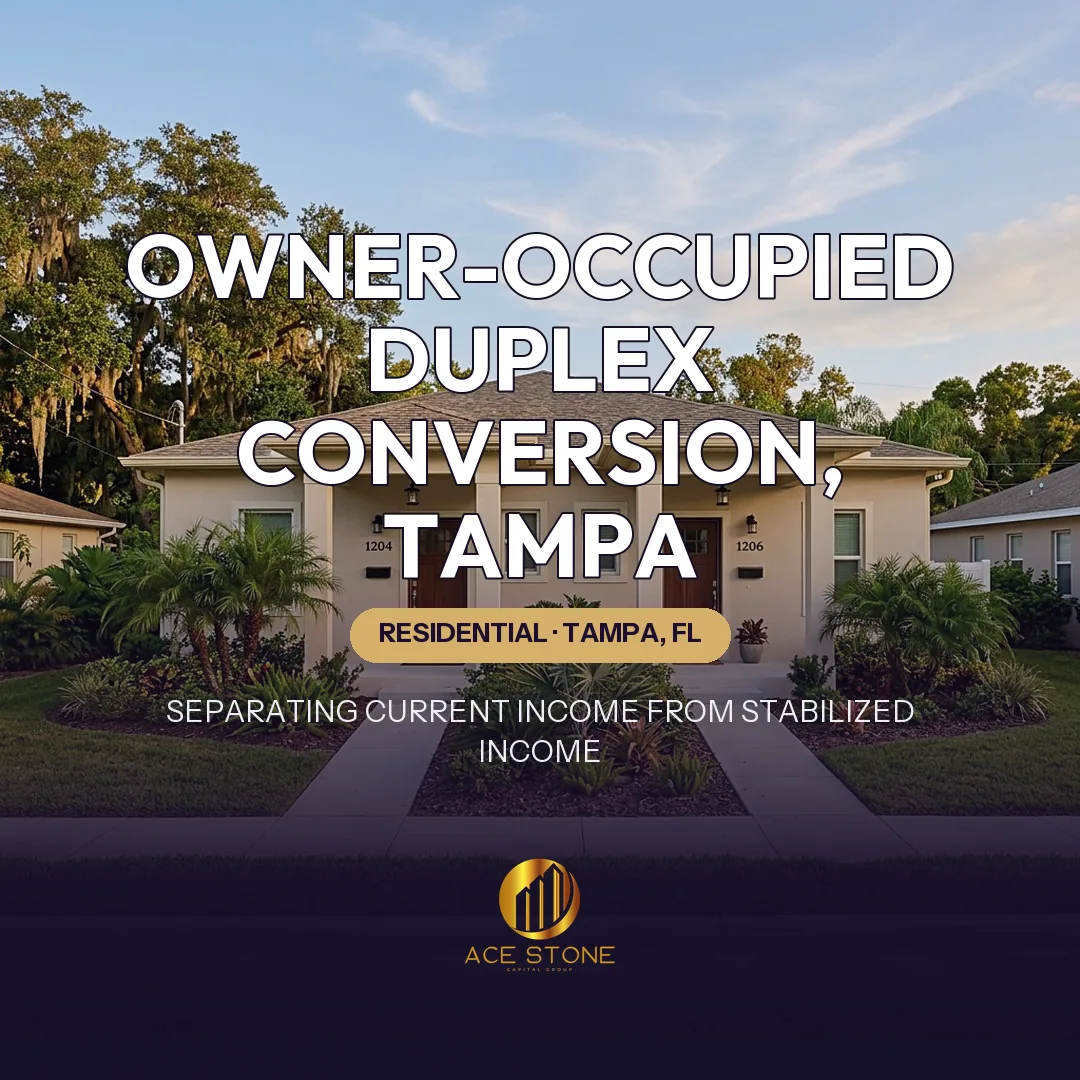
    Side-by-side two-unit duplex with two entrances in a Tampa residential neighborhood.
    Representative imagery of the asset type and market — not a photograph of the subject property.

    Case Context

    This acquisition profile examines how AceStone Capital Group underwrites a two-unit residential property in the Tampa market. Specific counterparties and pricing are not identified. The subject profile is a side-by-side duplex in which the owner occupies one unit as a primary residence and leases the second unit to a third-party tenant.

    Acquisition Profile

    An owner-occupied duplex presents a hybrid economic profile. One side of the building produces contractual rental income supported by a lease; the other side produces no income at all and instead reflects the owner's housing consumption. A property presented on this basis will show roughly half the gross revenue a fully leased identical building would produce, which distorts every yield metric derived from the trailing figures. The correct starting point is to separate the two sides and value each on its own economic terms.

    Applied exampleSee how this played out in Multifamily Acquisition: Eight-Unit Apartment Property, Tampa — a residential acquisition in Tampa, FL.

    Occupancy and Rent Profile

    Diligence on the tenanted side covers the executed lease, remaining term, renewal or holdover provisions, security deposit handling under Florida statute, escalation language, and any concessions or informal arrangements not reflected in the written document. Diligence on the owner-occupied side is entirely comparative: there is no lease to review, so achievable rent is established from competing two-unit and detached rentals within the same submarket, adjusted for unit size, parking, laundry configuration, and whether utilities are separately metered.

    Property Characteristics and Condition

    Owner-occupied sides frequently differ physically from the leased side. Personal improvements, non-permitted alterations, and finish levels above rental specification are common, while the leased side may show ordinary tenant wear. Physical review addresses the roof structure and remaining service life under Florida wind exposure, the age and condition of each air-handling and condensing unit, whether the building is on shared or separate electrical and water service, plumbing supply material, drainage and grading, and evidence of prior moisture intrusion.

    Applied exampleSee how this played out in Code-Violation Single-Family Acquisition: Resolving Property-Level Risk in Tampa — a residential acquisition in Tampa, FL.

    Operating Expense Review

    Trailing expenses from an owner-occupied building are rarely usable as presented. Property tax is a specific issue: a homesteaded owner-occupied duplex in Hillsborough County carries an assessment posture that does not survive transfer to an investment owner, so tax must be re-underwritten to a post-transfer basis rather than carried forward. Insurance is re-quoted as a non-owner-occupied dwelling policy in a coastal-exposed county, which typically prices differently than an owner's policy. Utilities, lawn and pest service, and routine maintenance are frequently absorbed personally by the resident owner and must be added back as real operating costs.

    Turnover and Stabilization

    The owner-occupied side becomes vacant at closing, which introduces a defined turnover scope and a lease-up interval before it produces income. The scope typically includes cleaning, paint, flooring assessment, appliance verification, rekeying, and correction of any personal alteration that would not pass a rental inspection. The lease-up interval is set from observed marketing times for comparable Tampa two-unit product rather than from an assumption of immediate occupancy.

    Applied exampleSee how this played out in Selling an Inherited Property in Florida — a residential acquisition in Florida.

    Basis Analysis

    Basis is constructed from stabilized income net of re-underwritten expenses, discounted for the cost and duration of reaching stabilization, and cross-checked against comparable two-unit sales and against replacement cost. A buyer who capitalizes stabilized income without deducting turnover cost, downtime, tax reset, and insurance repricing will overpay; a buyer who capitalizes only current in-place income will systematically undervalue the asset and will not be competitive with the seller's alternatives.

    Risk Factors

    The material risks are rent overestimation on a unit with no leasing history, post-transfer tax reassessment, insurance availability and pricing in a wind-exposed market, the possibility that the remaining tenant does not renew and creates simultaneous double vacancy, and unpermitted work on the owner side surfacing as a compliance item.

    Key Decision Points

    Three questions govern the decision. Is the market rent on the owner-occupied side evidenced by competing product rather than assumed? Does the re-underwritten expense load, particularly tax and insurance, still support the intended basis? And is the stabilization interval short enough that the cost of carrying a vacant unit does not consume the value created by converting it to income?

    Key Takeaway

    Current income and stabilized income are different figures and must be underwritten separately. An owner-occupied duplex is priced on what it will produce under investment ownership, net of the specific cost and time required to get there, not on what its trailing statements show today.

    Conclusion

    Owner-occupied two-unit properties can be sound acquisitions precisely because their reported income understates their capacity, but only where the conversion path is scoped, costed, and time-bound. The framework above reflects AceStone Capital Group's underwriting posture on assets of this profile.

    What This Case Shows

    A structured example of how AceStone Capital Group sources, underwrites, and structures off-market residential acquisitions in Tampa, FL. For broader context, see our active acquisition markets or initiate a direct-sale review for a similar property.

    Have a Property to Sell?

    Receive a written offer or a clear pass within 1–2 business days.

    Request a Cash Offer