
Back
    Residential Multi-State August 2026

    When a Residential Portfolio Fails Underwriting: A Twelve-Home Acquisition Review

    A twelve-home portfolio review that clears initial screening, fails disciplined underwriting, and documents the reasoning behind a walk-away.

    This acquisition profile examines asset strategy, underwriting method, transaction structure, and value-creation considerations. Counterparty and pricing details are not disclosed.

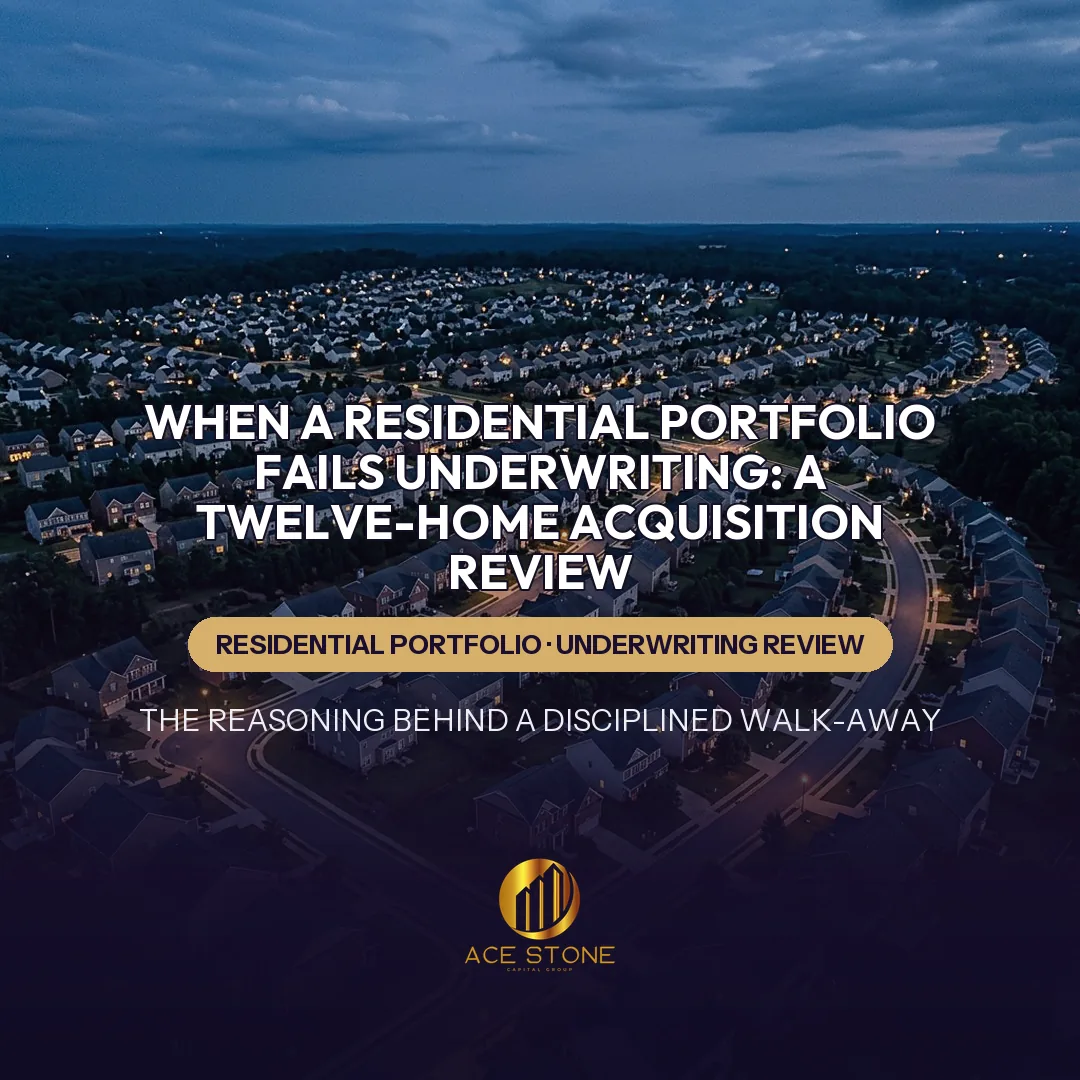
    Moody dusk aerial of a large American residential subdivision.
    Representative imagery of the asset type and market — not a photograph of the subject property.

    Case Context

    This modelled acquisition analysis follows a twelve-home residential portfolio through underwriting to a declined outcome. It sets out AceStone Capital Group's underwriting methodology.S. context,. Specific counterparties and pricing are not identified.

    Initial Presentation

    The opportunity screened well. The summary schedule showed high occupancy, rents at or near submarket levels, a modest blended expense ratio, and an asking level presented as a discount to the sum of individual values. On the first pass, the portfolio appeared to satisfy the mandate's size, geography, and yield parameters.

    Applied exampleSee how this played out in Why Infill Lots Are Outperforming in Growth Corridors — a residential acquisition in U.S. Growth Markets.

    Where the Rent Roll Weakened

    Estoppel verification and bank-deposit reconciliation reduced the effective rent roll. Several leases had concessions not reflected in the schedule, two tenancies were materially delinquent while still counted as occupied, and one home was recorded at a rent supported by no comparable in the submarket. Verified revenue landed below the presented figure by enough to change the basis conclusion.

    Condition and Capital Findings

    Inspection identified concentrated capital need: roofs at or past service life on a third of the homes, two mechanical systems requiring immediate replacement, one active moisture intrusion issue with unclear history, and evidence of unpermitted alterations at two properties. The scoped capital budget exceeded the allowance implied by the seller's pricing.

    Applied exampleSee how this played out in The Migration Effect: How Population Shifts Drive Lot Demand — a residential acquisition in U.S. Growth Markets.

    Insurance and Carry Analysis

    Insurance quoting on the aged-roof cohort returned premiums well above the schedule's assumption, with deductible structures that shifted meaningful risk to ownership. Combined with tax reassessment on transfer, the corrected expense load compressed the net operating position further.

    Title and Structural Issues

    Preliminary title review surfaced an unreleased lien on one parcel, an access question on another where the recorded easement did not match observed use, and inconsistent vesting across entities that would require curative before a coordinated closing could be scheduled.

    Applied exampleSee how this played out in Path-of-Growth Markets: Where Land Appreciation Starts Early — a residential acquisition in U.S. Growth Markets.

    Liquidity and Concentration

    The twelve homes were split across markets with thin institutional buyer participation, leaving a narrow exit universe. The portfolio was simultaneously too small to attract programmatic buyers and too dispersed to offer route density to a regional operator — a combination that limits both operating efficiency and disposition optionality.

    The Walk-Away Decision

    Repricing was offered and declined by the seller. At the seller's level, the corrected revenue, verified capital need, repriced insurance, curative timeline, and constrained exit liquidity left no adequate margin of safety. Proceeding would have required assuming that every corrected item resolved favorably and that stabilization occurred on schedule — a set of dependent assumptions no disciplined underwriting supports. The file was declined.

    What the Rejection Preserved

    Declining preserved capital for opportunities where basis is defensible without dependent assumptions, avoided an operating commitment across markets the mandate could not service efficiently, and maintained the underwriting standard that governs every subsequent file. Rejection is a routine output of a functioning process, not a failure of sourcing.

    Key Takeaway

    A serious acquisitions platform is defined as much by the opportunities it rejects as by the opportunities it pursues. Discipline is only visible at the point of refusal.

    Conclusion

    This profile illustrates AceStone Capital Group's underwriting standard applied to an unsuccessful file. It. Specific properties, counterparties, and pricing are not identified.

    What This Case Shows

    A structured example of how AceStone Capital Group sources, underwrites, and structures off-market residential acquisitions in Multi-State. For broader context, see our active acquisition markets or initiate a direct-sale review for a similar property.

    Have a Property to Sell?

    Receive a written offer or a clear pass within 1–2 business days.

    Request a Cash Offer