Code-Violation Single-Family Acquisition: Resolving Property-Level Risk in Tampa
A analysis of a Tampa house carrying municipal violations and suspected unpermitted work, and how quantifiable cost is separated from open-ended liability.
This acquisition profile examines asset strategy, underwriting method, transaction structure, and value-creation considerations. Counterparty and pricing details are not disclosed.
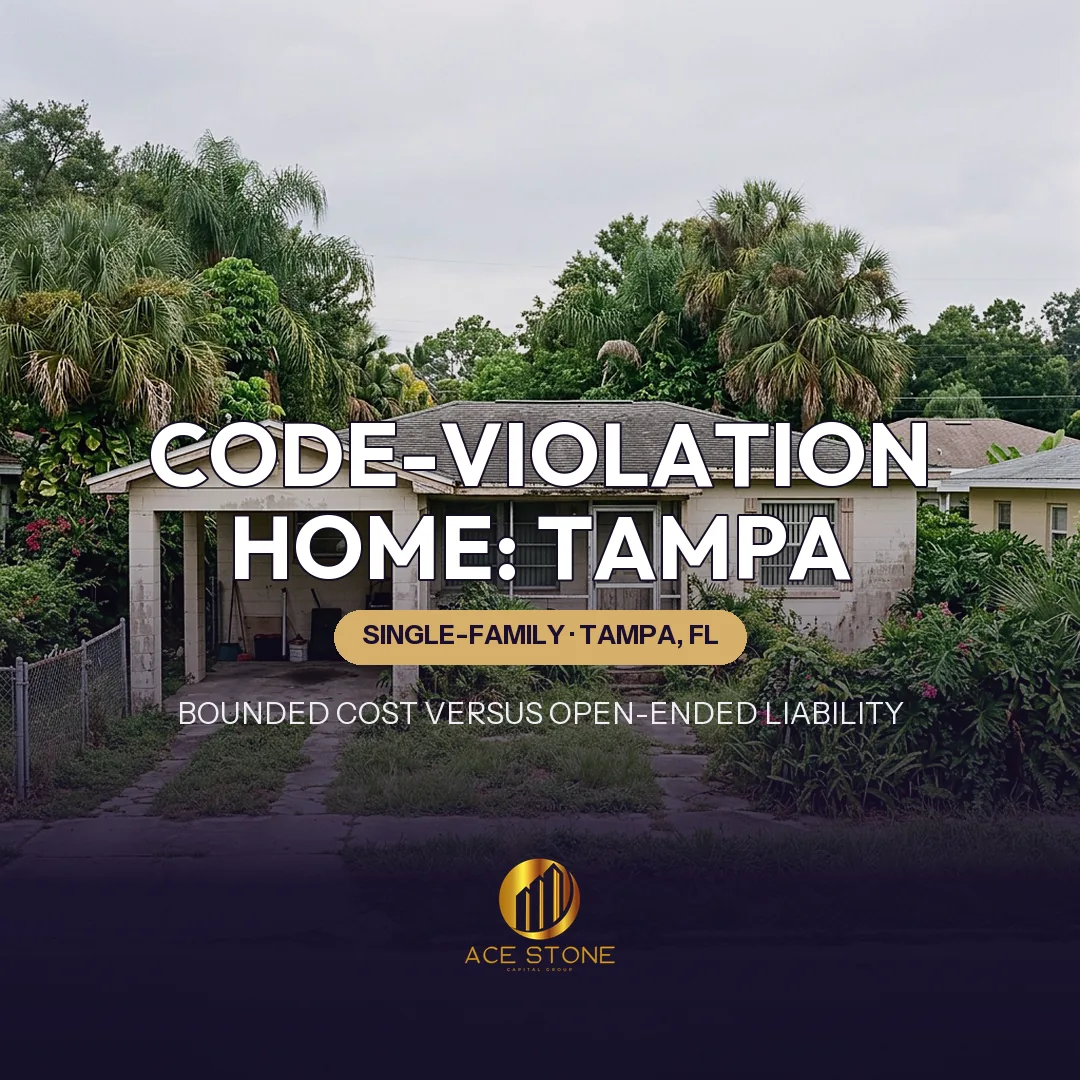
Representative imagery of the asset type and market — not a photograph of the subject property.
Case Context
This acquisition profile examines how AceStone Capital Group underwrites a detached single-family home in the Tampa market with unresolved municipal code issues and suspected unpermitted improvements. Specific properties, counterparties, and pricing are not identified. The subject profile is a single-story concrete-block home of mid-century construction in an established Hillsborough County neighborhood, with deferred exterior maintenance and an enclosed addition of uncertain permit status.
Property Profile
The subject is a detached three-bedroom home of roughly 1,200 to 1,500 square feet with a carport or converted garage, a low-slope or shingle roof at or beyond typical Florida service life, central cooling, and tropical landscaping that has outgrown its setbacks. The suspected addition — commonly an enclosed porch, converted carport, or rear room — is the central diligence question, because its permit status determines whether it is square footage that contributes to value or a liability that must be remediated.
Regulatory exposure differs from repair exposure in one decisive way: repairs have a price, while open violations can accrue. A code case with daily fines, a lien that has already recorded, or an addition that the jurisdiction will require to be permitted retroactively or removed does not have a fixed cost until the municipality has been engaged. The underwriting task is to convert each item into either a bounded number or an explicitly open condition, and to refuse to average across the two.
Municipal Records and Permit History
Diligence begins with the public record rather than the property. The permit history for the parcel is pulled and compared to the physical improvements observed, which exposes work performed without permit and permits opened and never closed — the latter being common and often cheaper to resolve than the former. Code enforcement records are reviewed for open cases, hearing dates, prior findings, compliance deadlines, and accrued daily fines. Where records are ambiguous, the jurisdiction is contacted directly for a written status rather than relying on inference.
Each open item is characterized by what it will take to clear it. Lot and exterior maintenance findings — overgrowth, debris, fence condition, peeling exterior — are inexpensive and quickly abated. Structural or occupancy findings are not. Accrued fines are quantified as of a stated date and confirmed in writing, and whether the jurisdiction will mitigate or reduce fines upon compliance is treated as an unconfirmed possibility, never as a modeled reduction. Recorded code liens are traced through the title commitment so that the encumbrance total is complete before basis is discussed.
Unpermitted Improvements
Unpermitted work is evaluated on three outcomes, each with a different cost. It may be legalized through a retroactive permit and inspection, which requires the work to meet current code and can involve selective demolition to expose framing, electrical, and connections. It may be required to be removed and the structure restored. Or it may be tolerated but excluded from recognized living area, which reduces value and complicates a future sale and appraisal. Underwriting assumes the outcome the record supports, not the outcome most favorable to the transaction, and where the jurisdiction's position is unknown the item is carried at the more expensive path.
In the Florida market, insurability is part of the physical analysis. Roof age and covering condition, the presence of a four-point-eligible electrical panel, plumbing supply material, and any unpermitted structure attached to the dwelling all affect whether coverage is available and at what cost. An unpermitted addition can complicate both binding coverage and any subsequent claim. Wind mitigation features and roof documentation are collected because their absence changes carrying cost materially, and carrying cost changes basis.
Repair Scope and Remediation Requirements
Two budgets are built and kept separate. The remediation budget covers everything required to bring the property into compliance and clear the open cases: abatement work, retroactive permitting and inspection, corrective construction, and municipal fees and fines. The improvement budget covers work that raises value beyond compliance. Combining them obscures the question that decides the file — whether the property is worth acquiring once compliance alone is paid for, before any value-add is contemplated.
Title Review and Comparable Sales
The title commitment is reviewed for recorded code liens, tax status, mortgage payoff, HOA claims, and judgments, with written figures obtained for each. Value is established from closed sales of comparable Hillsborough County homes at the same construction type and finish level, with the subject's recognized living area adjusted to exclude any unpermitted square footage. Comparables that themselves included unpermitted space are identified and set aside, because they carry the same unresolved risk into the analysis.
Acquisition-Basis Adjustments
Basis is the as-is value conclusion on recognized living area, less the full remediation budget, less quantified fines and liens, less carry across a compliance timeline that depends on municipal scheduling rather than on the buyer, less reserve for the more expensive permitting outcome where that outcome is unconfirmed, less a margin for regulatory uncertainty. Applied honestly, this stack frequently moves an apparently inexpensive property out of range — which is the analysis working, not failing.
Conditions Required to Proceed
Proceeding requires a written statement of open cases and accrued fines from the jurisdiction, a complete permit history for the parcel, a title commitment reflecting any recorded code liens, access sufficient to scope the suspected unpermitted work, and a bounded remediation estimate from a contractor familiar with local permitting practice. Each of these converts an open-ended item into a number.
Walk-Away Conditions
The analysis discontinues where fines continue to accrue with no defined path to compliance, where the jurisdiction indicates removal of an addition will be required and the restoration cost is not bounded, where recorded liens exceed a disciplined basis, where insurability cannot be established, or where the compliance timeline extends carry beyond what the property's value supports.
Key Takeaways
A property priced attractively can become unattractive once regulatory and remediation exposure is correctly priced — and correctly pricing it requires the municipal record, not an estimate. Fixed costs can be underwritten; accruing liabilities with no defined resolution cannot. Owners facing municipal issues on a property they no longer wish to hold can review parameters on the residential property acquisitions desk.
Conclusion
Code and permit issues are not automatically disqualifying. They are disqualifying when they cannot be bounded. The discipline is to insist on the record, price the more expensive outcome where the record is silent, and decline where the exposure remains open-ended. The framework above reflects AceStone Capital Group's underwriting posture on assets of this profile.
What This Case Shows
A structured example of how AceStone Capital Group sources, underwrites, and structures off-market residential acquisitions in Tampa, FL. For broader context, see our active acquisition markets or initiate a direct-sale review for a similar property.
Have a Property to Sell?
Receive a written offer or a clear pass within 1–2 business days.