
Back
    Residential Beverly Hills, CA March 2026

    Underwriting a Post-War Ranch on a Flat Beverly Hills Lot

    A underwriting profile for a single-story Flats residence whose wide, flat parcel supports a materially larger architectural replacement than current zoning has utilized.

    This acquisition profile examines asset strategy, underwriting method, transaction structure, and value-creation considerations. Counterparty and pricing details are not disclosed.

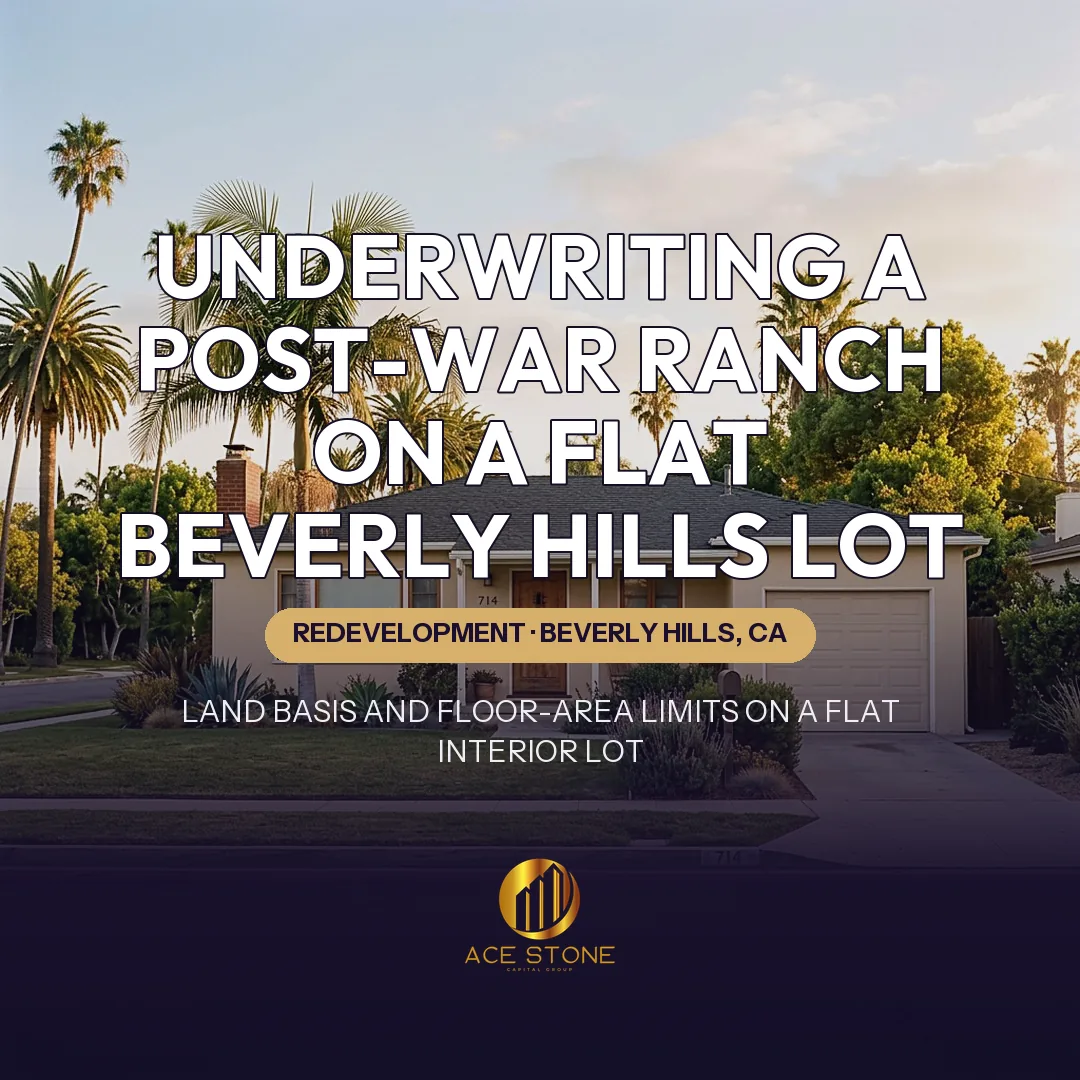
    Post-war single-story ranch house on a flat palm-lined Beverly Hills street.
    Representative imagery of the asset type and market — not a photograph of the subject property.

    Overview

    This profile examines a single-story ranch residence built in the postwar decades on a wide, flat lot south of Sunset. The house has been maintained but not substantially updated, and its footprint occupies well under the floor-area ratio the parcel is entitled to carry. The property was underwritten not as a house needing renovation but as a development site whose principal asset is the lot itself: its dimensions, orientation, and proximity to a corridor of recently completed architectural replacements that establish achievable resale value for a new residence built to current R-1 standards.

    Market Context

    Beverly Hills' Flats retain a disproportionate share of one-story homes from the 1940s through 1960s sitting on lots configured for structures nearly double their current square footage. Demand for architecturally significant new construction in this submarket has pushed replacement-home values well ahead of renovated-original pricing, widening the gap between an unimproved structure's contribution to value and the land beneath it. That gap is the basis for treating the parcel, rather than the house, as the transaction's subject matter.

    Applied exampleSee how this played out in Why Infill Lots Are Outperforming in Growth Corridors — a residential acquisition in U.S. Growth Markets.

    Valuation Approach

    We modeled residual land value by starting from achievable replacement-residence value for the lot's buildable envelope, then deducting projected hard construction cost, demolition and abatement of the existing structure, entitlement carry through the Architectural Commission and plan-check process, and soft costs including design, engineering, and permitting fees. The resulting residual figure — not a renovated-house comparable — set the basis for the written offer, since the existing improvement contributed negligible value relative to the parcel's development capacity.

    Key Considerations

    Beverly Hills R-1 floor-area ratio limits, required setbacks, and Architectural Commission design review govern what can actually be built, and all three were resolved before pricing rather than left as buyer contingencies. Because the lot is flat, hillside grading and geotechnical exposure were not factors here, which shortened diligence relative to a canyon or Trousdale parcel. Title was reviewed for any recorded design or height restriction that could constrain the replacement envelope.

    Applied exampleSee how this played out in The Migration Effect: How Population Shifts Drive Lot Demand — a residential acquisition in U.S. Growth Markets.

    Timeline

    Diligence on the parcel's zoning capacity, title, and demolition scope was completed ahead of an offer being extended, allowing the written offer to carry funding and due-diligence conditions stated in each offer and no subsequent re-trade. The owner selected the closing date, and the transaction was structured to close within the firm's typical 14 to 30 day window from executed agreement, without requiring the owner to obtain permits, plans, or Architectural Commission approval beforehand.

    Outcome

    The owner avoided listing a dated single-story house against a submarket where buyers increasingly price toward replacement construction, and avoided carrying entitlement or demolition risk personally. AceStone Capital Group took that risk as principal, closing on a defined date without a marketing period, open houses, or a public repricing history attached to the address.

    Applied exampleSee how this played out in Path-of-Growth Markets: Where Land Appreciation Starts Early — a residential acquisition in U.S. Growth Markets.

    What This Case Shows

    A structured example of how AceStone Capital Group sources, underwrites, and structures off-market residential acquisitions in Beverly Hills, CA. For broader context, see our active acquisition markets or initiate a direct-sale review for a similar property.

    Owners in this market can review local acquisition parameters on the Beverly Hills, CA market page.

    Have a Property to Sell?

    Receive an initial review or a clear pass within 1–2 business days.

    Request an Offer