
Back
    Residential Cincinnati, OH June 2026

    Value-Add Multifamily Acquisition: Eight-Unit Building, Cincinnati

    A analysis of a Cincinnati eight-unit building that looked more distressed than it operated, and how cosmetic deterioration was separated from economically significant capital needs.

    This acquisition profile examines asset strategy, underwriting method, transaction structure, and value-creation considerations. Counterparty and pricing details are not disclosed.

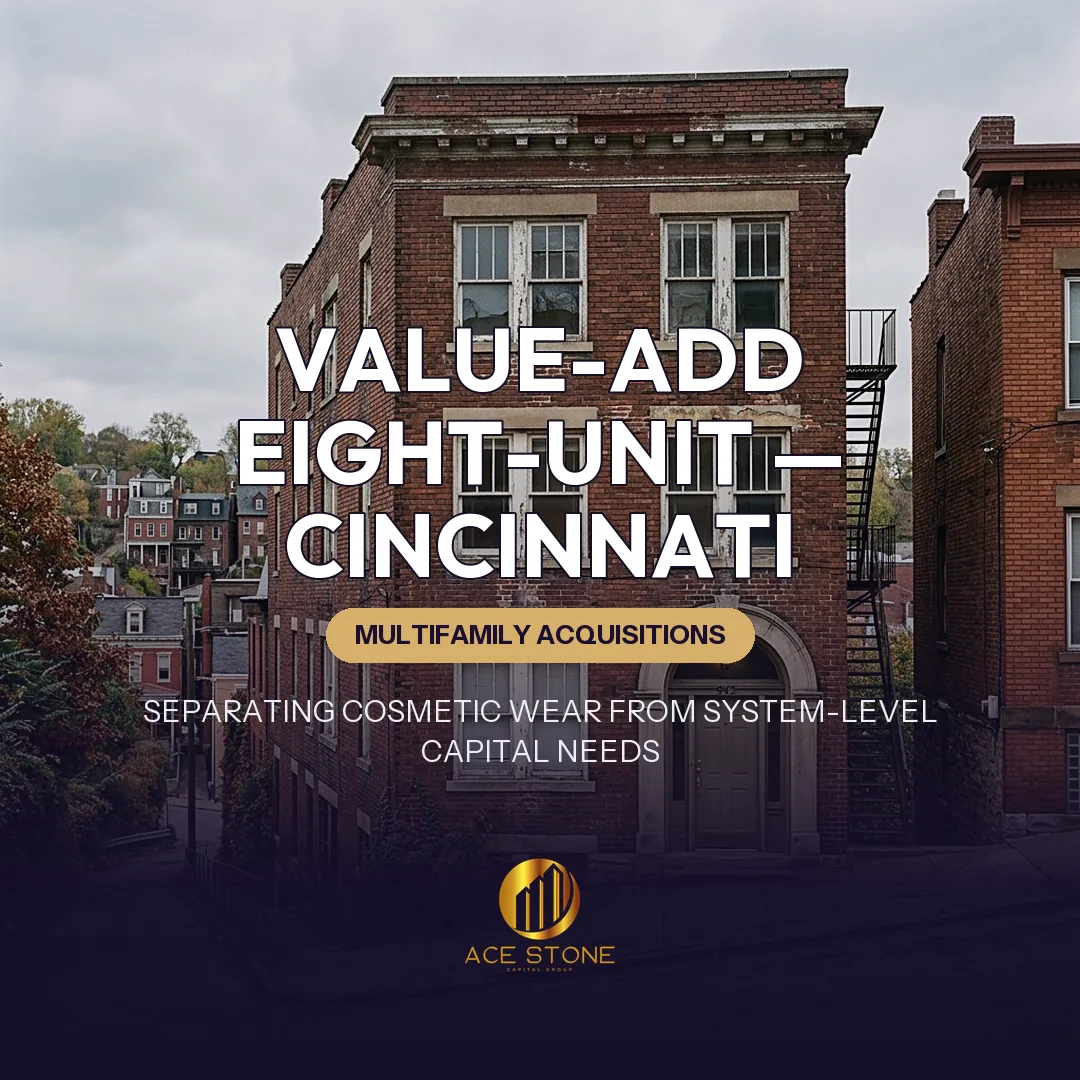
    Older brick apartment building with architectural character in Cincinnati.
    Representative imagery of the asset type and market — not a photograph of the subject property.

    Case Context

    This acquisition profile examines an eight-unit residential building in Cincinnati with visible deferred maintenance that made the asset appear more distressed than its operating history suggested. It sets out AceStone Capital Group's underwriting methodology; specific counterparties and pricing are not identified.

    Appearance Versus Economics

    Visible deterioration and economic impairment are different conditions that frequently occur separately. Peeling paint, worn common-area flooring and dated fixtures are legible from the sidewalk and cost comparatively little to correct. A failing sewer lateral, an undersized electrical service or a structurally compromised roof deck are invisible from the sidewalk and can consume the entire acquisition thesis. Pricing on appearance alone produces error in both directions.

    Applied exampleSee how this played out in Why Out-of-State Owners Sell to Direct Buyers — a residential acquisition in Multi-State.

    Inspection Logic

    Inspection is sequenced by consequence rather than by visibility. Structure, roof assembly, drainage, foundation, and the mechanical, electrical and plumbing systems are examined first, because they determine whether the acquisition is viable. Unit interiors and common areas are examined second, because they determine what the acquisition is worth once viability is established. Reversing that order produces a scope built around what was easiest to see.

    Building Systems Review

    Plumbing review covers supply-line material, any remaining galvanized runs, waste-stack condition, and the sewer lateral, which in older Cincinnati stock is a recurring high-cost item. Electrical review covers service capacity, panel type, unit-level distribution and obsolete wiring. Roofing review addresses covering, deck condition, flashing and drainage. Mechanical review ages each heating unit and water heater individually. Masonry and tuckpointing condition are assessed on a building of this vintage as a capital item, not a cosmetic one.

    Applied exampleSee how this played out in Why Infill Lots Are Outperforming in Growth Corridors — a residential acquisition in U.S. Growth Markets.

    Cosmetic Scope

    Cosmetic work — paint, flooring, fixtures, cabinetry refresh, common-area lighting, landscaping and exterior cleanup — is scoped separately and priced separately. It is the portion of the work that reliably converts into rent, which makes it the productive part of a value-add program and also the part most likely to be over-credited if it is confused with system work.

    Unit Interiors and Common Areas

    Each unit interior is graded individually for finish level, kitchen and bath condition, window condition, and evidence of moisture. Common areas are graded for entry condition, stair and railing safety, lighting, laundry equipment and basement condition. The grades produce a per-unit scope rather than a building-level allowance, which is what allows renovation cost to be tied to specific achievable rents.

    Applied exampleSee how this played out in The Migration Effect: How Population Shifts Drive Lot Demand — a residential acquisition in U.S. Growth Markets.

    Existing Rents and Vacancy

    In-place rents, collections and vacancy are examined against the physical grades. Where a low rent corresponds to a low finish grade, capital is required to close it. Where a low rent corresponds to a sound unit, the gap is a management issue closable at renewal. Persistent vacancy in a specific unit is investigated as a physical or configuration problem rather than absorbed into a building-level vacancy factor.

    Condition-Adjusted Underwriting

    Capital estimates are split into work required to preserve habitability and system integrity, work that generates rent, and work that can be reserved and sequenced. Only the first two are deducted from basis at closing. Rent credit is granted exclusively for the second category and only at the level supported by leased comparables at the corresponding finish grade.

    Acquisition Economics

    Basis is stabilized income net of normalized expenses, less the mandatory system schedule, less the rent-generating renovation cost, less carry across the execution period. If the system schedule alone consumes the spread between as-is value and stabilized value, the asset does not clear regardless of how attractive the cosmetic upside appears. That test is applied before any renovation credit is considered.

    Risk Factors

    The material risks are sewer lateral or waste-stack failure discovered after closing, electrical service requiring upgrade to support unit improvements, masonry work expanding once staging is in place, roof deck deterioration beneath an apparently serviceable covering, post-transfer tax reassessment, and renovation rent premiums not materializing at the assumed level.

    Key Takeaway

    The discipline in value-add multifamily is separating manageable cosmetic work from capital requirements capable of undermining the thesis. A building that looks distressed and operates soundly can be an opportunity; a building that shows well and hides a system failure is not. Owners of comparable assets can review parameters on the multifamily acquisitions desk.

    Conclusion

    Condition-adjusted underwriting prices what the building requires, not what it looks like. The framework above reflects AceStone Capital Group's underwriting posture on assets of this profile.

    What This Case Shows

    A structured example of how AceStone Capital Group sources, underwrites, and structures off-market residential acquisitions in Cincinnati, OH. For broader context, see our active acquisition markets or initiate a direct-sale review for a similar property.

    Have a Property to Sell?

    Receive a written offer or a clear pass within 1–2 business days.

    Request a Cash Offer