
Back
    Residential Raleigh, NC July 2026

    Multifamily Acquisition: Owner-Managed Seven-Unit Property, Raleigh

    An acquisition profile examining a Raleigh seven-unit property operated directly by its owner for years, with fragmented records and several month-to-month tenancies.

    This acquisition profile examines asset strategy, underwriting method, transaction structure, and value-creation considerations. Counterparty and pricing details are not disclosed.

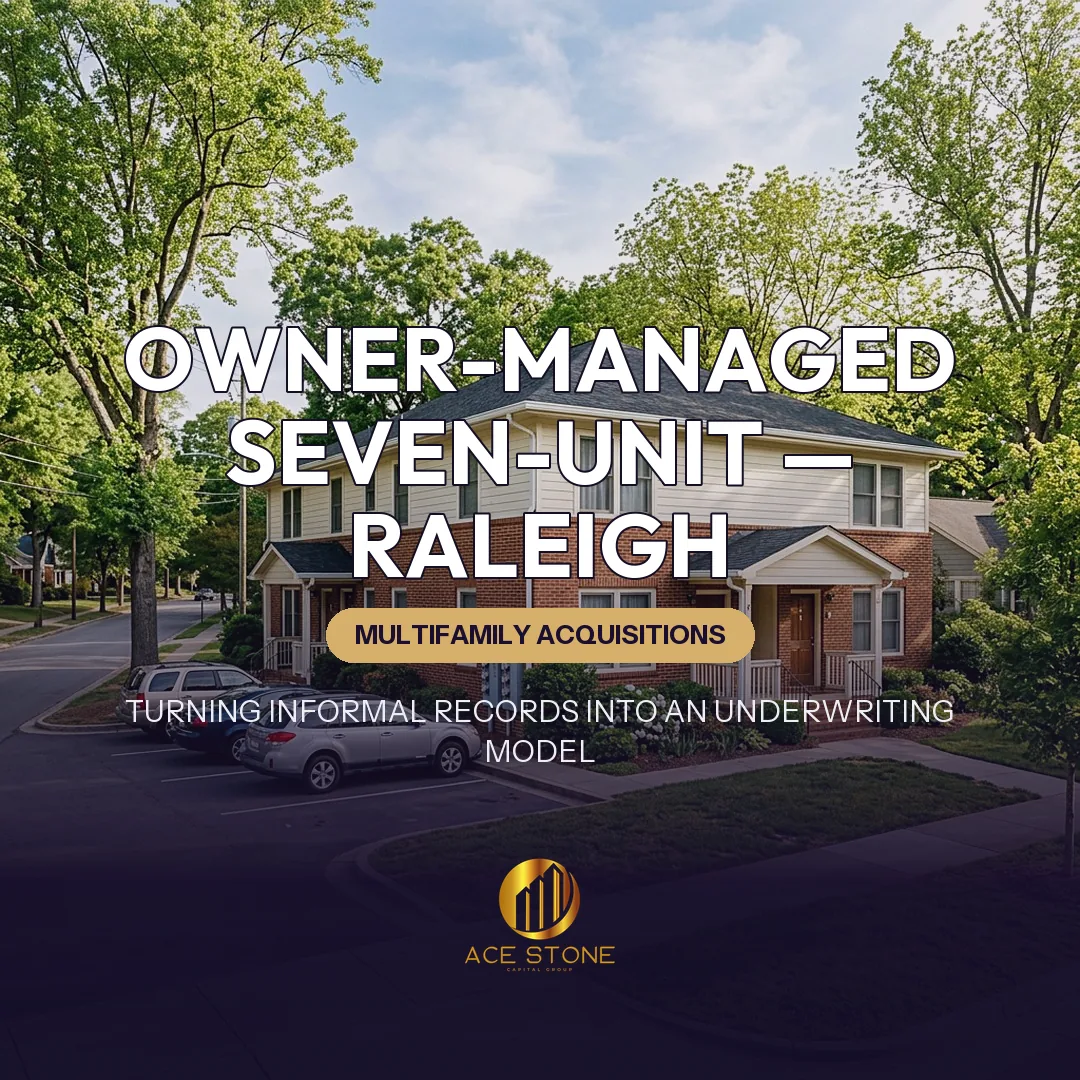
    Mature seven-unit apartment property on a tree-lined Raleigh street.
    Representative imagery of the asset type and market — not a photograph of the subject property.

    Case Context

    This acquisition profile examines a seven-unit residential property in Raleigh operated directly by the same owner for many years, with limited formal reporting and several month-to-month tenancies. It sets out AceStone Capital Group's underwriting methodology; specific counterparties and pricing are not identified.

    Owner-Managed Operations

    Direct owner management produces a recognizable profile: stable tenants, low reported expenses, informal repairs, personally performed labor, and records kept in a form useful to the owner but not to a buyer. None of this indicates a poorly run building. It indicates that the operating history exists primarily as behavior rather than as documentation, and must be converted before it can be underwritten.

    Applied exampleSee how this played out in Why Infill Lots Are Outperforming in Growth Corridors — a residential acquisition in U.S. Growth Markets.

    Record Assembly

    The first task is assembling what exists: leases where written, notes or ledgers where not, bank deposit patterns, tax bills, utility statements, insurance declarations and any repair invoices retained. The second task is establishing what each document proves. A deposit record proves collection. A tax bill proves assessment. A note in a ledger proves intent, not payment, and is treated accordingly.

    Month-to-Month Tenancies

    Month-to-month occupancy is neither an asset nor a liability by default. It offers flexibility to reset rents on statutory notice and simultaneously offers the tenant flexibility to leave. Each tenancy is characterized by tenure, payment record, rent level relative to market, and deposit status. A long-tenured month-to-month tenant paying reliably below market presents a retention decision, not merely a repricing opportunity.

    Applied exampleSee how this played out in The Migration Effect: How Population Shifts Drive Lot Demand — a residential acquisition in U.S. Growth Markets.

    Occupancy and Collections

    Occupancy is verified by unit rather than accepted as a percentage, and income is established from collections rather than from stated rent. Where the seller cannot produce a payment ledger, estoppel confirmation with occupants and deposit-pattern analysis substitute. Uncorroborated income is excluded from the underwritten figure rather than discounted.

    Expense Normalization

    Owner-managed expense records almost always omit the owner's own labor and management. Normalization adds market management, a maintenance and turnover allowance appropriate to unit age, per-unit reserves, common-area utilities and services, re-quoted insurance, and property tax re-underwritten on a post-transfer basis. The normalized expense ratio, not the reported one, is what the building will carry under new ownership.

    Applied exampleSee how this played out in Path-of-Growth Markets: Where Land Appreciation Starts Early — a residential acquisition in U.S. Growth Markets.

    Property Condition and Maintenance History

    Physical review substitutes for the missing maintenance record: roof and drainage, siding and trim condition in a humid climate, crawlspace or foundation moisture, HVAC equipment age by unit, water heaters, electrical service and panels, plumbing supply material, and interior condition at units that have not turned recently. Where a repair is claimed but undocumented, it is verified physically or excluded from the condition assumption.

    Building the Underwriting Model

    The model carries three layers: corroborated current income, normalized expenses, and a scheduled reversion to documented market rents governed by notice periods and expected retention. Capital items are attached to the units and systems that require them rather than pooled. The output is a defensible operating picture that a lender, a partner or an auditor could follow from source documents.

    Acquisition Parameters

    Structure fits the seller's position: an as-is purchase with tenants in place, no requirement to formalize leases or perform repairs before closing, a defined diligence window in which verification occurs, and a fixed closing date. Deposit reconciliation and tenancy documentation are handled as closing mechanics rather than as seller obligations.

    Risk Factors

    Principal risks are undocumented tenancy terms and deposits, simultaneous departures among month-to-month occupants after a rent reset, deferred maintenance concealed by long tenancies, expense normalization proving insufficient, post-transfer tax reassessment, and rent assumptions exposed to new supply in an active Raleigh submarket.

    Key Takeaway

    Informal owner-level information can be converted into an organized underwriting model, provided every income and expense line traces to primary evidence and every uncorroborated item is treated as risk rather than as value. Owners of comparable assets can review parameters on the multifamily acquisitions desk.

    Conclusion

    The transition from owner management to institutional operation is an underwriting exercise before it is an operational one. The framework above reflects AceStone Capital Group's underwriting posture on assets of this profile.

    What This Case Shows

    A structured example of how AceStone Capital Group sources, underwrites, and structures off-market residential acquisitions in Raleigh, NC. For broader context, see our active acquisition markets or initiate a direct-sale review for a similar property.

    Have a Property to Sell?

    Receive a written offer or a clear pass within 1–2 business days.

    Request a Cash Offer