
Back
    Residential Charlotte, NC April 2026

    Mixed-Occupancy Portfolio Acquisition: Stabilized and Vacant Homes in Charlotte

    A modelled Charlotte analysis of a rental portfolio combining leased, vacant, month-to-month and turnover-stage homes within a single acquisition.

    This acquisition profile examines asset strategy, underwriting method, transaction structure, and value-creation considerations. Counterparty and pricing details are not disclosed.

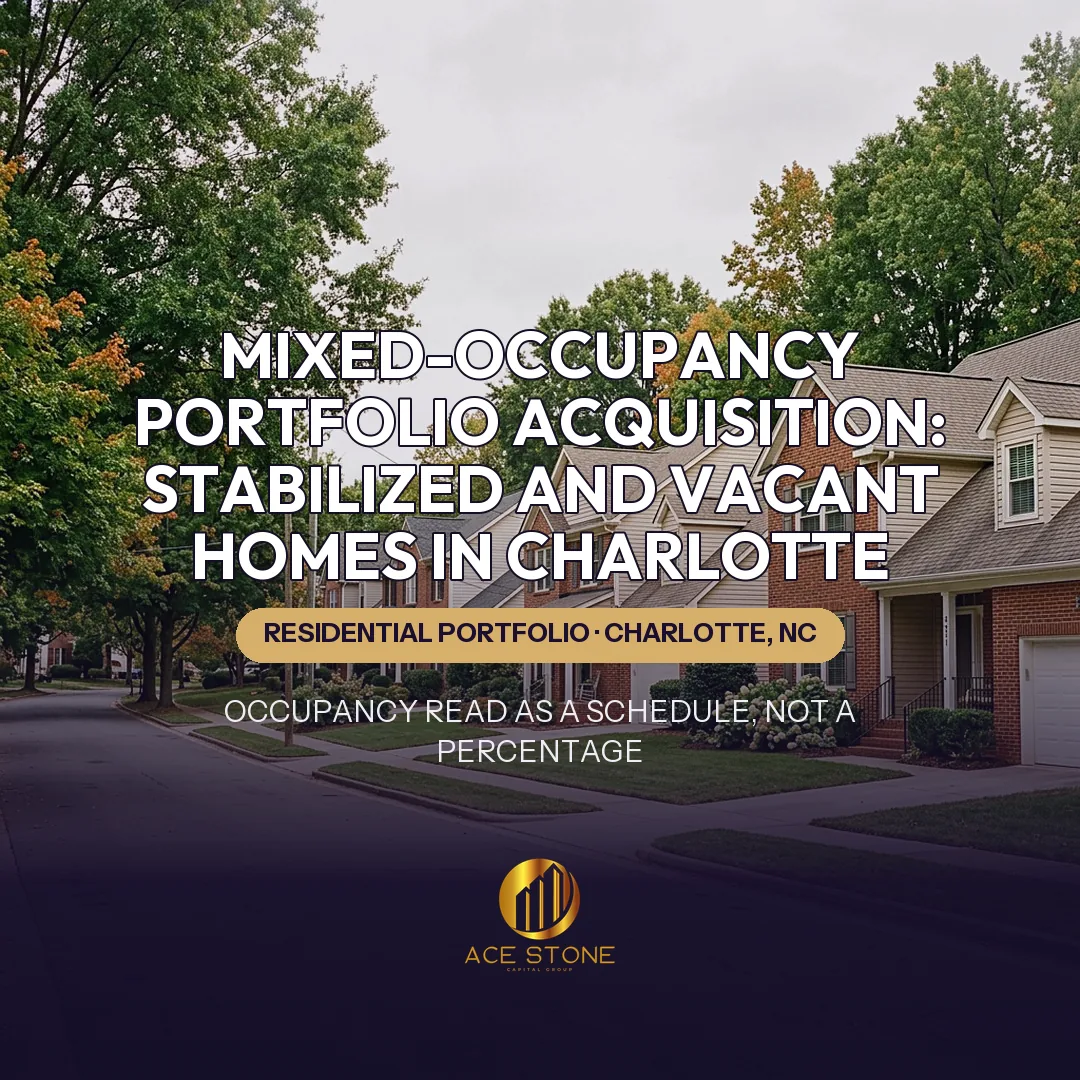
    Charlotte residential street lined with similar single-family rental homes.
    Representative imagery of the asset type and market — not a photograph of the subject property.

    Case Context

    This acquisition profile examines a Charlotte-area rental portfolio containing stabilized leased homes, vacant homes, month-to-month tenancies, and properties requiring turnover work. It sets out AceStone Capital Group's underwriting methodology. Specific properties, counterparties, and pricing are not identified.

    Occupancy States as Distinct Economic Positions

    Each occupancy state carries a different near-term cash-flow profile. A stabilized home under a term lease at market rent produces immediate, predictable revenue. A month-to-month tenancy produces revenue with elevated turnover probability. A vacant home produces no revenue and consumes carry until leased. A home mid-turn consumes both carry and capital. Treating all four as one blended occupancy percentage conceals the actual cash-flow shape of the portfolio.

    Applied exampleSee how this played out in New-Construction Duplex Acquisition: Growth-Corridor Delivery, Charlotte — a residential acquisition in Charlotte, NC.

    Lease Schedule Analysis

    Underwriting builds a lease expiration schedule across the entire portfolio and tests it for clustering. Where several leases expire in the same quarter — particularly outside Charlotte's peak leasing season — the portfolio carries a concentrated turnover event that must be reflected in vacancy loss, leasing cost, and renewal-concession assumptions.

    Turnover Economics

    Turnover cost is modeled per home: make-ready scope and duration, marketing period, leasing commission or in-house cost, concession levels prevailing in the submarket, utility and lawn carry during vacancy, and the risk of a second turn if the new tenancy is short. Retention economics are modeled alongside, since a modest renewal increase accepted from a paying tenant frequently outperforms a market-rate re-lease after a full turn.

    Applied exampleSee how this played out in Occupied Multifamily Acquisition: Five-Unit Property, Charlotte — a residential acquisition in Charlotte, NC.

    Effect on Acquisition Basis

    Basis is constructed by valuing each home at its stabilized level and then deducting the specific cost and time required to bring that home to stabilization. A vacant home is not worth a stabilized home less a generic vacancy allowance; it is worth the stabilized value less scoped work, carry, leasing cost, and the time value of the delay.

    Risks Identified

    Risks include a longer-than-modeled lease-up in a competitive submarket, tenant-quality issues inherited with in-place leases, make-ready scope discovered only after possession, deposit and estoppel discrepancies, and clustered expirations that convert into simultaneous vacancy.

    Applied exampleSee how this played out in Selling an Inherited Property in Florida — a residential acquisition in Florida.

    Execution Considerations

    A mixed-occupancy portfolio benefits from sequencing: stabilized assets close and transition to management immediately, while vacant and mid-turn assets enter a defined work program from day one. Access coordination with occupied units is scheduled to a single visit per home wherever practicable.

    Key Takeaway

    Portfolio occupancy cannot be treated as one blended percentage without understanding the economic position of every home. Occupancy is a schedule, not a statistic.

    Conclusion

    Mixed-occupancy portfolios are underwritten one lease at a time. This analysis reflects that method.

    What This Case Shows

    A structured example of how AceStone Capital Group sources, underwrites, and structures off-market residential acquisitions in Charlotte, NC. For broader context, see our active acquisition markets or initiate a direct-sale review for a similar property.

    Have a Property to Sell?

    Receive a written offer or a clear pass within 1–2 business days.

    Request a Cash Offer