
Case Context
This acquisition profile examines twelve rental homes located within a single Atlanta submarket. It sets out AceStone Capital Group's underwriting methodology. Specific properties, counterparties, and pricing are not identified.
A analysis of twelve rental homes clustered in a single Atlanta submarket, weighing operating density against concentrated demand exposure.
This acquisition profile examines asset strategy, underwriting method, transaction structure, and value-creation considerations. Counterparty and pricing details are not disclosed.
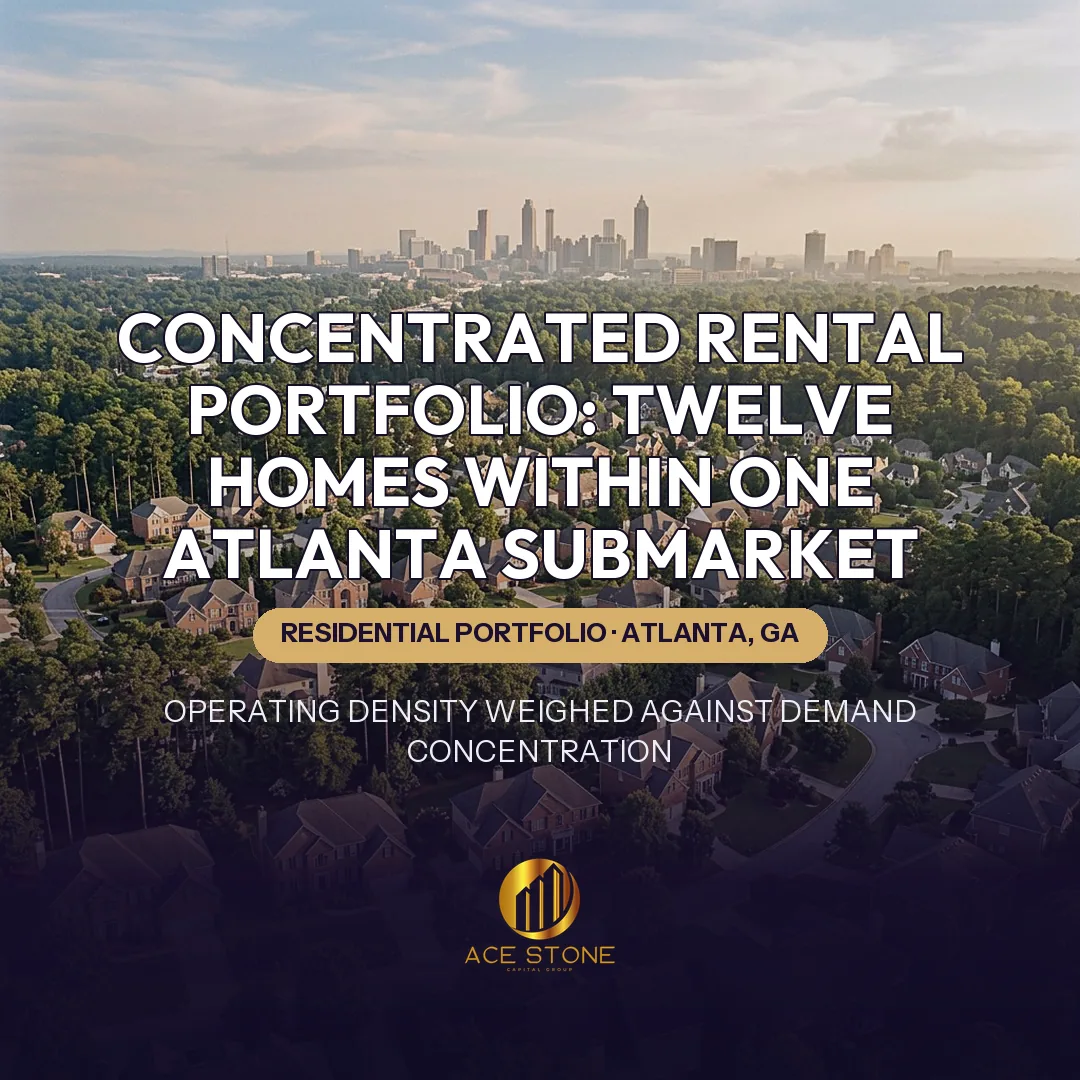
This acquisition profile examines twelve rental homes located within a single Atlanta submarket. It sets out AceStone Capital Group's underwriting methodology. Specific properties, counterparties, and pricing are not identified.
A concentrated cluster is not simply twelve homes; it is a single demand thesis expressed twelve times. Every asset shares the same employment catchment, the same school assignment, the same permitting authority, the same insurance profile, and the same competitive supply. Underwriting therefore spends proportionally more effort on the submarket and less on reconciling asset-to-asset differences.
Applied exampleSee how this played out in Why Infill Lots Are Outperforming in Growth Corridors — a residential acquisition in U.S. Growth Markets.
Demand work covers household formation and in-migration at the ZIP and tract level, employer composition and whether the catchment depends on a small number of large employers, commute geometry relative to the metro's employment nodes, school assignment quality as a driver of family tenancy length, and the depth of competing rental supply including recently delivered product.
Twelve homes inside one submarket support real efficiency: a single management route, shorter maintenance response times, vendor pricing leverage, faster showings and lower days-on-market through cross-referral between units, and reliable internal comparables for setting renewal rents. Turn costs typically compress because scopes and materials repeat.
Applied exampleSee how this played out in The Migration Effect: How Population Shifts Drive Lot Demand — a residential acquisition in U.S. Growth Markets.
Despite geographic similarity, each home is underwritten individually for vintage, floor plan, lot orientation, condition, roof and mechanical age, and lease position. Within a single Atlanta submarket, homes built across different decades can carry meaningfully different capital profiles and rent bands even on adjacent streets.
The mirror image of efficiency is exposure. A single large employer relocation, a school reassignment, a change in local rental regulation, a supply wave from a nearby build-to-rent delivery, or a localized insurance event affects all twelve assets simultaneously. Concentration is priced by requiring a wider margin of safety on basis rather than by assuming diversification benefits that do not exist.
Applied exampleSee how this played out in Path-of-Growth Markets: Where Land Appreciation Starts Early — a residential acquisition in U.S. Growth Markets.
Concentrated clusters can be sold as a single operating unit to a buyer seeking route density, which is a genuine liquidity advantage. That same cluster, however, is exposed to a narrower buyer set if the submarket falls out of favor. Both conditions are modeled rather than assumed.
Concentration can improve operating efficiency while simultaneously increasing exposure to one local demand profile. The correct response is not to avoid density but to price it explicitly.
Density is an operating asset and a risk position at the same time. This profile illustrates how both are underwritten.
What This Case Shows
A structured example of how AceStone Capital Group sources, underwrites, and structures off-market residential acquisitions in Atlanta, GA. For broader context, see our active acquisition markets or initiate a direct-sale review for a similar property.
Receive a written offer or a clear pass within 1–2 business days.
Request a Cash OfferContinue Reading
Additional residential acquisitions structured through the same underwriting and closing framework.