
Case Context
This acquisition profile documents a decision not to proceed. It sets out AceStone Capital Group's underwriting methodology. Specific counterparties and pricing are not identified.
A disciplined acquisition-rejection analysis of a duplex presenting an attractive headline yield, and the diligence findings that made the basis unsupportable.
This acquisition profile examines asset strategy, underwriting method, transaction structure, and value-creation considerations. Counterparty and pricing details are not disclosed.
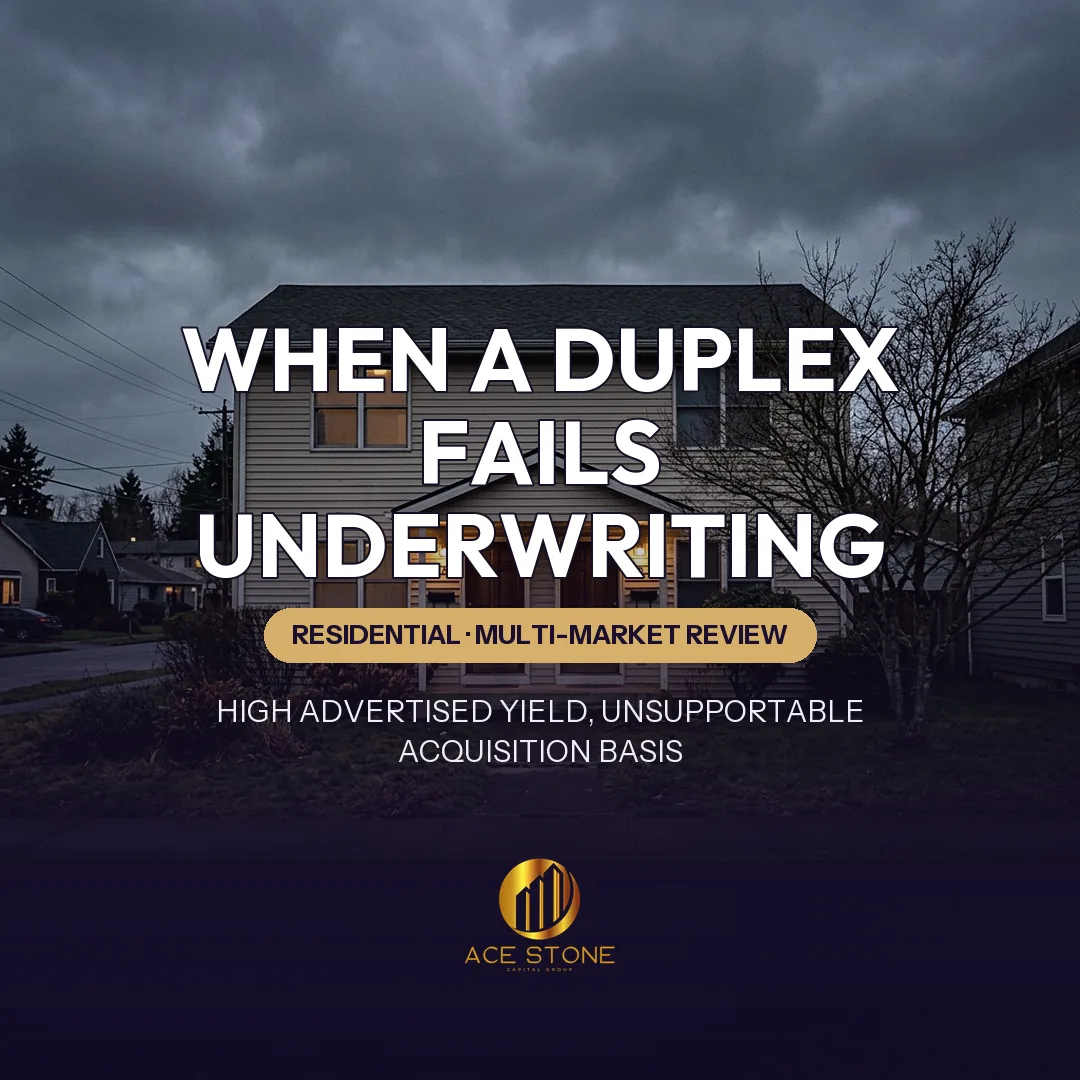
This acquisition profile documents a decision not to proceed. It sets out AceStone Capital Group's underwriting methodology. Specific counterparties and pricing are not identified.
The opportunity presented well on its summary page: a fully occupied duplex, gross rents comfortably above the submarket average for the unit type, an advertised capitalization rate materially higher than competing two-unit product, and an apparent cash flow figure that survived a first-pass debt assumption. Opportunities that screen this favourably in an efficient small-asset market almost always contain an explanation, and the purpose of diligence is to find it before committing capital rather than after.
Applied exampleSee how this played out in Why Infill Lots Are Outperforming in Growth Corridors — a residential acquisition in U.S. Growth Markets.
The first finding was the gap between contractual rent and collected rent. Ledger review showed recurring partial payments, periodic arrears carried forward rather than cured, and concessions granted informally to retain occupancy. Effective rent — what the property actually collected over a trailing period — sat well below the scheduled rent the yield calculation had used. Recomputing the yield on collections rather than on the rent roll removed a substantial part of the headline advantage immediately.
Tenancy history showed short average tenure, repeated turnover in both units, and a pattern of lease terminations before natural expiration. High turnover in a two-unit building is disproportionately expensive: each turn carries make-ready cost, leasing time, and lost revenue against a base of only two income streams. The economic vacancy allowance required to model the property honestly was several times the figure implied by the seller's presentation.
Applied exampleSee how this played out in The Migration Effect: How Population Shifts Drive Lot Demand — a residential acquisition in U.S. Growth Markets.
Maintenance spend over the trailing period was elevated and recurring rather than episodic, indicating systems near end of life rather than isolated incidents. Insurance was re-quoted at a level well above the figure carried in the operating statement, reflecting both the building's claims posture and current market pricing for the property type. Neither adjustment was discretionary; both were required to state the expense load accurately.
Physical review identified a near-term capital schedule covering envelope and mechanical systems in both units. None of this was contingent or speculative; it was work with a defined timing window. Funding it from basis rather than from operations reduced the price the asset could support, and funding it from operations would have consumed the cash flow that made the opportunity attractive in the first place.
Applied exampleSee how this played out in Path-of-Growth Markets: Where Land Appreciation Starts Early — a residential acquisition in U.S. Growth Markets.
The sales evidence did not support the asking basis. Comparable two-unit transactions in the immediate area cleared below the level implied by the yield presentation, and the submarket showed weak fundamentals: flat or declining household formation, limited employment diversification, elevated days on market for both rental and for-sale product, and thin buyer depth at exit. A high yield in a market with poor liquidity is compensation for risk, not evidence of value.
Restating the analysis on effective rent, a realistic vacancy allowance, re-quoted insurance, observed maintenance, and a funded capital schedule produced a supportable basis substantially below the asking level. The gap was not a negotiating position; it was the difference between the yield the property advertised and the yield the underlying asset could actually deliver.
AceStone Capital Group would decline to proceed on this profile. The asset was not mispriced by a margin that disciplined negotiation could close, and the yield that made it attractive was a function of collection risk, turnover cost, capital deferral, and weak exit liquidity rather than of favourable pricing. No counter was warranted.
Headline yield does not compensate for a weak basis. A capitalization rate is only as reliable as the income and expense figures beneath it, and an asset in a market with limited buyer depth offers no recovery path if those figures prove optimistic.
Declining an opportunity is an underwriting outcome, not a failure of sourcing. The analysis above reflects AceStone Capital Group's rejection discipline and does not identify any specific party.
What This Case Shows
A structured example of how AceStone Capital Group sources, underwrites, and structures off-market residential acquisitions in Multi-Market Review. For broader context, see our active acquisition markets or initiate a direct-sale review for a similar property.
Receive a written offer or a clear pass within 1–2 business days.
Request a Cash OfferContinue Reading
Additional residential acquisitions structured through the same underwriting and closing framework.