
Back
    Residential Orlando, FL June 2026

    Portfolio vs. Individual Sales: Ten Rental Homes in Orlando

    A modelled comparison of transacting ten Orlando rental homes as one portfolio versus ten individual dispositions, and where the value difference arises.

    This acquisition profile examines asset strategy, underwriting method, transaction structure, and value-creation considerations. Counterparty and pricing details are not disclosed.

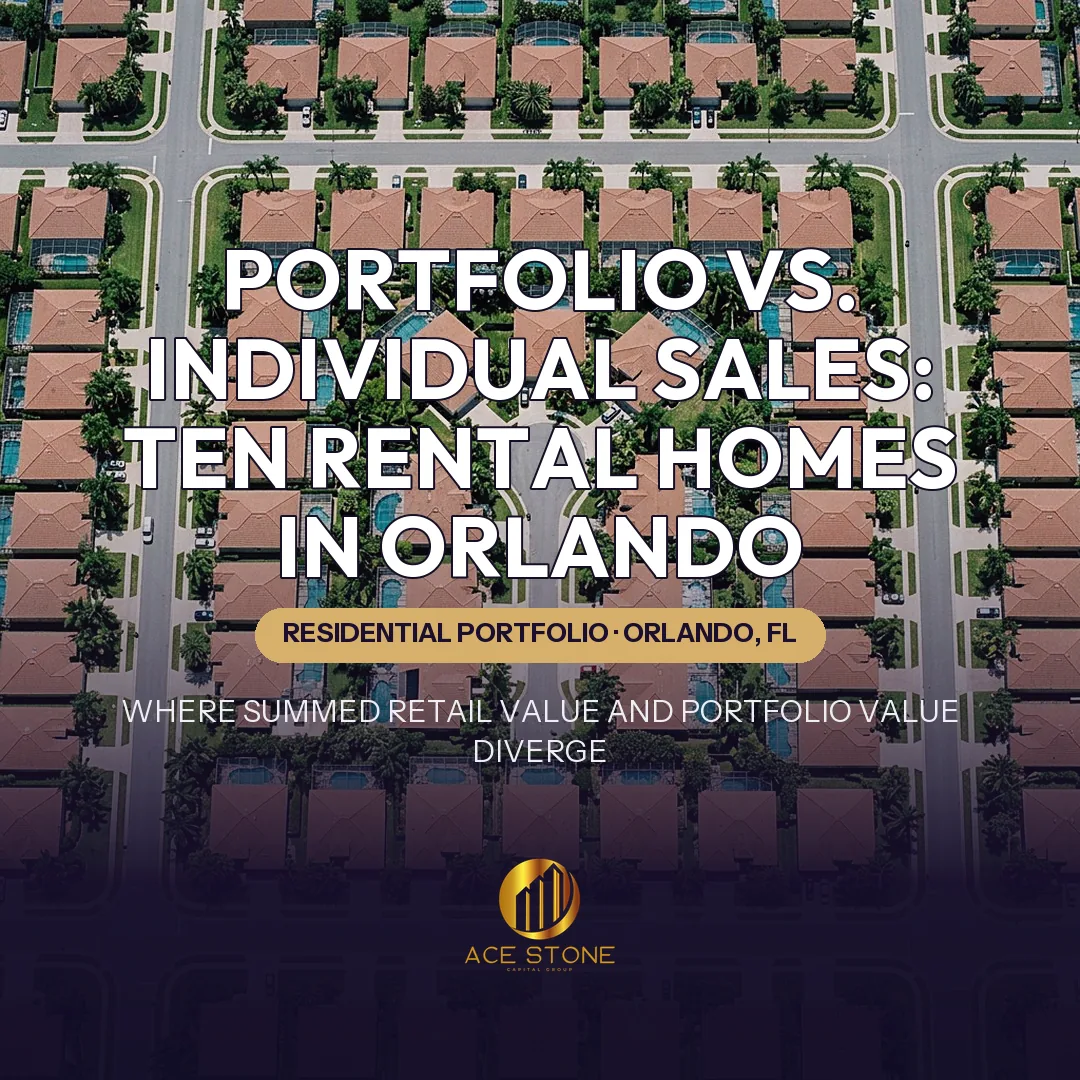
    Aerial grid view of Orlando-area suburban single-family homes.
    Representative imagery of the asset type and market — not a photograph of the subject property.

    Case Context

    This acquisition profile compares two execution paths for the same ten Orlando rental homes: a single portfolio transaction or ten separate individual sales. It sets out AceStone Capital Group's underwriting methodology. Specific counterparties and pricing are not identified.

    The Aggregation Question

    Owners frequently begin with the sum of individual retail values and treat that figure as the portfolio's worth. That arithmetic ignores the conditions attached to each retail value: vacant possession, marketing period, inspection and repair negotiation, financing contingencies, and a buyer universe of individual purchasers. Portfolio pricing reflects a different execution — one counterparty, one timeline, no vacancy requirement, and no serial negotiation.

    Applied exampleSee how this played out in Why Out-of-State Owners Sell to Direct Buyers — a residential acquisition in Multi-State.

    Buyer Universe and Liquidity

    Individual homes access the deepest buyer pool, including owner-occupants using conventional financing, but only when delivered vacant and in retail condition. Tenant-occupied homes are excluded from most owner-occupant demand. Portfolios access a narrower, more sophisticated buyer set that transacts with certainty and speed but underwrites to investment metrics rather than emotional value.

    Time, Carry and Friction

    Ten individual dispositions carry cumulative friction: sequential listing periods, ten inspection cycles, ten appraisal and financing risks, ten closing processes, and continuing taxes, insurance, management and maintenance across the full disposition window. Where homes must be delivered vacant, lost rent during the marketing period is a direct cost. Transaction costs on the retail path also include listing-side representation and negotiated concessions.

    Applied exampleSee how this played out in Why Infill Lots Are Outperforming in Growth Corridors — a residential acquisition in U.S. Growth Markets.

    Execution Complexity

    The retail path also concentrates operational burden on the seller: coordinating showings around tenants, staging turnover to match listing sequence, managing repair requests, and absorbing the risk that later sales occur into a weaker market than earlier ones. The portfolio path converts that variability into a single negotiated outcome.

    Where the Spread Comes From

    The gap between summed retail values and portfolio value is not arbitrary. It is composed of vacancy and turn cost, carry across the disposition period, transaction and representation costs, financing and appraisal fallout risk, market-timing risk across a longer window, and the certainty premium the seller receives for a single-event exit.

    Applied exampleSee how this played out in The Migration Effect: How Population Shifts Drive Lot Demand — a residential acquisition in U.S. Growth Markets.

    Key Decision Points

    The correct path depends on the owner's time horizon, tolerance for execution variance, willingness to deliver vacant possession, and whether the homes are individually retail-ready. Where several homes require work or carry tenancies, the theoretical retail advantage often erodes entirely.

    Key Takeaway

    Aggregate individual retail values do not automatically equal portfolio value. The two figures describe different transactions with different costs, timelines, and risk allocations.

    Conclusion

    Comparing execution paths honestly requires pricing time and risk, not only headline value. This analysis is modelled ; no specific transaction is described.

    What This Case Shows

    A structured example of how AceStone Capital Group sources, underwrites, and structures off-market residential acquisitions in Orlando, FL. For broader context, see our active acquisition markets or initiate a direct-sale review for a similar property.

    Have a Property to Sell?

    Receive a written offer or a clear pass within 1–2 business days.

    Request a Cash Offer