
Back
    Residential Northern New Jersey August 2026

    Transit-Oriented Mixed-Use Acquisition: Apartments and Retail Near a North Jersey Rail Station

    A North Jersey residential-over-retail asset within walking distance of Manhattan-bound rail — testing whether transit proximity justifies a more aggressive basis.

    This acquisition profile examines asset strategy, underwriting method, transaction structure, and value-creation considerations. Counterparty and pricing details are not disclosed.

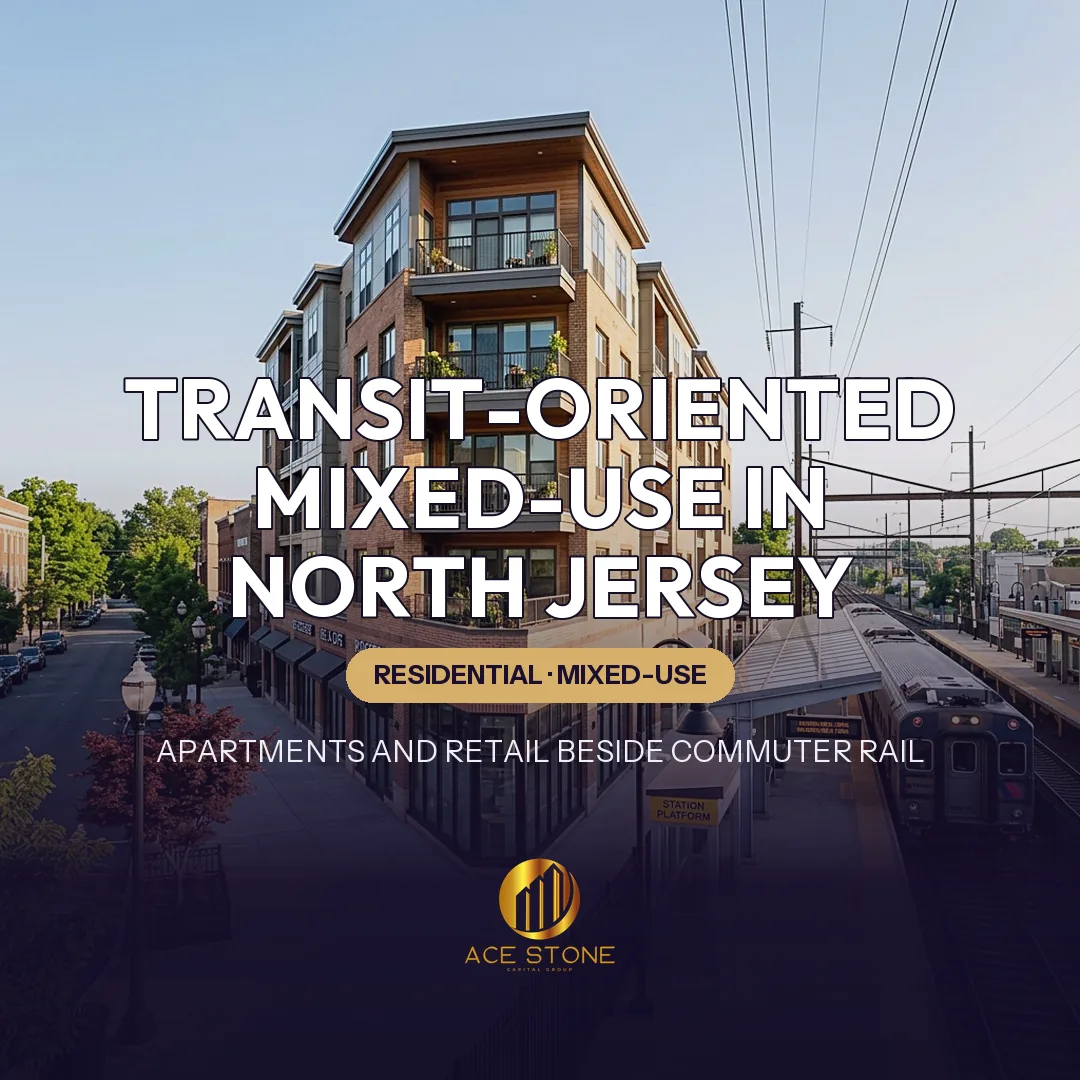
    Contemporary North Jersey residential-over-retail building beside a commuter rail station platform.
    Representative imagery of the asset type and market — not a photograph of the subject property.

    Executive Summary

    Transit proximity is the most consistently over-credited attribute in suburban mixed-use underwriting. It is real: walkable rail access to Manhattan supports a rent premium, shortens lease-up and broadens the renter base. It is also finite, priced into the land, and vulnerable to changes in commuting patterns. This acquisition profile quantifies the premium rather than assuming it, then asks whether the durable portion justifies a tighter going-in rate.

    Case Context

    Modelled analysis of a mid-size residential-over-retail property within a short walk of a commuter rail station. Specific properties, counterparties, and pricing are not identified.

    Applied exampleSee how this played out in Why Infill Lots Are Outperforming in Growth Corridors — a residential acquisition in U.S. Growth Markets.

    Measuring the Transit Premium

    The premium is measured as the observed rent spread between comparable units inside a defined walking radius of the station and comparable units beyond it, controlling for age, finish and unit size. The spread is then decomposed: part reflects genuine access, part reflects the broader downtown amenity base that clusters around stations. Only the access component is treated as durable, because amenity clusters can be replicated elsewhere in the submarket.

    Commuter Demographics

    The renter base skews toward households with one or two Manhattan-bound commuters and above-median incomes. That profile is credit-strong and mobility-sensitive: it responds quickly to changes in fare structure, schedule reliability, employer location policy and the relative pricing of city apartments. Underwriting assumes some erosion of the premium over a long hold rather than perpetual expansion.

    Applied exampleSee how this played out in The Migration Effect: How Population Shifts Drive Lot Demand — a residential acquisition in U.S. Growth Markets.

    Residential Occupancy and Rent Roll

    Occupancy in station-adjacent product is typically high with short marketing periods. The rent roll is examined for concession patterns, renewal trade-outs and the proportion of tenancies that have rolled month-to-month. Achievable rents are set against the controlled comparable set and reduced where the subject lacks in-unit laundry, elevator service, or dedicated parking.

    Parking Requirements

    Transit-oriented sites frequently carry reduced parking ratios by ordinance, which lowers construction and maintenance cost and constrains the tenant base to households with fewer vehicles. Where the ratio is below one space per unit, the model tests whether that is a market-accepted condition in the submarket or a source of persistent leasing friction. Municipal permit parking availability is checked directly rather than assumed.

    Applied exampleSee how this played out in Path-of-Growth Markets: Where Land Appreciation Starts Early — a residential acquisition in U.S. Growth Markets.

    Retail Component

    Station-adjacent retail benefits from commuter flow that is dense, brief and time-concentrated — favourable for coffee, quick food, pharmacy and personal services; unfavourable for uses requiring dwell time or destination parking. Leases are abstracted, and each expiration inside the hold carries downtime, an improvement allowance and a commission. Foot-traffic strength does not compress the commercial rate to the residential rate.

    Competing Supply

    Transit-oriented zoning overlays tend to attract multiple developers to the same station area. Permitted and under-construction projects within the walking radius are counted as direct competition, with delivery timing mapped against the hold period. A premium that depends on being the newest product near the station is not a premium; it is a lead time.

    Operating Expenses

    New Jersey property taxes are the dominant expense line and are restated on a post-sale assessment with attention to any abatement or PILOT structure — including its expiry date, which frequently sits inside a normal hold period and can materially reset net income. Insurance, common utilities, snow removal, elevator service, management and reserves complete the model.

    Acquisition Yield and Exit

    The going-in rate is set from residential income at the submarket apartment rate, adjusted modestly tighter only for the durable access component of the premium, with commercial income capitalized separately and wider. Exit is tested at a rate no tighter than entry, with any abatement assumed to have stepped down. Market liquidity for station-adjacent product is genuinely deep, which supports exit confidence — but liquidity is not the same as price appreciation.

    Key Takeaways

    Transit proximity justifies a somewhat tighter basis, not an aggressive one. Quantify the spread, discount the portion that reflects replicable amenities, model the tax reset, count the competing pipeline, and keep the retail on its own rate.

    What This Case Shows

    A structured example of how AceStone Capital Group sources, underwrites, and structures off-market residential acquisitions in Northern New Jersey. For broader context, see our active acquisition markets or initiate a direct-sale review for a similar property.

    Have a Property to Sell?

    Receive a written offer or a clear pass within 1–2 business days.

    Request a Cash Offer