From Industrial Plant to Data Center Campus: Underwriting a Brownfield Redevelopment
A Ohio heavy-industrial property with inherited transmission infrastructure and inherited environmental liabilities — weighing one against the other.
This acquisition profile examines asset strategy, underwriting method, transaction structure, and value-creation considerations. Counterparty and pricing details are not disclosed.
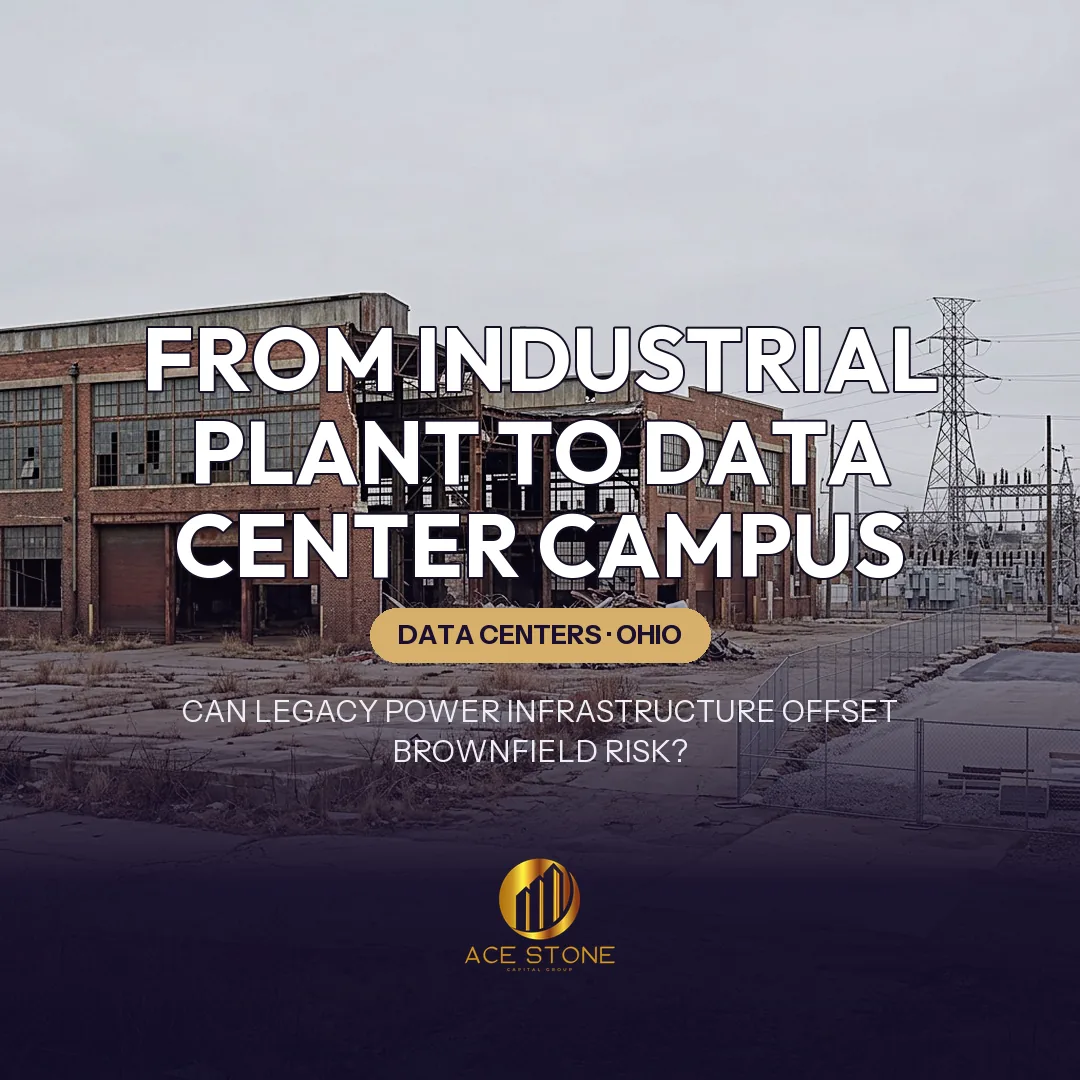
Representative imagery of the asset type and market — not a photograph of the subject property.
Case Context
This acquisition profile examines AceStone Capital Group's underwriting method for an asset of this type. Specific properties, counterparties, and pricing are not identified. The subject profile is a former heavy-industrial Ohio facility on substantial acreage whose original operations required unusually large electrical service. Sites of this type are increasingly examined for data-center reuse on the premise that inherited power infrastructure shortens the hardest part of the development path. The analysis tests whether that premise survives the cost of the liabilities that come with it.
The Inherited Electrical Position
The first task is establishing what electrical infrastructure actually exists and what of it remains usable. The analysis records transmission lines serving the property, on-site substation equipment with its voltage class, age, condition and remaining capacity, the historical peak demand of the prior operation, the current status of any service agreement, and whether the utility considers the historical capacity available to a new user or released back to the system. Historical load and available load are different quantities, and the difference is often the entire basis of the thesis.
A retired plant's former demand is not a capacity entitlement. The analysis seeks written confirmation from the serving utility on what capacity can be made available to a new large load at this location, whether existing infrastructure can be reused or must be replaced, whether a study is required, what queue treatment applies, and what timeline results. Where the utility confirms substantial reusable capacity, the site holds genuine and scarce advantage. Where it does not, the substation on site is equipment of uncertain value and the parcel is an ordinary brownfield.
Condition of Legacy Infrastructure
Equipment installed decades ago and idle for years requires assessment rather than assumption. The analysis covers transformer age, condition and dielectric testing, switchgear obsolescence and parts availability, protection and control systems relative to current standards, grounding, the condition of duct banks and underground feeders, and whether the configuration matches the redundancy a data center requires. Refurbishment can be economical; replacement of obsolete medium-voltage equipment frequently is not, and the two outcomes differ by an order of magnitude in cost.
Heavy-industrial history requires environmental investigation proportionate to the operations conducted. The analysis provides for phased assessment, subsurface investigation where indicated, review of regulatory files and prior enforcement history, evaluation of soil and groundwater conditions, identification of hazardous materials in existing structures, and consideration of available liability-protection mechanisms and state voluntary cleanup frameworks. Remediation cost and, equally important, remediation schedule are carried as ranges, because both determine when construction can begin.
Demolition and Site Clearance
Legacy structures rarely suit data-center use. The analysis prices demolition of buildings and foundations, abatement of hazardous materials, removal of below-grade structures, tanks, pits and utility tunnels, salvage value of recoverable metals as an offset, and the disposal cost of materials that require special handling. Below-grade obstructions are the most common source of schedule and cost overrun on sites of this type, because they are discovered during construction rather than during diligence.
Decades of industrial use alter subsurface conditions. The analysis addresses fill of unknown origin and compaction, contaminated soils requiring management rather than ordinary earthwork, foundation design over disturbed ground, existing paving and slab removal, and the regrading required to create the flat, well-drained pads a campus needs. Stormwater design must also be brought to current standards, which on a legacy site with substantial existing impervious cover can require significant new detention capacity.
Zoning, Entitlement and Community Posture
Heavy-industrial zoning is generally permissive for data-center use, which removes a common obstacle. The analysis confirms permitted use, height and setback compliance, noise standards against generator testing, and any conditions attaching to the prior industrial approvals. Community posture toward the reuse of a closed plant is often favourable where the redevelopment restores tax base and removes a blighted structure, and that posture has practical value in the approval timeline.
Water, Sewer and Connectivity
Legacy industrial sites frequently retain water and sewer service sized for the former operation, which can support a cooling strategy that a greenfield parcel could not. The analysis verifies capacity, condition and current availability of those services, and separately confirms fiber: carrier presence, physically diverse route availability and lateral cost. Industrial districts are often single-carrier environments, so connectivity is assessed independently of the power advantage rather than assumed to follow it.
Infrastructure Value Against Liability Cost
The central comparison sets the quantified value of inherited advantages — confirmed reusable capacity, time saved against a utility queue, existing substation equipment with remaining life, water and sewer capacity, permissive zoning and existing road access — against the quantified cost of inherited liabilities: remediation, demolition, abatement, geotechnical remediation, stormwater upgrades, equipment replacement and the schedule those items consume. Both sides are expressed in dollars and months, and the comparison is made against the greenfield alternative rather than in the abstract.
Scenario Analysis
Three scenarios are modelled. In the favourable case the utility confirms substantial reusable capacity, contamination is localised and manageable under a state programme, and demolition proceeds without major below-grade surprises; the site outperforms greenfield on both cost and schedule. In the base case capacity is partially reusable and remediation is moderate; the advantage narrows to a modest schedule benefit. In the adverse case capacity must be re-studied like any new request and remediation is extensive; the site is worth less than raw land because the buyer inherits obligations without the offsetting benefit.
Structuring and Risk Allocation
Structure carries more weight here than in most acquisitions. Useful mechanisms include an extended diligence period covering subsurface investigation, closing conditioned on written utility confirmation and on regulatory acceptance of a remediation approach, environmental insurance where available, indemnities from a creditworthy seller, holdbacks against remediation cost, and enrolment in a state voluntary cleanup programme prior to closing. Where the seller cannot provide meaningful protection, the price must absorb the full adverse scenario.
Exit Optionality
Alternative outcomes include redevelopment as industrial or logistics space once remediated and cleared, sale of the remediated and powered site to another developer, or partial disposition retaining the acreage nearest the substation. A remediated, cleared, powered industrial site is a liquid asset in most Ohio markets even if the data-center programme never advances, and that liquidity is a meaningful component of the downside case.
Key Takeaways
Legacy power infrastructure can be worth a great deal, but only when the utility confirms it is available to a new user and the equipment is genuinely reusable. The disciplined question is not whether the site has impressive infrastructure but whether that infrastructure is worth more, in dollars and in months, than the environmental, demolition and geotechnical liabilities attached to it. Frequently it is not, and the analysis should be capable of reaching that conclusion.
What This Case Shows
A structured example of how AceStone Capital Group sources, underwrites, and structures off-market commercial acquisitions in Ohio. For broader context, see our active acquisition markets or initiate a direct-sale review for a similar property.
Have a Property to Sell?
Receive a written offer or a clear pass within 1–2 business days.