Fiber as Real Estate Infrastructure: Underwriting a Chicago Data Center Site
A Chicago-area site where connectivity, not power, determines value — the difference between fiber being nearby and diverse, economically deliverable routes existing.
This acquisition profile examines asset strategy, underwriting method, transaction structure, and value-creation considerations. Counterparty and pricing details are not disclosed.
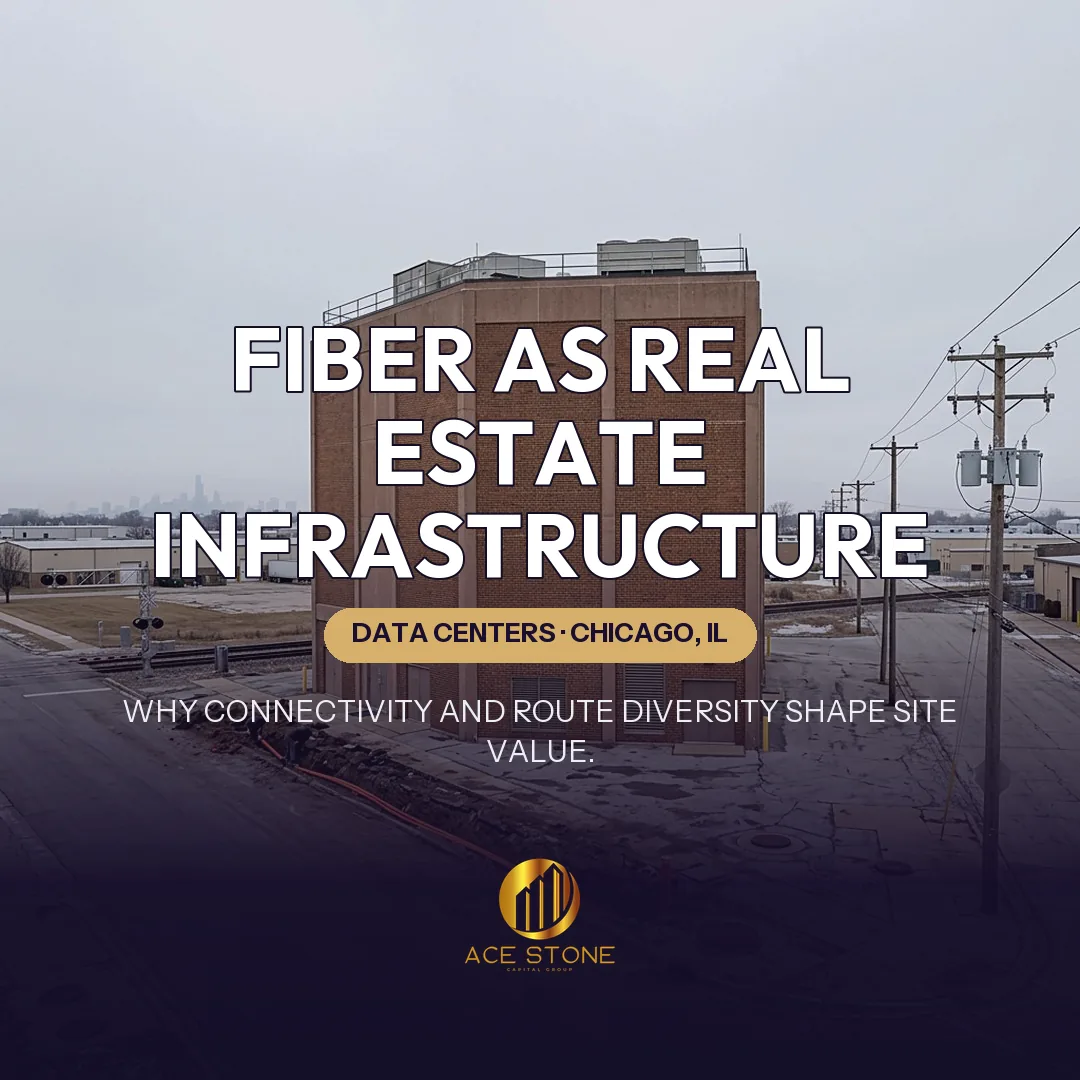
Representative imagery of the asset type and market — not a photograph of the subject property.
Case Context
This acquisition profile examines AceStone Capital Group's underwriting method for an asset of this type. Specific properties, counterparties, and pricing are not identified. The subject profile is a Chicago-area industrial parcel offered for data-center development with the observation that fiber runs along the frontage road. That statement is true of a great many parcels and tells an underwriter very little. The analysis converts connectivity from a marketing claim into a costed, verified piece of infrastructure.
Chicago as a Network Market
Chicago's value in this asset class rests substantially on its position as a major interconnection market with dense long-haul and metro fiber infrastructure and significant carrier presence. That density is a genuine advantage, and it is also the reason connectivity claims in the market are made loosely. Being in a well-connected metropolitan area does not mean a specific parcel has economically deliverable, physically diverse connectivity, and the distinction is where site value is actually determined.
Fiber in the street may be a long-haul cable with no available splice point, a carrier's dedicated route with no willingness to serve a new building, a cable at full capacity, or plant whose owner will quote a lateral at a cost that exceeds the land price. The analysis asks four questions of each identified route: who owns the plant, is there available capacity, will the owner serve this building, and at what cost and on what schedule. A route that fails any of the four is not connectivity; it is a cable that happens to be nearby.
Carrier Availability and Willingness
The analysis inventories carriers with plant within practical build distance, distinguishing long-haul, metro and dark-fiber providers, and records what each has indicated about serving the site, at what construction contribution, and on what timeline. Occupant requirements vary: some require multiple named carriers, others require dark fiber to specific interconnection points, and others require only redundant transport. The site is underwritten against the requirement of the occupant profile the development actually targets, not against a generic standard.
True diversity means two paths that share no conduit bank, no bridge crossing, no railroad undercrossing and no common manhole. The analysis traces each proposed route on a map and physically, looking for the pinch points where nominally diverse routes converge: a single bridge over a waterway, a single crossing under a rail corridor, a shared duct along a constrained arterial. Two circuits that share one physical crossing constitute one route with two invoices, and they should be underwritten as a single point of failure.
Route Construction, Easements and Cost
Constructing a lateral is a real-estate exercise as much as a telecommunications one. The analysis prices trenching and boring by surface type, railroad and highway crossing permits with their characteristic durations, easements across intervening private parcels and the negotiation risk each represents, municipal permitting, conduit and vault installation, and restoration. Long laterals across multiple ownerships regularly cost more and take longer than the buyer's initial estimate, and the easement negotiations are frequently the schedule driver rather than the construction itself.
Distance to major interconnection points affects the occupant pool. Latency-sensitive workloads narrow the acceptable radius considerably, while workloads tolerant of a few additional milliseconds open a far wider geography with cheaper land and often easier power. The analysis positions the site within that spectrum honestly and prices it against the occupant set it can realistically serve, rather than against the premium interconnection tier its metropolitan address might suggest.
Building Entry and Meet-Me Design
Diversity must be preserved into and inside the building. The analysis reviews the number and separation of entry points, the pathways from the property line to the meet-me room, the meet-me room's placement, size, power and cooling, and the internal riser and pathway separation. Two diverse routes entering through one conduit at one wall penetration reduce to a single failure point at the last hundred feet, which is a common and expensive design oversight.
Power and Land Fundamentals
Connectivity is analysed alongside the other dependencies rather than in isolation: available electrical capacity and the substation path, usable acreage after easements and stormwater, zoning and permitted use, noise standards, water and sewer availability for the cooling strategy, and site development cost. The purpose of the exercise is to identify which dependency binds. On this profile, power is workable and connectivity is the variable that decides both feasibility and price.
How Connectivity Reprices the Site
The analysis models the land value under three connectivity outcomes: two genuinely diverse routes deliverable at modest cost, two routes deliverable only with substantial lateral construction and easement acquisition, and effectively single-path connectivity. The first supports full development pricing; the second reduces value by the construction cost plus a schedule and easement-risk allowance; the third eliminates the data-center thesis for most occupants and returns the parcel to industrial pricing. The spread across those outcomes is wide enough to determine whether the acquisition happens.
Risks
Principal risks include carrier quotes expiring or repricing, easement negotiations with intervening owners failing or extending, railroad and highway crossing permits taking longer than modelled, apparent diversity collapsing at a shared physical crossing on closer inspection, and construction cost escalation on long laterals. Written carrier indications and a physically traced route map are diligence conditions, not optional refinements.
Exit Optionality
Where connectivity underwriting fails, the parcel remains an industrial site in a deep Chicago logistics market, and that alternative value sets the floor. Where it succeeds, the constructed diverse routes become a durable improvement that benefits any future owner and is a defensible component of the site's value on resale.
Key Takeaways
Fiber is infrastructure with an owner, a capacity limit, a price and a physical path, and it should be underwritten with the same rigour applied to electrical capacity. The relevant test is not whether fiber is nearby but whether diverse, economically deliverable connectivity can be constructed to and into the building on the development schedule. A site that fails that test is not a discounted data-center site; it is industrial land.
What This Case Shows
A structured example of how AceStone Capital Group sources, underwrites, and structures off-market commercial acquisitions in Chicago, IL. For broader context, see our active acquisition markets or initiate a direct-sale review for a similar property.
Have a Property to Sell?
Receive a written offer or a clear pass within 1–2 business days.