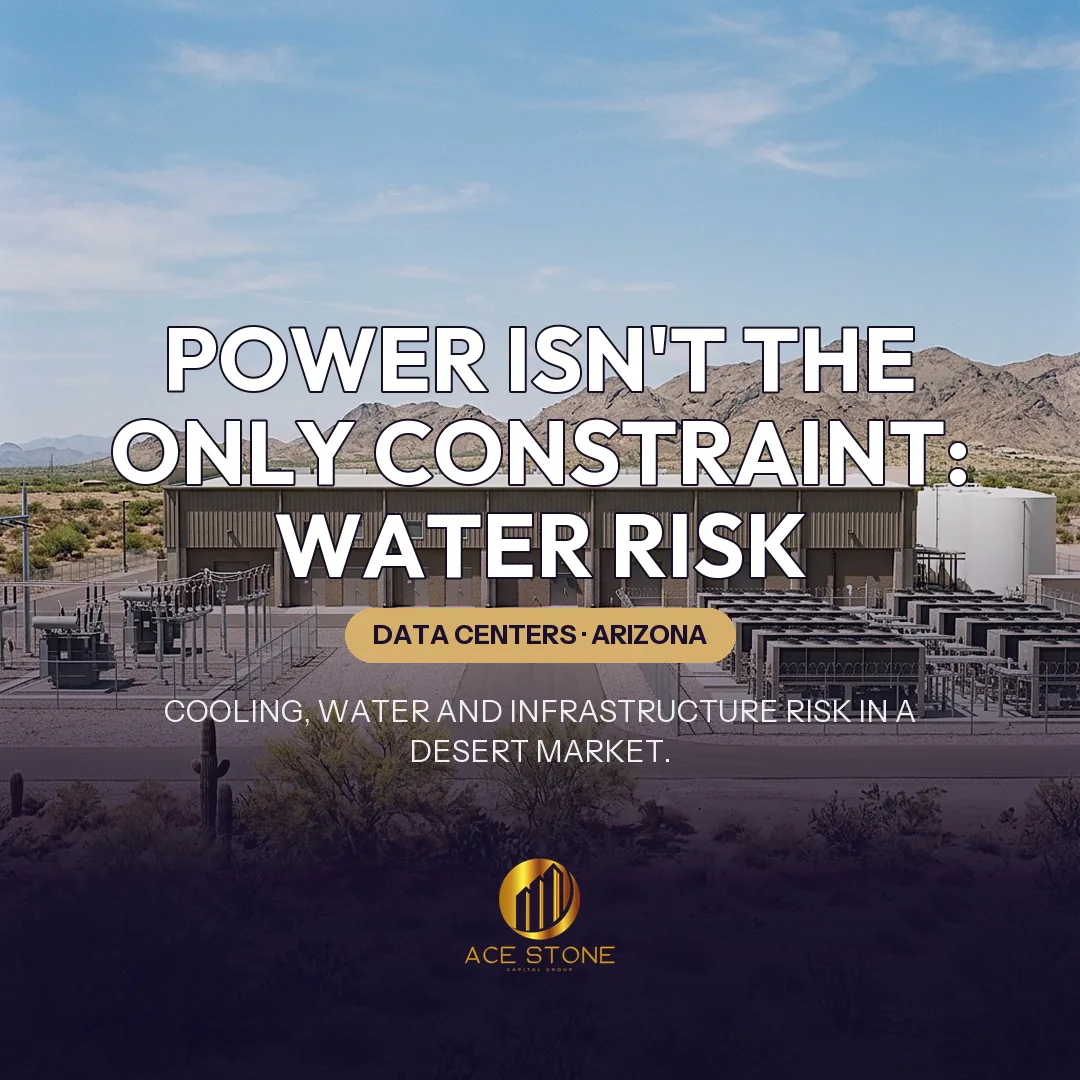
Power Isn't the Only Constraint: Underwriting Data Center Water Risk in Arizona
A Arizona site with strong electrical characteristics and an unresolved cooling dependency — why a power-ready parcel can still fail institutional underwriting.
This acquisition profile examines asset strategy, underwriting method, transaction structure, and value-creation considerations. Counterparty and pricing details are not disclosed.
Representative imagery of the asset type and market — not a photograph of the subject property.
Case Context
This acquisition profile examines AceStone Capital Group's underwriting method for an asset of this type. Specific properties, counterparties, and pricing are not identified. The subject profile is an Arizona development parcel with credible electrical characteristics — proximate transmission, a workable substation path and industrial zoning — being marketed primarily on that strength. The analysis examines the second infrastructure dependency that determines whether the site is developable: how the facility will reject heat, and what that choice requires.
Climate and Cooling Strategy
Design conditions govern equipment selection. High summer dry-bulb temperatures reduce the efficiency of air-cooled equipment precisely when demand peaks, while low humidity historically favoured evaporative approaches that trade water consumption for electrical efficiency. The analysis evaluates air-cooled chilled water, closed-loop and hybrid designs against peak-condition capacity, annual energy consumption, equipment footprint, acoustic output and water dependency. In this market the cooling decision is an underwriting decision, not a design-development detail, because it changes both the electrical budget and the resource exposure.
The analysis develops a modelled water demand range for each cooling alternative at the assumed critical load, expressed as an order of magnitude rather than a precise figure, and states plainly that it is an assumption. That range is then compared with what the relevant provider can confirm about capacity and service for a user of that size. An evaporative design and a closed-loop design produce demand profiles that differ by a wide margin, and the same site can be feasible under one and infeasible under the other.
Supply, Infrastructure and Confirmation
Whether water can be delivered is a question of physical infrastructure and provider policy, and both must be confirmed in writing rather than assumed from the presence of nearby development. The analysis records main size and distance, pressure, capacity commitments the provider is willing to make, the extension the site would require, any commitment or assurance process applicable to a large user, and the timeline for each. Where the provider cannot or will not confirm service for the assumed demand, the design must change to one that the confirmed supply supports.
Arizona's water framework is administratively complex and evolving, and the analysis treats it as a live regulatory variable rather than a fixed condition. It notes that requirements differ by location and provider, that assurance obligations can apply to development approvals, and that policy governing large users can change over a facility's operating life. No claim is made about any specific municipality's supply position or about guaranteed availability. The underwriting response is to prefer designs whose viability is least sensitive to future regulatory change.
Cooling Alternatives and Their Trade-Offs
A closed-loop or air-cooled design largely removes the water dependency and its regulatory exposure, at the cost of higher electrical consumption, larger equipment yards, greater acoustic output and reduced peak-condition efficiency. An evaporative or hybrid design lowers power draw and improves efficiency, at the cost of a supply dependency that must be secured and maintained. The analysis prices both across the assumed hold, including the incremental megawatts an air-cooled design consumes, which reduce the salable capacity a fixed electrical position can support.
The site's electrical characteristics are verified rather than accepted: available capacity, substation headroom and expansion potential, routing for the feed, redundancy configuration, study and interconnection timelines, and the equipment lead times that set the energization date. The site's marketing strength is genuine, but it is verified to the same standard as the constraint being examined, because a strong attribute confirmed only informally is not yet an asset.
Site, Zoning and Environmental Factors
The analysis reviews usable acreage after washes, floodplain, setbacks and easements; grading and stormwater design for desert hydrology, where infrequent high-intensity events govern detention sizing; zoning and permitted use; height and noise standards against a large air-cooled plant; screening requirements; and habitat or cultural resource considerations that can constrain the developable footprint. Yard area is a particular constraint where an air-cooled strategy is selected, since the equipment field is substantially larger.
Fiber and Connectivity
Carrier presence, physical route diversity, lateral construction cost and easement requirements are confirmed to the same standard as power and water. A site with three resolved dependencies and one unresolved one is not seventy-five per cent developable; it is contingent, and the analysis treats it that way.
Development Cost and Basis
The model aggregates land basis, grading and stormwater, utility extensions for both power and water, the incremental equipment cost of the selected cooling approach, off-site improvements, entitlement and study costs, and carry. The total is expressed as cost per deliverable megawatt under each cooling alternative, so the water question is answered in the same currency as every other underwriting question rather than debated qualitatively.
Why a Power-Ready Site Can Still Fail
Institutional underwriting requires every critical dependency to be resolved, not most of them. A site with confirmed capacity, good acreage and clean zoning fails if the cooling strategy that makes its electrical budget work cannot be supplied, and fails equally if the alternative strategy consumes so much of the electrical position that the salable capacity no longer supports the basis. The binding constraint is whichever dependency is weakest, and it is rarely the one featured in the marketing.
Risks
Principal risks include provider capacity proving unavailable at the assumed demand, regulatory change affecting large users over the hold period, higher-than-modelled efficiency penalties under peak conditions, equipment yard area exceeding available acreage, acoustic compliance requiring additional treatment, and cost escalation in cooling equipment. Each risk is tied to a diligence deliverable that must be satisfied before capital is placed at risk.
Decision Framework and Takeaways
The site is acquirable at a price supported by the cooling strategy the confirmed supply can sustain, using a structure that keeps capital at risk limited until written confirmations are in hand. Power availability opens the conversation in this asset class; it does not conclude it. Every critical dependency — power, cooling supply, connectivity, entitlement and usable land — must be independently resolved, because the weakest of them, not the strongest, sets the value.
What This Case Shows
A structured example of how AceStone Capital Group sources, underwrites, and structures off-market commercial acquisitions in Arizona. For broader context, see our active acquisition markets or initiate a direct-sale review for a similar property.
Have a Property to Sell?
Receive a written offer or a clear pass within 1–2 business days.