Data Center Sale-Leaseback: Underwriting the Tenant, the Facility, and the Power
A Texas owner-occupied data center monetised through a long-term leaseback — why an attractive going-in cap rate says little about the underlying real estate.
This acquisition profile examines asset strategy, underwriting method, transaction structure, and value-creation considerations. Counterparty and pricing details are not disclosed.
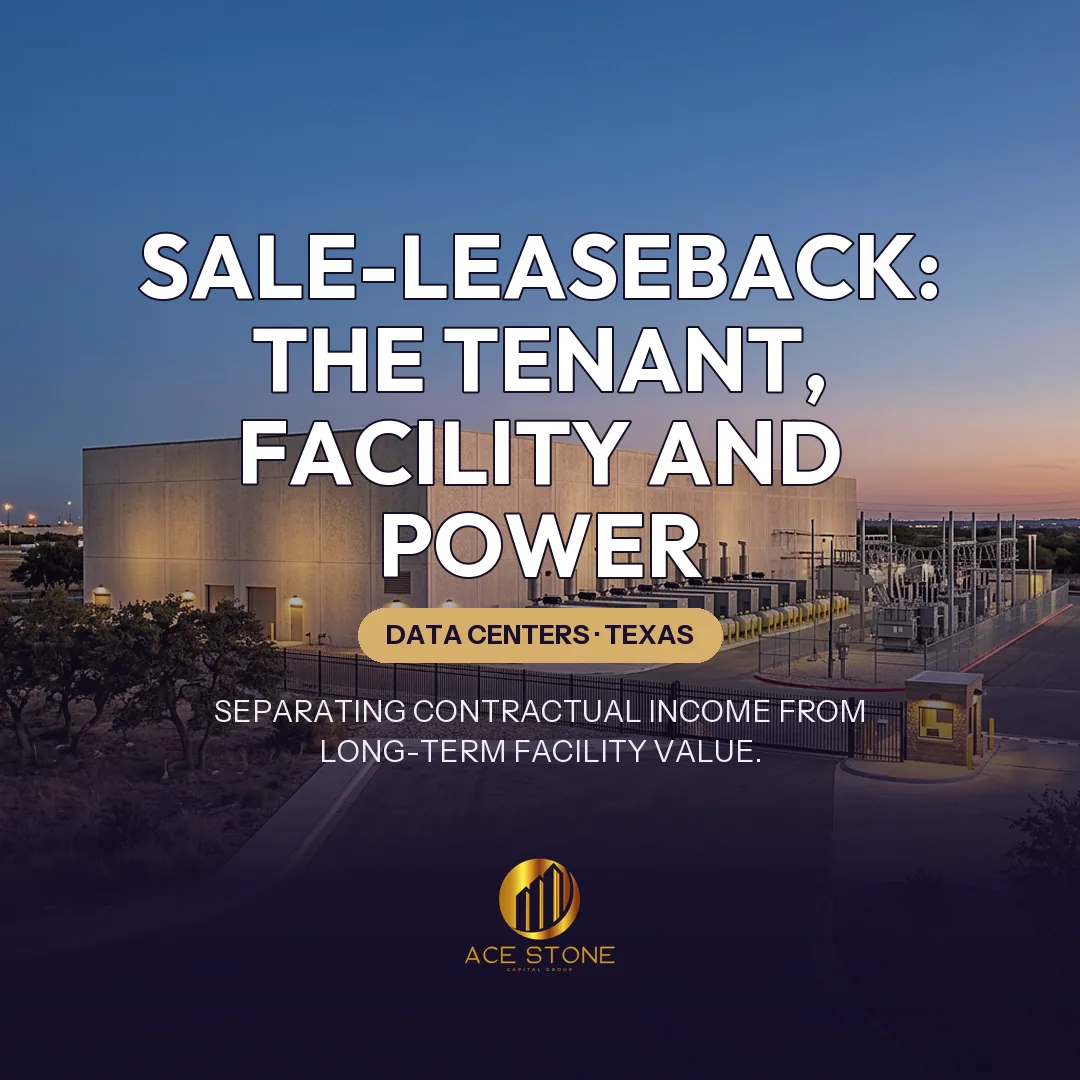
Representative imagery of the asset type and market — not a photograph of the subject property.
Case Context
This acquisition profile examines AceStone Capital Group's underwriting method for an asset of this type. Specific properties, counterparties, and pricing are not identified. The subject profile is a Texas enterprise data center owned and occupied by the company that built it, offered for sale with a simultaneous long-term leaseback under which the seller remains in occupancy. The structure converts a corporate asset into contractual income. The buyer must decide how much of the purchase price is supported by that contract and how much by the real estate underneath it.
Five Separate Underwritings
The transaction is underwritten as five distinct exercises: the tenant's credit and its likely durability over the lease term; the lease document and its economic terms; the physical facility and its condition; the electrical and mechanical infrastructure and the power position; and the residual real estate value if the tenant leaves. A common error is allowing the first to substitute for the others. Credit supports income for a defined term; it does not create real-estate value beyond that term.
The analysis examines the tenant's financial position, leverage, liquidity and the stability of the business line the facility supports, and identifies whether the obligation sits with an operating entity or a parent, and whether a guarantee exists and from whom. Strategic importance matters as much as balance sheet: a facility hosting core production systems is far stickier than one hosting workloads a tenant could migrate to third-party colocation or public cloud within the lease term. The migration question is asked explicitly, because the answer determines renewal probability.
Lease Structure and Terms
The analysis abstracts term, renewal options and their strike rents, escalation structure and whether it is fixed or index-linked, expense responsibility and any caps, maintenance and capital-replacement obligations, casualty and condemnation provisions, assignment and subletting rights, termination and contraction rights, and the treatment of tenant-installed equipment at expiry. In sale-leasebacks, capital-replacement responsibility for major mechanical and electrical plant is the term most often glossed over and most consequential over a long hold.
Sale-leaseback rent is set by negotiation between parties with an interest in the sale price, which means it may sit above what the market would pay another occupant for the same facility. The analysis independently estimates market rent for comparable powered, cooled space in the region and compares it with contract rent. Where contract rent exceeds market, the excess is treated as a credit-supported annuity that expires with the lease rather than as durable real-estate income, and it is capitalised accordingly.
Facility Condition and Specialisation
The analysis assesses building age and construction, roof and envelope condition, structural capacity, the age and remaining life of UPS systems, batteries, generators, switchgear, chillers and air handlers, the redundancy configuration and how it was maintained, and the maintenance and testing records. It also identifies how specialised the improvements are. Highly customised enterprise facilities suit the current tenant precisely and a narrower set of future occupants, and that narrowness is a residual-value issue rather than a condition issue.
The electrical position is the most durable component of value. The analysis records contracted capacity, actual utilisation against it, headroom for expansion, the redundancy configuration of the utility feeds, the age and condition of on-site electrical infrastructure, and the terms and assignability of the utility arrangement. Meaningful unused capacity is an asset in its own right: it supports expansion, improves the re-letting case and can be worth more than the building if the tenant departs.
Cooling, Fiber and Operating Infrastructure
The analysis reviews the cooling design, equipment condition and remaining life, water dependency and supply arrangements, and the site's capacity to accommodate replacement plant. Connectivity is assessed on the same basis as in a development underwriting: carrier count, genuine physical route diversity, entry configuration and meet-me room capability. A single-carrier enterprise facility that served its owner adequately may be difficult to re-let to a multi-tenant occupant without material connectivity investment.
Replacement Cost and Alternative Users
The analysis estimates what it would cost to build equivalent capacity today, and separately identifies which categories of occupant could use the facility as configured. The pool typically includes enterprises with similar requirements, colocation operators and, at the low end, industrial users who would value the shell and the site but not the specialised improvements. The breadth of that pool, not the replacement cost figure, determines how quickly the asset re-lets.
Residual Value and the Vacancy Stress Test
The critical exercise assumes the tenant vacates at expiry. The model applies a realistic downtime period, the capital required to make the space marketable to another occupant, brokerage and legal costs, free rent and improvement allowances, carrying costs through the vacancy, and an achievable market rent from the narrower pool identified above. The resulting value is frequently far below the value implied by capitalising contract rent, and the gap between the two is the real measure of the risk being taken.
Why the Going-In Cap Rate Misleads
A high initial yield on a sale-leaseback often compensates for above-market rent, a single-tenant risk profile, specialised improvements and an uncertain residual, and pricing at that yield can amount to purchasing a bond backed by a depreciating, purpose-built asset. The disciplined method separates the contractual income stream, valued against credit and term, from the residual real estate, valued on its own merits, and prices the two independently rather than blending them into a single yield.
Risks
Principal risks include tenant credit deterioration over a long term, workload migration reducing renewal probability, above-market rent that cannot be re-let, major mechanical and electrical replacement obligations falling to the landlord, technological obsolescence of a purpose-built configuration, and a thin buyer pool at exit for single-tenant specialised assets. Lease provisions governing capital replacement and end-of-term equipment treatment are the primary levers for managing several of these.
Exit Optionality
Exits include sale to a net-lease investor while substantial term remains, re-letting to a colocation operator that values the capacity, repositioning the site around its power position with a new facility, or industrial reuse of the shell at a materially lower value. Where the power position is strong and underutilised, the site retains optionality regardless of the tenancy, which is the most reliable protection available in this structure.
Key Takeaways
A sale-leaseback is two assets sold as one: a credit-supported income stream for a defined term, and a specialised building with a power position that must stand on its own afterwards. A strong initial cap rate does not make the acquisition attractive; it frequently signals that the market has already priced the residual risk the buyer is being asked to accept. Underwrite the tenant, the lease, the facility and the power separately, then decide.
What This Case Shows
A structured example of how AceStone Capital Group sources, underwrites, and structures off-market commercial acquisitions in Texas. For broader context, see our active acquisition markets or initiate a direct-sale review for a similar property.
Have a Property to Sell?
Receive a written offer or a clear pass within 1–2 business days.