When a Data Center Site Fails Underwriting: The 150-Acre Walk-Away Case
A Southeast U.S. tract that screened well and failed diligence — how cheap land near transmission lines became an unattractive cost per developable megawatt.
This acquisition profile examines asset strategy, underwriting method, transaction structure, and value-creation considerations. Counterparty and pricing details are not disclosed.
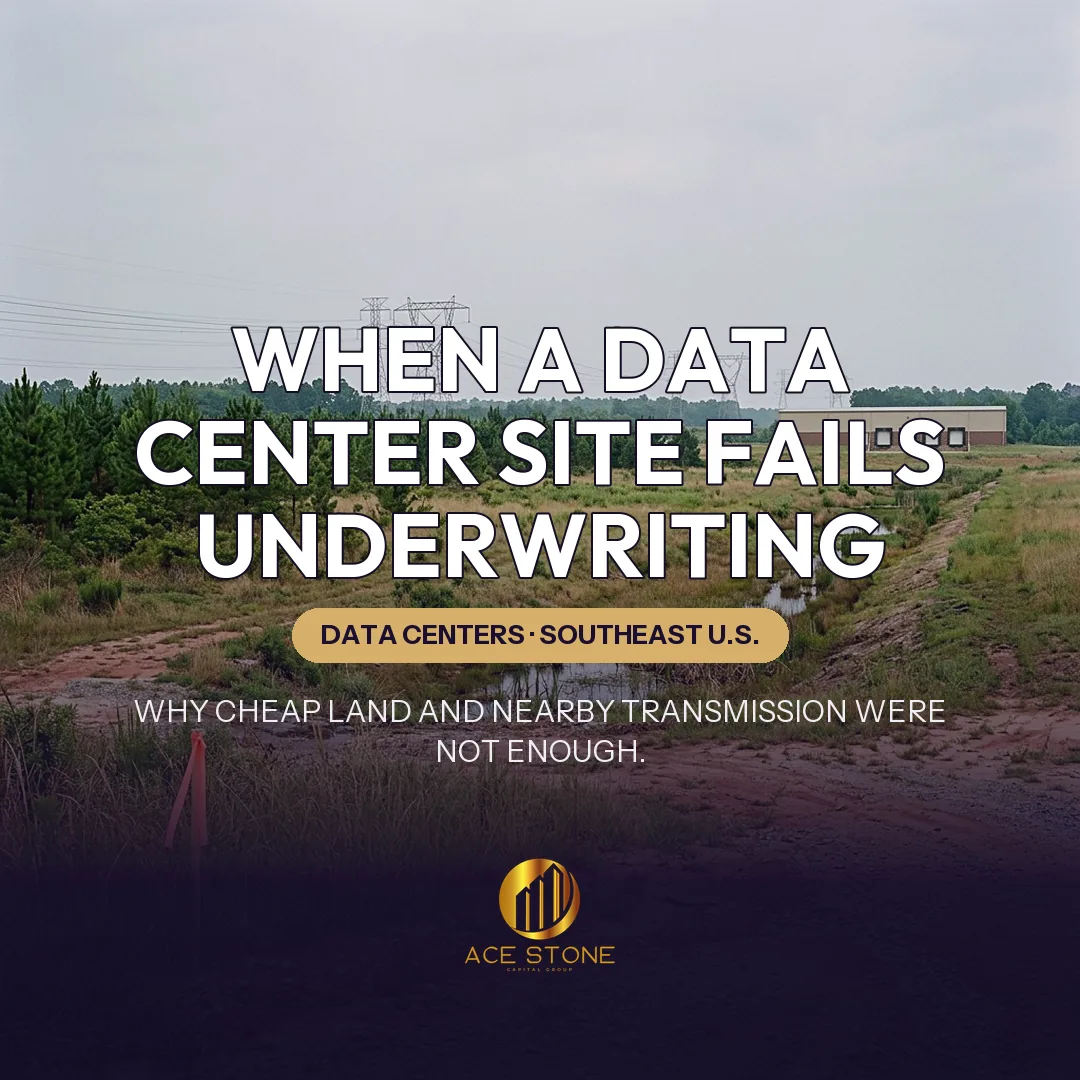
Representative imagery of the asset type and market — not a photograph of the subject property.
Case Context
This acquisition profile examines AceStone Capital Group's underwriting method for an asset of this type. Specific properties, counterparties, and pricing are not identified. The subject profile is a 150-acre Southeast U.S. tract that screened attractively against every conventional metric and did not survive diligence. It is presented because the discipline demonstrated in declining an opportunity is the same discipline that makes acquisitions worth making, and because the failure modes described here are the most common in this asset class.
Initial Screening
On the initial screen the tract presented well: 150 contiguous acres, land pricing far below established data-center corridors, direct access from an interstate interchange, industrial zoning permitting the use by right, high-voltage transmission lines crossing the northern portion of the property, fiber along the state route at the frontage, a cooperative jurisdiction and a motivated seller. Every attribute on a standard screening checklist was satisfied, which is precisely why the site advanced to diligence and precisely why the screen alone is insufficient.
The working thesis was straightforward: acquire inexpensive land adjacent to existing transmission infrastructure, entitle and grade it, secure capacity and either develop a facility or sell an entitled, powered site into a market with more demand than supply. Modelled early modelling — assumptions rather than results — suggested an attractive cost per developable megawatt if capacity could be secured within roughly two years and if the substantial majority of the acreage proved usable. Both conditions were assumptions, and diligence was designed to test them.
Power Diligence: Proximity Is Not Capacity
The transmission lines crossing the property were high-voltage bulk transmission with no interconnection point at or near the site. Serving a large load would require a new substation with a transmission-level interconnection, not a distribution extension. The serving utility indicated that a load of the intended size would require full study, that other large-load requests in the same area were already ahead in the queue, and that available capacity in the local system was limited pending reinforcement with no committed completion date. Lines overhead deliver nothing without a substation, and the substation was the project.
Combining study duration, agreement negotiation, transmission-level interconnection design, long-lead transformer and switchgear procurement, and utility and developer construction, the realistic energization horizon extended well beyond the two years assumed in the initial model — and that horizon depended on network reinforcement whose schedule was outside the developer's and the utility's near-term control. The timeline assumption did not slip modestly; it roughly doubled and acquired a dependency the buyer could not manage.
Site and Environmental Diligence
The physical diligence was equally unkind. Wetland delineation identified substantial jurisdictional areas along the drainage crossing the tract, with associated buffers. The transmission easement removed a wide corridor from developable use. Topographic survey showed grade change requiring far more earthwork than the initial visit suggested, and geotechnical borings indicated shallow rock across part of the higher ground. Setback and buffer requirements against the adjoining residential parcels removed further area from the developable envelope.
After deducting wetlands and buffers, the transmission corridor, floodplain, required setbacks and screening, stormwater detention sized for the impervious cover a campus would create, internal roads, the generator and mechanical yards and the substation parcel, usable acreage fell to a fraction of the 150 gross acres marketed. The attractive price per gross acre translated to a materially higher price per usable acre — no longer a discount to established corridors once the programme was scaled to the land that could actually carry buildings.
Revised Infrastructure Costs
Off-site and on-site infrastructure costs rose in step. A transmission-level substation replaced a distribution extension. Earthwork increased with the grade change and the rock. Stormwater detention grew with the constrained area available for ponds. Water and sewer required extensions of meaningful length, and the traffic study associated with a project of this scale indicated intersection improvements at the interchange. Fiber, examined properly, offered one usable route with a second requiring a lengthy lateral and easements across three intervening ownerships.
Revised Carrying Period and Cost
With the energization horizon extended and entitlement work running in parallel, the carrying period lengthened considerably. Property taxes, insurance, maintenance, engineering, legal, study and consulting fees and the cost of capital on the full basis accumulated across those additional years. Carry alone, which had been a rounding item in the initial model, became a significant multiple of its original figure and a direct deduction from the value of any capacity eventually delivered.
Risk-Adjusted Valuation
Recomputed on the diligence findings, cost per developable megawatt moved from attractive to unattractive relative to sites in established corridors with confirmed capacity paths. Probability-weighting the outcomes made it worse: a favourable case in which reinforcement completed on the represented schedule, a base case with several additional years of delay, and an adverse case in which capacity was allocated to competing requests and the site never received a viable path at all. The weighted value fell below the seller's price and below the price at which the risk was worth carrying.
The Walk-Away Decision
The position was terminated within the diligence period, with the expenditure limited to study and consulting costs. No counteroffer was pursued, because the defect was not price alone: the schedule risk was concentrated in a network reinforcement outside anyone's control, and no discount adequately compensates for a dependency that cannot be managed, monitored or contractually transferred. Where the risk cannot be structured around, the correct response is to decline rather than to re-price.
What Would Have Changed the Answer
Several conditions would have made the site investable: a utility confirmation of an interconnection point and a defined capacity path; a seller willing to grant a long-dated option with modest extension payments rather than requiring a purchase; a wetland delineation preserving more of the developable envelope; or a price approaching agricultural and industrial value, so that the data-center outcome was an option rather than the basis for the price. None was available on this transaction.
Lessons Learned
Transmission crossing a property is not capacity available to it; interconnection points and substations are. Gross acreage is not developable acreage, and the gap widens with wetlands, easements and stormwater. Cheap land plus expensive infrastructure is not a cheap site. Carrying cost across a multi-year utility timeline is a primary underwriting variable rather than an administrative expense. And an early screen that satisfies every checklist item is an invitation to diligence, not a conclusion.
Key Takeaways
Walking away is an outcome of the underwriting process, not a failure of it. The capital preserved by declining a site whose cost per developable megawatt cannot support the basis remains available for a site where it can. Disciplined acquisition means being prepared to reach a negative conclusion after substantial work, and being unwilling to let the effort already invested justify the transaction.
What This Case Shows
A structured example of how AceStone Capital Group sources, underwrites, and structures off-market commercial acquisitions in Southeast U.S.. For broader context, see our active acquisition markets or initiate a direct-sale review for a similar property.
Have a Property to Sell?
Receive a written offer or a clear pass within 1–2 business days.