Cold-Storage Warehouse Acquisition: Underwriting Specialized Industrial Infrastructure in Central Florida
A refrigerated distribution facility in Central Florida, valued as two layers: a conventional warehouse shell and a depreciating cold-storage improvement set.
This acquisition profile examines asset strategy, underwriting method, transaction structure, and value-creation considerations. Counterparty and pricing details are not disclosed.
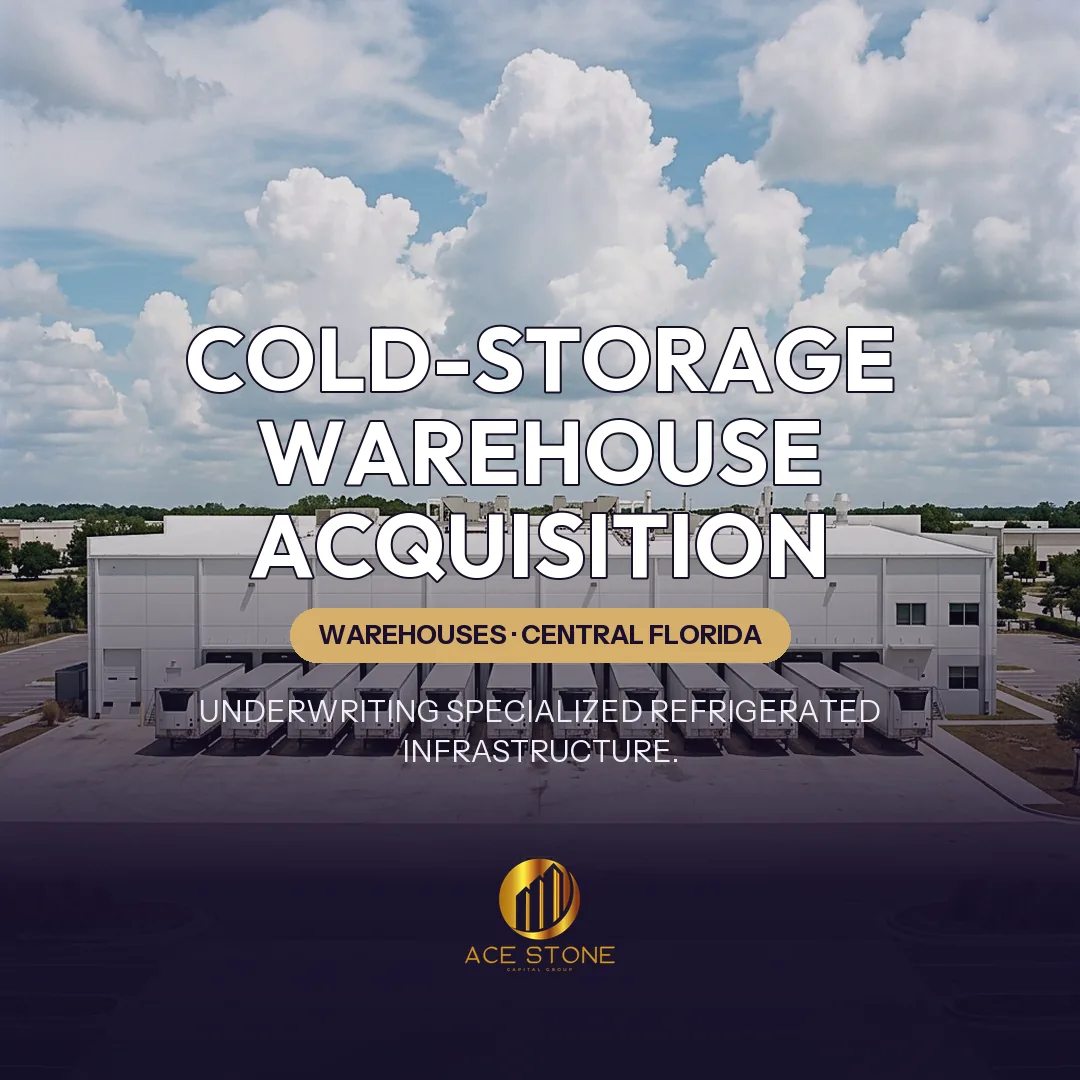
Representative imagery of the asset type and market — not a photograph of the subject property.
Case Context
This acquisition profile examines AceStone Capital Group's underwriting method for an asset of this type. Specific properties, counterparties, and pricing are not identified. The subject profile is a refrigerated distribution warehouse in Central Florida serving regional food distribution, comprising freezer and cooler space with a modest ambient dock and staging area.
Executive Summary
Cold storage commands higher rents than dry warehouse because it costs far more to build and to run. That premium is not free income. The refrigeration plant, envelope and controls are depreciating mechanical assets with finite lives, high replacement costs and an operating burden that dwarfs a dry building's. The analysis therefore separates conventional shell value from specialized improvement value, and tests whether the asset still underwrites if the cold layer is eventually abandoned.
The profile assumed here combines low-temperature freezer space, coolers held at chilled temperatures, a small controlled-atmosphere or produce room, a refrigerated dock, and a limited ambient staging area. Clear heights differ by zone, reflecting how the building was expanded over time. Loading includes refrigerated dock positions with seals, shelters and levellers rated for cold service, plus limited drive-in access. Blast freezing capacity, if present, is recorded separately because it changes both tenant demand and the energy profile.
Refrigeration Systems and Condition
The refrigeration plant is the asset within the asset. The analysis records system type and refrigerant, compressor count, age and rebuild history, condenser and evaporator condition, control system vintage and whether it is still supported, insulation panel integrity, vapour barrier condition, floor heating in freezer slabs to prevent frost heave, and door and dock seal condition. Refrigerant type carries regulatory exposure; ammonia systems carry process-safety compliance obligations. A third-party mechanical assessment is a condition of underwriting, not an optional courtesy.
A refrigerated facility's electrical service is a constraint on both operations and future flexibility. The analysis records incoming service capacity, headroom for additional compressors or expansion, switchgear age, and whether backup generation exists and is sized to hold temperature during an outage — a material consideration in a Florida hurricane exposure. Absence of adequate backup is a capital item, and it is also an underwriting fact about which tenants can use the building.
Market Context and Tenant Demand
Demand for refrigerated space in Central Florida is grounded in food distribution to a large resident and visitor population. The analysis measures the depth of that demand narrowly: how many operators in the region require space of this size and temperature mix, how much competing refrigerated inventory exists, and how much new purpose-built capacity has been delivered or announced. Cold storage has a materially shallower tenant pool than dry warehouse, and shallow pools produce longer downtime when a tenant leaves.
The first valuation layer treats the property as a dry industrial building: land, shell, dock positions, clear height, yard and location, valued at market dry-warehouse rent for the submarket. This layer is liquid, financeable and supported by a deep buyer and tenant pool. It also functions as the floor for the asset, and its size relative to the purchase price determines how much of the transaction rests on specialized value.
Layer Two — Specialized Cold Improvement Value
The second layer is the incremental value of refrigeration: insulated envelope, mechanical plant, controls, refrigerated dock equipment and freezer slab systems. It is valued as the capitalized rent premium over dry space, adjusted for the remaining useful life of the equipment and for the reserve required to sustain it. This layer amortizes toward zero as the plant ages; underwriting it as permanent value is the single most common error in cold-storage acquisition.
Operating Expenses
Energy is the defining line item and is modelled on actual consumption data across a full seasonal cycle, not on a per-square-foot rule of thumb. Maintenance contracts for refrigeration, compressor rebuild reserves, sanitation, regulatory compliance including process-safety management where applicable, property insurance priced for Florida wind exposure, and product-loss liability all follow. The recovery structure is examined closely, because a lease that recovers common industrial expenses but caps or excludes refrigeration maintenance shifts the most volatile cost to the landlord.
Capital Requirements
Capital planning is scheduled by system rather than reserved as a flat percentage: compressor rebuilds and replacements at their expected intervals, condenser replacement, control system modernization, insulated panel and vapour barrier repair, dock seal and door replacement, roof, and any refrigerant transition driven by regulation. The schedule is then expressed as an annualized cost per square foot and deducted from the rent premium the cold layer generates. What remains is the true economic contribution of the specialization.
Downside Scenario — Conversion to Dry Storage
The critical downside is not vacancy; it is obsolescence of the cold layer. The scenario assumes the plant reaches end of life at a point when re-investment is not justified by achievable cold rents. The building is then converted to conventional dry use: refrigeration equipment removed and disposed of, insulated panels stripped where they impede layout, floors and dock equipment remediated, lighting and ventilation brought to dry standard. The result is an older dry building with a lower clear height in some zones, valued at dry market rent — the layer-one floor, less the cost of getting there.
Scenario and Sensitivity Analysis
Base, upside and downside cases are carried. The base assumes the current use continues with scheduled capital sustaining the plant. The upside assumes tightening regional cold capacity supports rent growth and a longer economic life. The downside applies the conversion scenario. Each is flexed for energy cost movement, insurance cost movement and exit capitalization rate. Cold-storage capitalization rates are sensitive to plant age, so the exit rate is deliberately set wider than the entry rate in the downside.
Acquisition Decision
On these underwriting assumptions the asset is investable where the purchase price is close to conventional warehouse value plus a disciplined, life-adjusted credit for the cold improvements, where a mechanical assessment supports the assumed remaining life, and where capital for the rebuild schedule is reserved at closing. Where the price capitalizes the full cold rent premium in perpetuity, the buyer is paying today for infrastructure that will require replacement at their own cost.
Key Takeaways
Underwrite cold storage in two layers and know which one you are buying. The shell is durable; the plant is a depreciating machine with a maintenance schedule and a regulatory profile. Model energy on actual data, reserve for compressors by name, count the shallow tenant pool honestly, and confirm that the transaction still works if the building ends its life as dry warehouse.
What This Case Shows
A structured example of how AceStone Capital Group sources, underwrites, and structures off-market commercial acquisitions in Central Florida. For broader context, see our active acquisition markets or initiate a direct-sale review for a similar property.
Have a Property to Sell?
Receive a written offer or a clear pass within 1–2 business days.