Warehouse Sale-Leaseback: Separating Tenant Credit From Real Estate Value in Charlotte
A owner-user industrial sale-leaseback in Charlotte, underwritten as two separate assets: a contracted income stream and a building that must stand on its own.
This acquisition profile examines asset strategy, underwriting method, transaction structure, and value-creation considerations. Counterparty and pricing details are not disclosed.
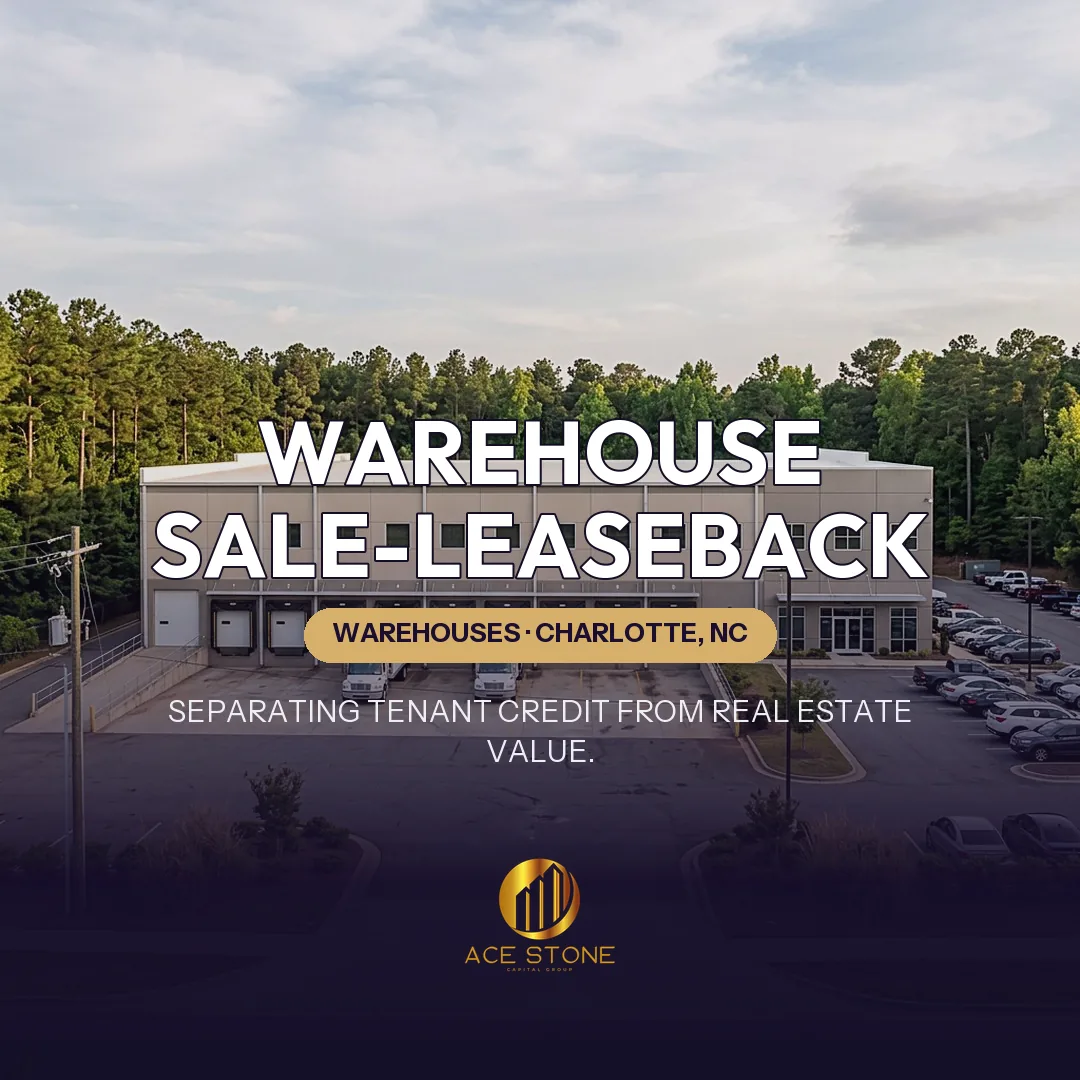
Representative imagery of the asset type and market — not a photograph of the subject property.
Case Context
This acquisition profile examines AceStone Capital Group's underwriting method for an asset of this type. Specific properties, counterparties, and pricing are not identified. The subject profile is a privately held manufacturer and distributor in the Charlotte metropolitan area selling the industrial facility it occupies and simultaneously entering a long-term lease as sole tenant.
Executive Summary
A sale-leaseback delivers two assets in one transaction: a contracted income stream backed by a single covenant, and a physical building whose value is realized only when that covenant ends. Pricing the transaction on the income stream alone treats the real estate as a residual afterthought. The correct method underwrites both independently, then asks whether the combined price is supported when the lease is stripped away.
Motive is diligence, not curiosity. Owner-users typically monetize real estate to fund equipment, working capital, an acquisition or a shareholder transition, and those are constructive reasons. Less constructive versions exist: the sale-leaseback is the cheapest remaining source of liquidity, or the rent being offered is set high specifically to maximize sale proceeds. Understanding the motive frames every subsequent judgment about credit and rent.
Underwriting the Tenant Covenant
The covenant is underwritten as a credit exposure, not as a label. The analysis examines the business model and its cyclicality, revenue concentration by customer, margin stability, leverage and debt maturities, fixed-charge coverage including the new rent obligation, and whether the entity on the lease is the operating company, a subsidiary or a holding vehicle. Guarantee structure, financial reporting covenants and security deposit or letter-of-credit provisions determine what the landlord can actually enforce.
This is the central discipline of sale-leaseback underwriting. The seller sets the rent, and the sale price is a multiple of it, so there is a structural incentive to set it high. The analysis benchmarks contract rent against benchmark market rent for comparable buildings, loading and location. Where contract rent exceeds market, the excess is not income — it is a return of the buyer's own capital, disguised as yield, that disappears the moment the lease is re-set. That portion is valued at a discount or excluded entirely.
Lease Structure and Escalations
Term length, renewal options and their rent-setting mechanism, escalation rate, and the allocation of structural, roof, parking and mechanical obligations are all priced. Fixed escalations applied to an above-market starting rent widen the gap to market every year, so the building becomes progressively more overpriced to its own tenant and renewal probability declines. Renewal options struck at fixed rates rather than fair market value transfer optionality to the tenant at the landlord's expense.
The building is then valued as if vacant tomorrow. The analysis records size, clear height, dock and drive-in configuration, column grid, floor slab capacity, power service, sprinkler design, office finish ratio, yard and truck circulation, site coverage and location within the submarket. The determining question is how much of the improvement set is generic industrial infrastructure and how much is specific to this occupier's process.
Specialization and the Alternative-User Pool
Owner-users build for themselves. Heavy power service, process piping, cranes, pits, reinforced slabs, unusual bay configurations, a large office ratio or clean space raise the cost of the building without necessarily raising its value to the next occupier. The analysis counts the pool of plausible alternative users for the building as configured, then re-counts it after assuming a cost to convert it back to generic distribution use. A short list on both counts is a warning that residual value is thin.
Residual Value and Re-Leasing Economics
Residual value is modelled at lease expiry using market rent at that point, not contract rent, applied to a building that will then be older. Against it sit the costs of transition: downtime, demolition or reconfiguration of tenant-specific improvements, tenant improvement allowance, commissions, free rent and deferred capital. The gap between capitalized contract rent today and capitalized market rent at expiry is the real economic exposure in the transaction.
Stress Test One — Tenant Default
The first stress test assumes financial failure during the initial term. Income stops, the security package is exhausted quickly, the landlord absorbs taxes, insurance and maintenance, and the building enters the market carrying whatever specialization the occupier left behind. The recovery scenario is modelled at market rent after a realistic downtime and full re-leasing cost. Where that recovery value sits far below the purchase price, the transaction was a credit trade wearing real estate clothing.
Stress Test Two — Non-Renewal at Expiry
The second stress test is more likely and often more damaging because it is easy to ignore. The tenant performs perfectly, then relocates at expiry to a facility better suited to a changed operation. The landlord faces an older building, a market rent that may sit below the expiring contract rent, and the full transition cost. Modelling this outcome as the base case rather than the exception is what separates real estate underwriting from bond underwriting.
Pricing the Two Components
The disciplined method values the income stream at a capitalization rate appropriate to the covenant's actual strength and the lease's actual terms, values the building standalone at market rent with normalized capital, and reconciles the two. Where the sum only supports the asking price on the assumption of perfect performance and a full-term hold, the buyer is paying for certainty that has not been purchased.
Acquisition Decision
On these underwriting assumptions the transaction is investable where contract rent sits at or below market, the covenant is transparent and reported, the building is generic enough to attract a real alternative-user pool, and the price is supported by standalone real estate value plus a modest premium for contracted term. Where contract rent is well above market and the building is highly specialized, the correct response is to re-price toward standalone value or decline.
Key Takeaways
In a sale-leaseback the seller writes both the lease and the price. Underwrite the covenant and the building separately, benchmark contract rent to market before capitalizing it, count the alternative users, and treat non-renewal at expiry as the expected case. The income stream has a maturity date; the building does not, and it is the building the buyer is left holding.
What This Case Shows
A structured example of how AceStone Capital Group sources, underwrites, and structures off-market commercial acquisitions in Charlotte, NC. For broader context, see our active acquisition markets or initiate a direct-sale review for a similar property.
Have a Property to Sell?
Receive a written offer or a clear pass within 1–2 business days.