
Back
    Commercial Charlotte, NC August 2026

    Mixed-Use Acquisition: Retail Below, Apartments Above in Charlotte

    A Charlotte corner building with street-level retail and apartments above — why two income streams cannot be capitalized as if they were one.

    This acquisition profile examines asset strategy, underwriting method, transaction structure, and value-creation considerations. Counterparty and pricing details are not disclosed.

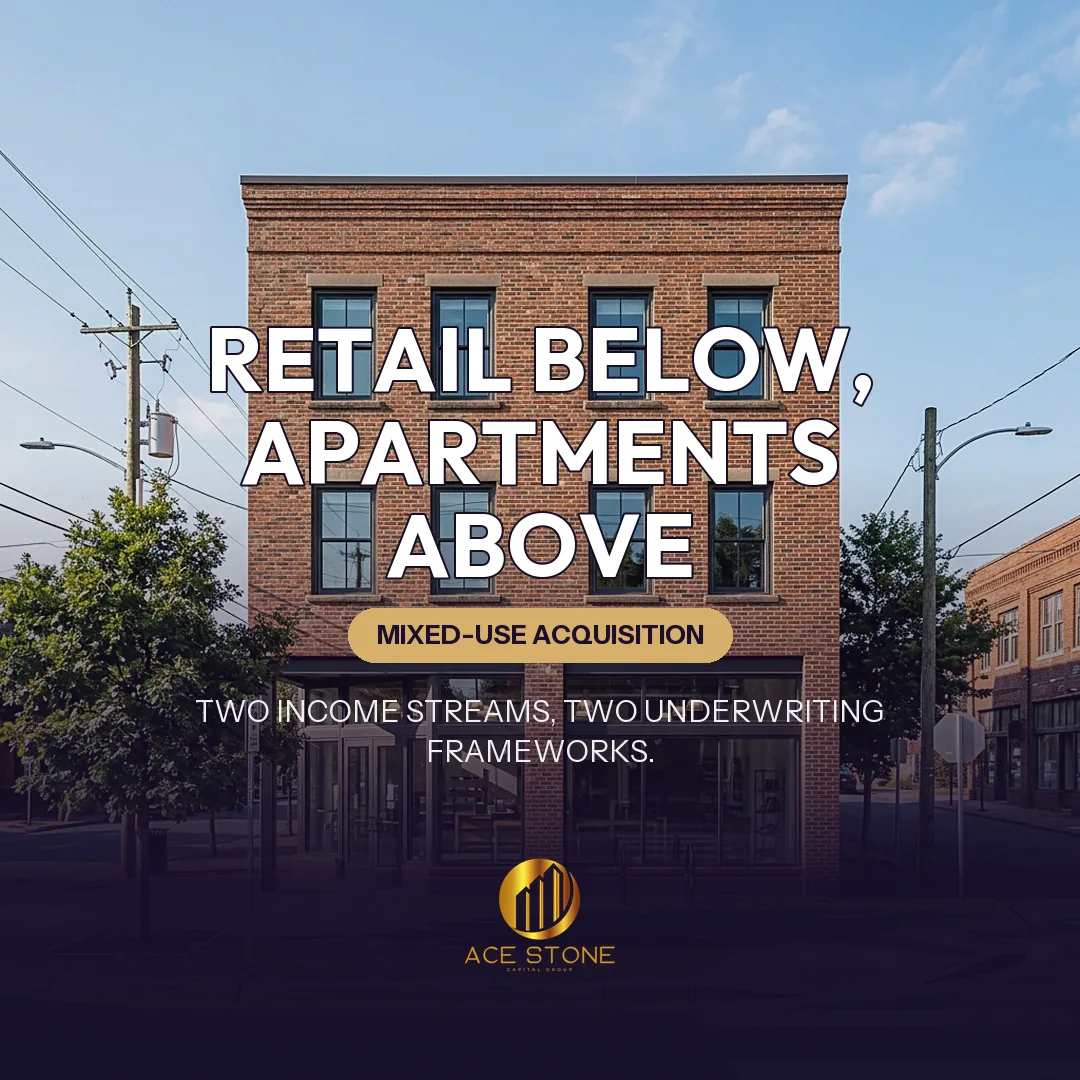
    Brick corner mixed-use building with street-level retail and apartments above.
    Representative imagery of the asset type and market — not a photograph of the subject property.

    Case Context

    This acquisition profile examines AceStone Capital Group's underwriting method for an asset of this type. Specific properties, counterparties, and pricing are not identified. The subject profile is a three-story brick corner building in a walkable Charlotte neighborhood: two retail bays at grade and a small group of apartments on the upper floors. The analytical question is straightforward and frequently answered badly in the market — how much of the value is genuinely commercial, how much is residential, and what happens to the price when those two components are underwritten separately rather than blended into a single convenient capitalization rate.

    Property Configuration

    The building presents two demised retail spaces with individual entries on the primary street frontage, a secured residential lobby on the side street, and apartments on the second and third levels reached by a single stair. Retail depth is shallow by modern standards, which limits the tenant types that can physically operate there. Residential units are compact one-bedroom and studio layouts of the era, with original window openings and radiator or through-wall mechanical systems. There is no dedicated parking field; the block relies on metered street parking and a public deck several minutes away, a condition that shapes both retail tenancy and residential rent ceiling.

    Applied exampleSee how this played out in Retail Land in Secondary Markets: A Quiet Recovery Story — a commercial acquisition in U.S. Growth Markets.

    Existing Retail Leases

    Lease abstraction precedes any rent roll arithmetic. For each retail bay the review captures commencement and expiration dates, base rent and escalation structure, the recovery method for taxes, insurance and common-area costs, renewal options and the rent at which those options strike, exclusive-use clauses, co-tenancy language, assignment rights, security deposits, and any unamortized landlord work. A below-market option exercisable for another five years is a real reduction in value even where current rent looks acceptable, because the buyer is purchasing the option, not the headline rate. Personal guarantees and their expiry dates are recorded as part of credit assessment rather than treated as decoration.

    Residential Occupancy and Rent Position

    The residential component is underwritten on the actual rent roll: lease start and end dates, whether tenancies have rolled to month-to-month, concessions granted, delinquency history and unit condition. In-place rents are then compared with achievable rents for renovated comparable units in the same submarket. The gap is not treated as automatic income. Capturing it requires unit turnover, a scoped renovation per unit, downtime, and marketing — each of which is priced. Where the building's units are meaningfully smaller than newer competing product, the analysis assumes a rent discount to that comparable set rather than parity, regardless of finish level.

    Applied exampleSee how this played out in Mixed-Use Development Sites in Live-Work Corridors — a commercial acquisition in U.S. Growth Markets.

    Rollover and Tenant-Quality Risk

    The two components fail differently. Residential turnover is frequent, individually small and statistically predictable; a vacant apartment is re-leased in weeks at a known cost. Retail turnover is infrequent, individually large and slow: a departing bay can sit dark for two or three quarters, then require tenant improvement dollars and free rent to fill. Concentration matters — with only two commercial bays, the loss of one is a material share of the building's commercial income. Underwriting therefore assigns a downtime, tenant-improvement allowance and leasing-commission reserve to each retail expiration inside the hold period rather than assuming continuous occupancy.

    Operating Expenses and Utility Structure

    Whether commercial and residential utilities are separately metered materially changes both expense load and recovery. Where retail is separately metered and reimburses its proportionate share of taxes and insurance, the commercial component is comparatively clean. Where a single master meter serves the entire building, the owner absorbs consumption risk from a tenant whose usage profile — refrigeration, extended hours, kitchen equipment — differs entirely from residential use. The expense model rebuilds taxes on a reassessed basis, insurance quoted for combined occupancy classes, common-area electricity, water and sewer, trash, management at a market rate for a hybrid asset, repairs and maintenance, and a per-unit replacement reserve.

    Applied exampleSee how this played out in The Value of Entitled Commercial Land in Tight Credit Cycles — a commercial acquisition in U.S. Growth Markets.

    NOI Normalization

    Reported seller cash flow is normalized before use. Non-recurring items are removed, owner-performed management and maintenance are replaced with market-rate line items, and property taxes are restated to reflect a post-sale assessment rather than a long-held basis. Vacancy and credit loss are applied separately to each income stream, using a residential factor appropriate to the submarket and a commercial factor that reflects the actual lease structure. The result is two normalized net operating income figures, not one, because the mistake this asset class invites is capitalizing a blended figure at an apartment cap rate and calling the difference upside.

    Valuation Method for a Two-Stream Asset

    Valuation proceeds component by component. Residential net income is valued against multifamily comparables in the immediate submarket, adjusted for unit size, condition and the absence of parking. Commercial net income is valued against retail comparables, with the capitalization rate driven by lease term remaining, tenant credit and the physical leasability of shallow bays. The sum is then sanity-checked against closed sales of comparable mixed-use buildings and against price per square foot of the whole structure. Where the two approaches diverge sharply, the conservative outcome governs, because the exit market prices whichever component a future buyer treats as the risk.

    Acquisition Basis and Downside

    The acquisition basis is set from the component valuation less deferred maintenance, less the reserved cost of near-term retail rollover, and less a return requirement sized to the execution risk of a hybrid asset. Downside testing holds residential occupancy stable while assuming one retail bay goes dark for three quarters and re-leases below the in-place rate, with full tenant improvement and commission cost. If the position still services its capital and produces an acceptable, if lower, yield under that scenario, the basis is defensible. If it only works with both bays leased continuously at current rents, the price is wrong regardless of how attractive the building looks.

    Exit Positioning and Takeaways

    The likely exit buyer is a local or regional private investor who understands hybrid operations, not an institutional apartment buyer and not a single-tenant net-lease buyer. That narrows the bid pool and argues for an exit capitalization rate at or above entry rather than below it. The durable takeaways: value the streams separately, treat retail rollover as a scheduled capital event rather than a surprise, verify metering before trusting the expense line, and never let the residential story finance an optimistic view of the commercial one. Owners of comparable Charlotte assets can review current acquisition parameters directly with the firm.

    What This Case Shows

    A structured example of how AceStone Capital Group sources, underwrites, and structures off-market commercial acquisitions in Charlotte, NC. For broader context, see our active acquisition markets or initiate a direct-sale review for a similar property.

    Have a Property to Sell?

    Receive a written offer or a clear pass within 1–2 business days.

    Request a Cash Offer