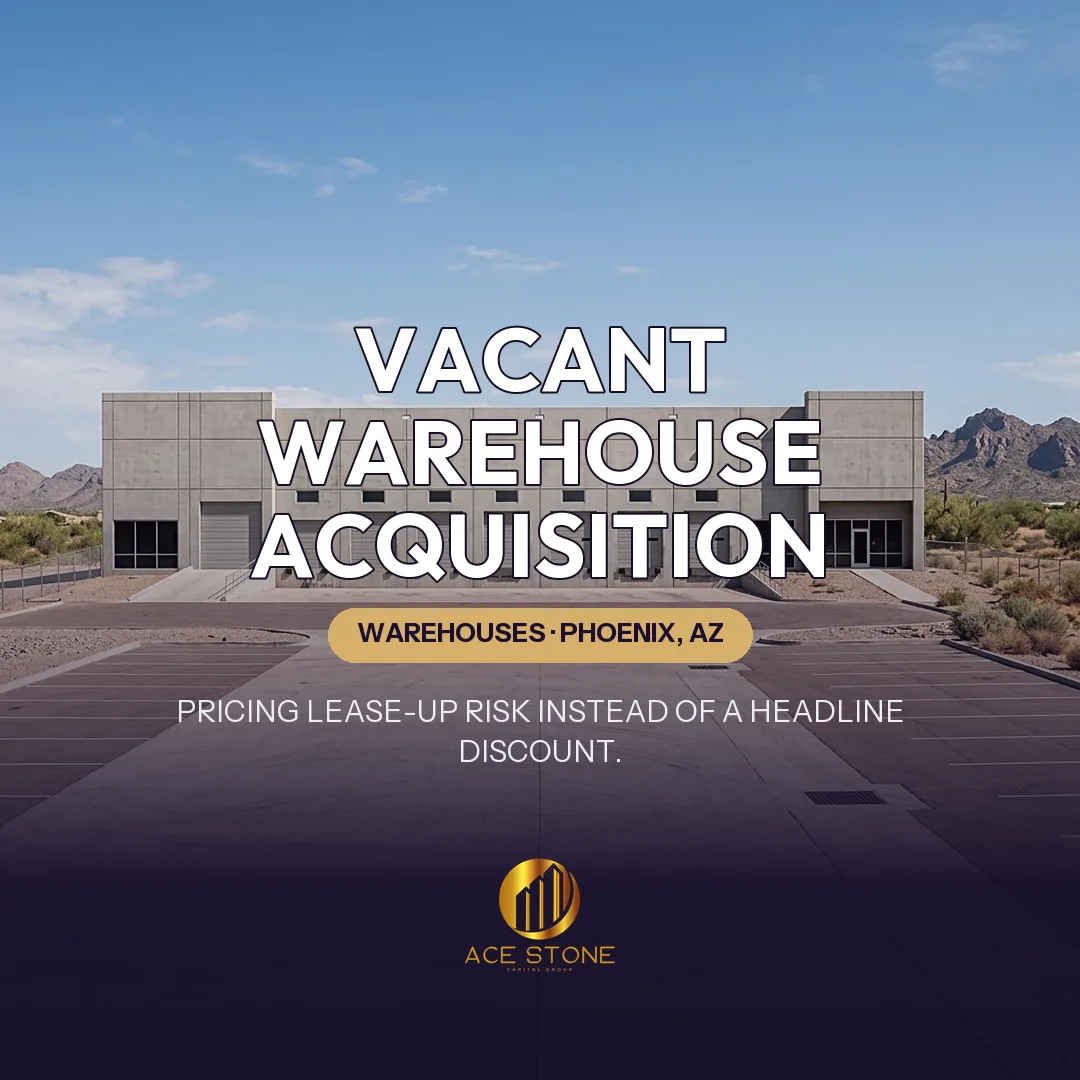
Vacant Warehouse Acquisition: Pricing Lease-Up Risk in Phoenix
A vacant 180,000 SF Phoenix industrial building offered at an apparent discount — and how the correct basis moves as lease-up assumptions get more conservative.
This acquisition profile examines asset strategy, underwriting method, transaction structure, and value-creation considerations. Counterparty and pricing details are not disclosed.
Representative imagery of the asset type and market — not a photograph of the subject property.
Case Context
This acquisition profile examines AceStone Capital Group's underwriting method for an asset of this type. Specific properties, counterparties, and pricing are not identified. The subject profile is a fully vacant 180,000 square foot industrial facility in the Phoenix metropolitan area, marketed at a headline price per square foot noticeably below recent occupied sales in the same submarket.
Executive Summary
Vacancy is a pricing input, not a discount. The building produces no income from the day of closing while consuming taxes, insurance, utilities, maintenance and the cost of capital on the full basis. Whether the apparent discount is real depends entirely on how long the building takes to lease and what it costs to get there. The analysis models three lease-up durations and solves for the acquisition basis each one supports.
Buyers commonly compare a vacant building's price per square foot to occupied comparable sales and treat the difference as value created. That comparison omits three things: the net operating income the occupied building generates during the period the vacant one does not, the transaction costs of manufacturing a lease, and the risk that the building is vacant for a reason. Only after all three are priced can the residual be called a discount.
Diagnosing the Vacancy
The first diligence question is why the building is empty. Benign explanations exist — a tenant consolidated, an owner-user relocated, a lease simply expired in a soft leasing window. Structural explanations do not price the same: clear height below current specification, an inadequate dock ratio, poor truck circulation, a floor slab unsuited to modern racking, insufficient power, obsolete fire protection for the commodity classes tenants store, or a location the market has moved away from. The distinction determines whether downtime is a timing problem or a permanent narrowing of the tenant pool.
The profile assumed here is a single-tenant-capable box of roughly 180,000 square feet with a dock ratio and clear height typical of its vintage, a truck court supporting maneuvering with limited trailer storage, ample paved yard given the site's generous land area, and a small office component in need of modernization. Fire protection design, electrical service capacity, roof age and HVAC in the office are catalogued because each determines whether the building can be delivered to a tenant without material landlord work.
Market Context
Phoenix has absorbed substantial new industrial development, which cuts both ways. Demand drivers are genuine, but a prospective tenant weighing this building is also weighing newly delivered space with higher clear heights and better loading. The analysis therefore measures the competitive set narrowly: available buildings of similar size within the same submarket, their asking rents, their concession packages, and how long comparable vacant space has historically taken to lease. Metro-level absorption statistics are not a substitute for this count.
A signed lease is a purchased asset. Its cost includes tenant improvement allowance sized to the office and warehouse work a market deal requires, leasing commissions on both sides across the full term, free rent, and any landlord work needed simply to make the building marketable — lighting, dock levellers, pavement repair, roof remediation, office refresh. These are capitalized into the all-in basis rather than treated as later operating expenses, because they are as much a part of acquisition cost as the purchase price.
Carrying Costs During Downtime
Carry runs from closing to rent commencement, not to lease signature. It includes real estate taxes at the reassessed value, property and liability insurance on a vacant building — which typically prices higher and carries stricter conditions than an occupied policy — utilities to keep systems and fire protection live, security, landscaping, routine maintenance, and the cost of capital on the entire basis. Vacant-building insurance and the reassessment are the two items most frequently understated.
Scenario One — Six-Month Lease-Up
The optimistic case assumes a tenant is identified quickly, terms are agreed without an extended negotiation, landlord work is modest and rent commences roughly six months after closing. Carry is limited, transaction costs are the market package, and the stabilized value comfortably exceeds the all-in basis. This scenario supports the highest acquisition price — and it is the scenario a seller's marketing materials implicitly assume.
Scenario Two — Twelve-Month Lease-Up
The base case doubles the downtime, adds a period of marketing before serious interest, allows for one prospect that does not convert, and assumes a more generous concession package to secure the tenant that does. Carry roughly doubles and leasing costs rise. Holding stabilized value constant, the acquisition basis this scenario supports is materially lower than the six-month case — the difference is the price of six months of empty building.
Scenario Three — Eighteen-Month Lease-Up
The conservative case assumes the vacancy reflects a functional limitation, that the tenant pool is genuinely narrower, and that the eventual deal requires both a rent concession and meaningful landlord capital. Eighteen months of carry, higher improvement costs and a lower stabilized rent compound against each other. In this scenario the apparent discount to occupied comparables is fully consumed, and in the more punitive variants the all-in basis exceeds stabilized value.
Solving for Basis Rather Than Accepting Price
The productive use of the three scenarios is not to select one but to invert the question. For each lease-up duration, the analysis solves for the maximum purchase price that still delivers the target return, then asks which duration the evidence supports. Where the seller's price is only justified by the six-month case, the buyer is being asked to accept the optimistic outcome as a certainty and to pay for it in advance.
Risk Analysis and Structure
The dominant risks are duration risk, concession risk and functional risk, and they correlate — the buildings that take longest to lease are the ones that require the largest packages. Structure is the mitigant: extended diligence to test the market with real leasing conversations before hard money, seller participation in downtime through price adjustment or a rent-guarantee escrow, and capital reserves funded at closing so lease-up work is not competing with debt service.
Acquisition Decision
On these underwriting assumptions the asset is acquirable, but only at a basis priced to the twelve- to eighteen-month range rather than the six-month case, and only with leasing capital reserved at closing. Priced to the optimistic scenario, the transaction offers little compensation for carrying an empty building through an uncertain marketing period.
Key Takeaways
Underwrite vacancy as a cost with a duration, not as a discount with a headline. Establish why the building is empty before modelling how quickly it fills. Capitalize the full cost of manufacturing a lease into basis, insure a vacant building at vacant-building pricing, and let the acquisition price be the output of the lease-up assumption rather than the input the assumption is reverse-engineered to justify.
What This Case Shows
A structured example of how AceStone Capital Group sources, underwrites, and structures off-market commercial acquisitions in Phoenix, AZ. For broader context, see our active acquisition markets or initiate a direct-sale review for a similar property.
Have a Property to Sell?
Receive a written offer or a clear pass within 1–2 business days.