
Back
    Commercial Phoenix, AZ August 2026

    Medical Office Acquisition: Underwriting Stickier Tenancy in Phoenix

    A multi-tenant Phoenix medical office building — why physician tenancy is durable, and where that durability quietly ends.

    This acquisition profile examines asset strategy, underwriting method, transaction structure, and value-creation considerations. Counterparty and pricing details are not disclosed.

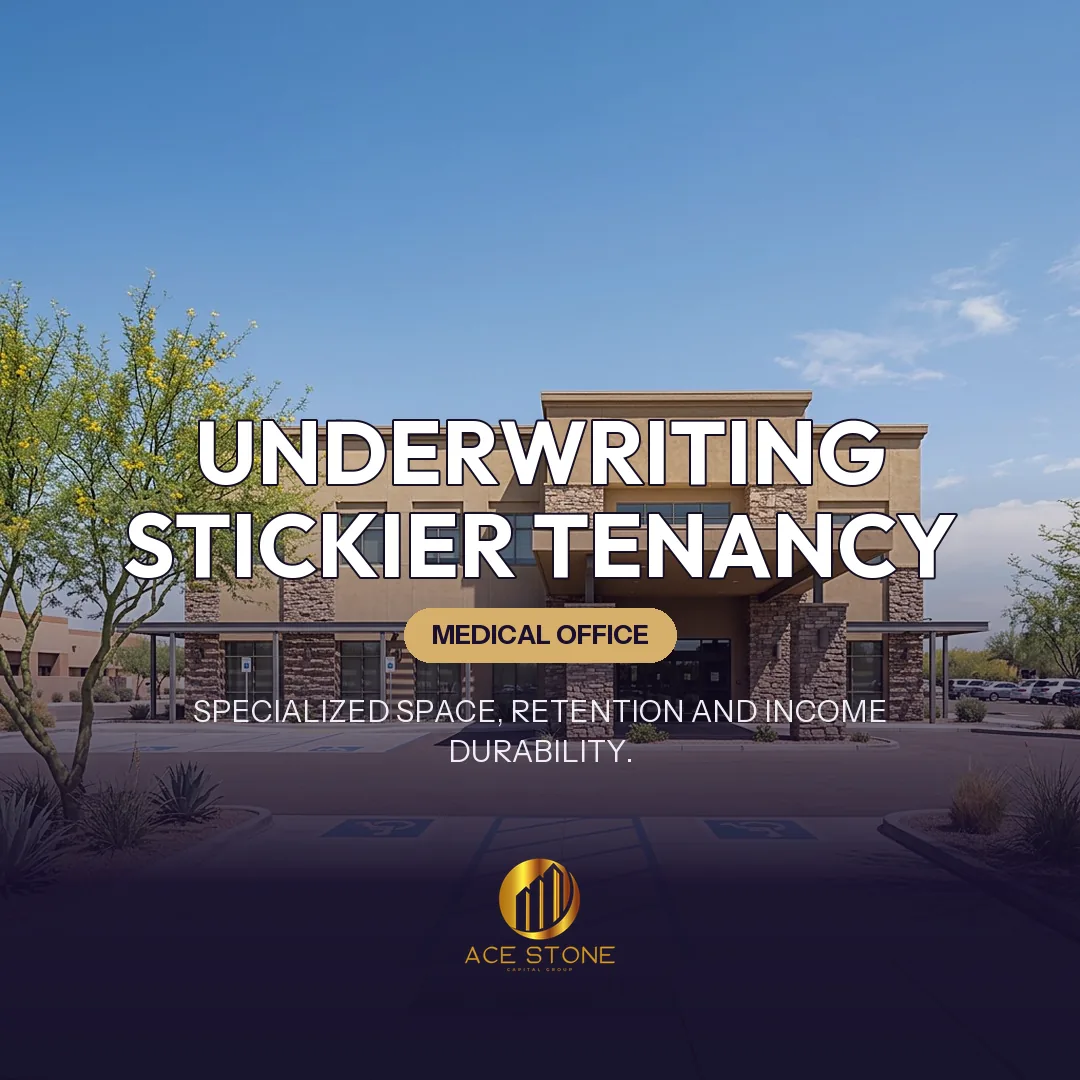
    Phoenix medical office building with covered patient entrance.
    Representative imagery of the asset type and market — not a photograph of the subject property.

    Case Context

    This acquisition profile examines AceStone Capital Group's underwriting method. Specific properties, counterparties, and pricing are not identified. The subject profile is a two-story multi-tenant Phoenix medical office building occupied by primary-care physicians, outpatient specialists, an imaging user and a laboratory draw station. Medical office is frequently underwritten as if it were conventional office with better retention. That shortcut misses both directions of the difference: tenancy is genuinely stickier, and the cost of losing a tenant is materially higher.

    Why Medical Tenancy Behaves Differently

    A physician practice is not merely occupying space; it is operating a licensed clinical business inside a fitted-out suite that its patients know how to find. Relocation means constructing new exam rooms, re-permitting, notifying a patient panel, absorbing revenue disruption during the move, and risking referral relationships tied to the location. That friction produces renewal behaviour conventional office does not exhibit. The same friction, however, means that when a practice does leave — through retirement, consolidation into a hospital system, or a sale to a larger group — the vacated suite is a specialized, expensive shell rather than open floor plate.

    Applied exampleSee how this played out in Why Industrial Land Is the New Core Asset — a commercial acquisition in U.S. Growth Markets.

    Physical Plant and Improvement Intensity

    The building survey prices the elements that make medical space work: plumbing distribution to sinks in exam rooms, waste and vent capacity, electrical service and panel capacity for imaging equipment, dedicated circuits, HVAC zoning and outside-air rates for clinical use, lead shielding where imaging is present, floor loading, corridor widths, accessible restrooms, and the condition of the entrance canopy and patient drop-off. Second-generation medical space carries a much higher improvement cost per square foot than conventional office. That figure, not the general office allowance, is what the model must reserve for every clinical suite scheduled to roll.

    Parking, Access and Patient Flow

    Parking ratio is an underwriting input in medical office, not an amenity. Practices with high patient throughput need materially more stalls per thousand square feet than conventional office, plus accessible spaces near the entrance and short-term drop-off. Shaded and covered parking carries real leasing weight in the Phoenix climate. Access is assessed from the arterial network, transit where relevant, and drive time from the population the practices serve. A building that cannot park its tenant mix at peak clinic hours will lose renewals regardless of rent, and a suite that cannot be reached comfortably by an elderly patient panel will not re-lease at the assumed rate.

    Applied exampleSee how this played out in Retail Land in Secondary Markets: A Quiet Recovery Story — a commercial acquisition in U.S. Growth Markets.

    Location Relative to Care Networks

    Proximity matters in specific, testable ways: distance to the nearest acute-care hospital and to ambulatory surgery centres, the presence of a hospital system's outpatient strategy in the immediate area, the density and age profile of the surrounding residential population, and the competitive supply of comparable medical space within a short drive. On-campus and campus-adjacent buildings behave differently from freestanding suburban medical office, and the analysis does not blend the two. Where the subject sits away from a system campus, the underwriting assumes a broader, more price-sensitive tenant pool and prices renewal accordingly.

    Tenant Credit and Concentration

    Tenant review distinguishes independent single-physician practices, multi-physician groups, private-equity-backed platforms and health-system affiliates, because each carries a different credit and behaviour profile. Practice-level financial information is rarely available in the depth an institutional buyer would like, so the analysis leans on payment history, length of tenancy, the size and specialty of the practice, guarantee structure and observed investment in the suite. Concentration is measured explicitly: if two suites represent an outsized share of income, or if several tenants depend on the same referral source or reimbursement category, the building's income is less diversified than the tenant count implies.

    Applied exampleSee how this played out in Mixed-Use Development Sites in Live-Work Corridors — a commercial acquisition in U.S. Growth Markets.

    Income, Expenses and Reimbursement Sensitivity

    Net operating income is rebuilt from abstracted leases, with recovery structures verified rather than assumed — medical leases vary widely between gross, modified gross and triple net, and the janitorial and utility load in clinical space is higher than in conventional office. Property taxes are restated post-sale, insurance is quoted for clinical occupancy, and management is priced at the level a medical asset actually requires. Reimbursement sensitivity is treated qualitatively but seriously: practices heavily dependent on a single payer category or on procedures facing reimbursement pressure carry more renewal risk than tenure alone would suggest.

    Rollover Cost and Downtime

    For each expiration in the hold period the model applies a renewal probability grounded in specialty, tenure and suite investment, then blends two cost paths: a renewal path with modest refresh allowance and a short commission, and a turnover path with a full second-generation medical improvement allowance, extended downtime while a specialty user is found, free rent, and full commissions. Where a suite's build-out is highly specific — imaging vaults, surgical suites, laboratory infrastructure — the analysis also tests the cost of demolishing improvements back to a leasable shell, because the next tenant may not want the previous tenant's clinic.

    Valuation and Acquisition Logic

    Medical office typically prices at a tighter capitalization rate than commodity suburban office, and the spread is defensible where tenancy is diversified, parking is adequate, the location is supported by a real patient catchment and improvements are recent. It is not defensible on the label alone. The acquisition basis is therefore built from normalized income, less the dated capital plan, less the probability-weighted rollover reserve, capitalized at a rate that reflects the actual tenant mix rather than the asset-class average. Exit is tested against a buyer pool that includes private investors and specialized medical-office capital, with an exit rate at or above entry.

    Key Takeaways

    Medical office earns its reputation for durable income, but the durability is a function of build-out cost and patient geography rather than a property of the sector. Underwrite the plumbing, the parking and the payer mix; reserve for clinical-grade re-tenanting rather than office-grade; and measure concentration honestly. Where those tests hold, the income is genuinely stickier than conventional office. Owners of comparable Phoenix medical office assets can review acquisition parameters with the firm's acquisition desk.

    What This Case Shows

    A structured example of how AceStone Capital Group sources, underwrites, and structures off-market commercial acquisitions in Phoenix, AZ. For broader context, see our active acquisition markets or initiate a direct-sale review for a similar property.

    Have a Property to Sell?

    Receive a written offer or a clear pass within 1–2 business days.

    Request a Cash Offer