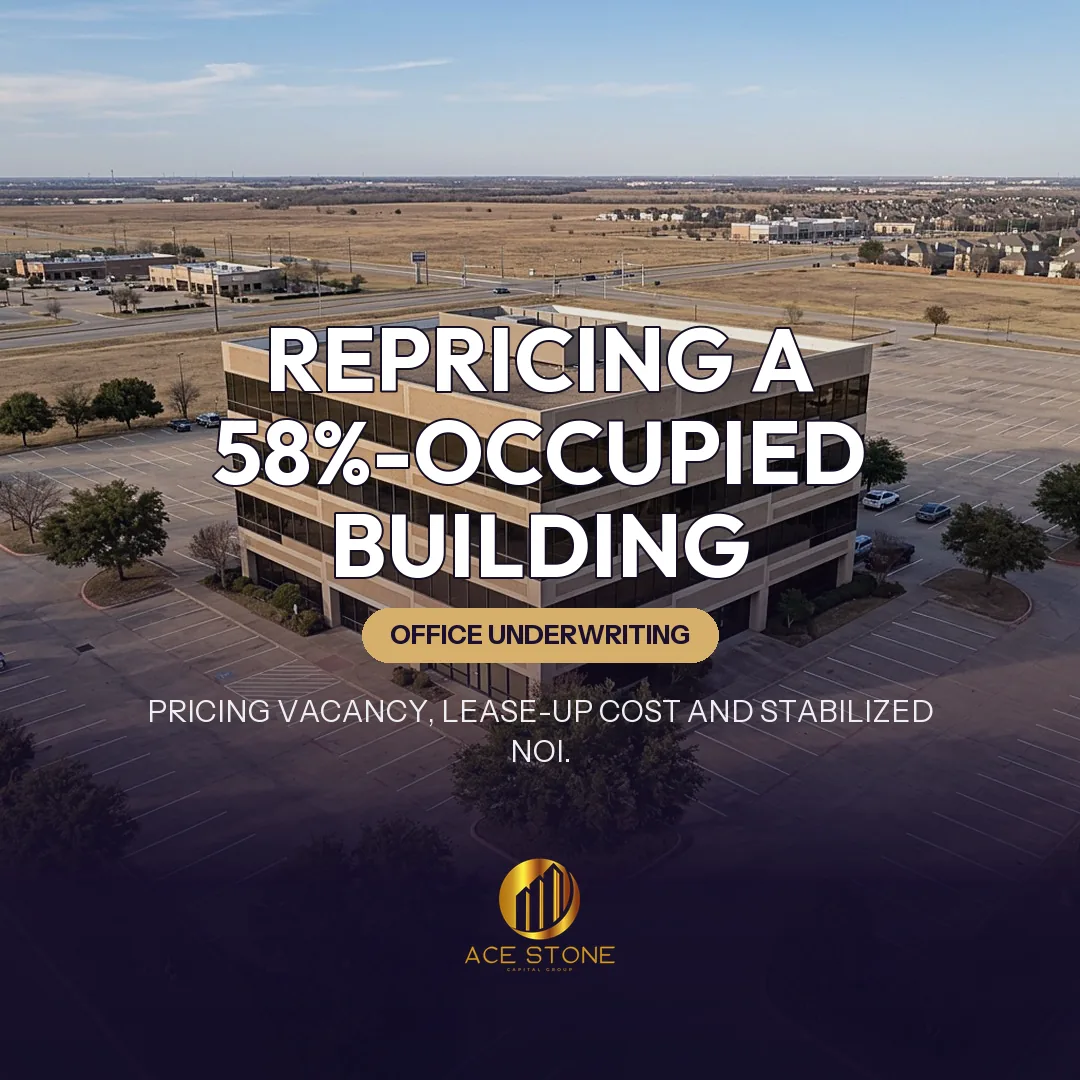
Distressed Office Acquisition: Repricing a 58%-Occupied Building in Dallas
A suburban Dallas Class B office building at roughly 58% occupancy — why a low price per square foot is not, by itself, a reason to buy.
This acquisition profile examines asset strategy, underwriting method, transaction structure, and value-creation considerations. Counterparty and pricing details are not disclosed.
Representative imagery of the asset type and market — not a photograph of the subject property.
Case Context
This acquisition profile examines AceStone Capital Group's underwriting method for an asset of this type. Specific properties, counterparties, and pricing are not identified. The subject profile is a four-story suburban Dallas office building of early-1990s vintage, roughly 58% leased after several tenants rolled off within an eighteen-month window. Buildings in this condition are usually marketed on price per square foot relative to replacement cost. That framing is the trap. The buyer is not purchasing square footage; the buyer is purchasing today's income plus an obligation to fund several years of lease-up, tenant improvements and carrying cost before the asset produces the net operating income implied by the offering memorandum.
Rent Roll and Occupancy Profile
Underwriting begins with a lease-by-lease abstraction rather than a summary rent roll. For each tenancy the review records demised area, commencement and expiration, base rent and escalation structure, the expense-recovery method, renewal and termination options with their strike rents and notice dates, unamortized landlord work, security deposits and guarantees. Occupied area is then separated from leased-but-dark area, and both are separated from vacant area, because a tenant paying rent on space it no longer uses is a rollover event in waiting. In a 58%-occupied building, the weighted average lease term of the occupied portion frequently proves shorter than headline occupancy suggests, and that figure — not the occupancy percentage — governs the risk.
Each in-place rent is compared with the current achievable rent for equivalent space in the same submarket, measured net of concessions rather than on face rates. Suburban Class B markets frequently quote face rents that survive only because landlords fund six to twelve months of free rent and elevated improvement allowances. The analysis therefore converts every comparable to an effective rent over the lease term before drawing a conclusion. Where in-place rents sit above effective market, the excess is treated as a temporary condition that expires with the lease, not as a permanent income stream. Where they sit below, the gap is captured only after downtime, improvement dollars and commissions are subtracted.
Operating Expenses and Current NOI
Expenses are rebuilt rather than inherited. Property taxes are restated on a post-sale reassessment basis, which in Texas is a material adjustment on any asset that has been held for a long period. Insurance is quoted for the current construction and occupancy profile. Utilities, janitorial, security, landscaping, elevator maintenance, repairs and management fees are modelled at the level required to run a partially occupied building — noting that many expense lines do not fall proportionally with occupancy, because the lobby, elevators, chillers and parking field must be operated regardless. Recoveries are then applied only where the leases actually permit them. The resulting current net operating income is usually well below the seller's normalized figure.
Filling the vacant 42% is a capital project with a schedule, not an assumption. The model carries an absorption pace derived from the submarket's recent net absorption and the building's competitive position, a tenant-improvement allowance per square foot appropriate for second-generation space, leasing commissions on both the tenant and landlord side, free-rent periods consistent with observed concessions, and the operating cost of carrying vacant space in the interim. The same treatment is applied to expirations inside the hold period, with a renewal probability applied so that renewal-level improvement costs and turnover-level costs are blended rather than assumed away. Lease-up cost frequently exceeds the apparent discount to replacement cost.
Deferred Maintenance and Building Capital
A property that lost occupancy has often also lost capital investment. Diligence prices roof condition and remaining life, parking-lot surface and drainage, façade sealant and glazing, chiller and rooftop unit age, controls and building automation, elevator modernization, life-safety systems, restroom and common-area accessibility compliance, and the condition of the lobby and corridors that a prospective tenant walks through before signing. These items are budgeted as a dated capital plan and funded from the acquisition basis. Cosmetic common-area improvement is treated as a leasing prerequisite in a competitive submarket, not as discretionary upside.
Three scenarios are modelled. In the conservative case, absorption runs materially slower than the submarket average, concessions remain elevated, one existing tenant does not renew, and stabilization arrives late in the hold with occupancy in the low seventies. In the base case, absorption tracks the submarket, renewal probability is applied at observed rates, and the building stabilizes in the mid-eighties. In the stabilized case, leasing outperforms and occupancy reaches the high eighties at effective rents modestly above today's. The purpose of the framework is not to produce a target return; it is to identify how much of the price is being paid for outcomes that have not happened yet.
Debt Service and Liquidity
Partially occupied office does not finance like stabilized office. Any assumed capital structure must be tested against current in-place income rather than stabilized income, with an interest reserve and a leasing reserve sized to the full lease-up period. If the position depends on refinancing at a lower rate or on a valuation that only exists at stabilization, the plan is a bet on the credit market rather than an underwriting conclusion. The analysis therefore asks whether the asset can be carried, unlevered or conservatively levered, through the slowest of the three absorption scenarios without a capital call.
Acquisition Basis and Pricing Logic
The basis is derived from stabilized net operating income capitalized at an exit rate at or above the entry market for Class B suburban product, discounted back over the absorption period, less the full cost of lease-up, less the dated capital plan, less a return requirement sized to execution risk. Only then is the implied price per square foot calculated — as an output, not an input. A building can be worth a third of replacement cost and still be overpriced, because replacement cost is irrelevant when the market is not building competing product and existing product is being absorbed slowly.
Key Takeaways
Distressed office is priced on income and execution, not on physical square footage. The three questions that decide the outcome are how much genuine income exists today, how much capital must be spent before the asset stabilizes, and what a future buyer will pay for the stabilized cash flow. When a seller's price requires the buyer to fund lease-up and also to award the seller credit for the stabilized result, the correct response is a lower basis or no transaction. Owners weighing a sale of comparable Dallas office product can review current acquisition parameters through the firm's acquisition desk.
What This Case Shows
A structured example of how AceStone Capital Group sources, underwrites, and structures off-market commercial acquisitions in Dallas, TX. For broader context, see our active acquisition markets or initiate a direct-sale review for a similar property.
Have a Property to Sell?
Receive a written offer or a clear pass within 1–2 business days.