Hyperscale Data Center Campus: Underwriting 200 Acres in Dallas-Fort Worth
A 200-acre DFW tract evaluated as a phased multi-building digital campus — usable acreage, staged energization, and why later phases are worth less than early ones.
This acquisition profile examines asset strategy, underwriting method, transaction structure, and value-creation considerations. Counterparty and pricing details are not disclosed.
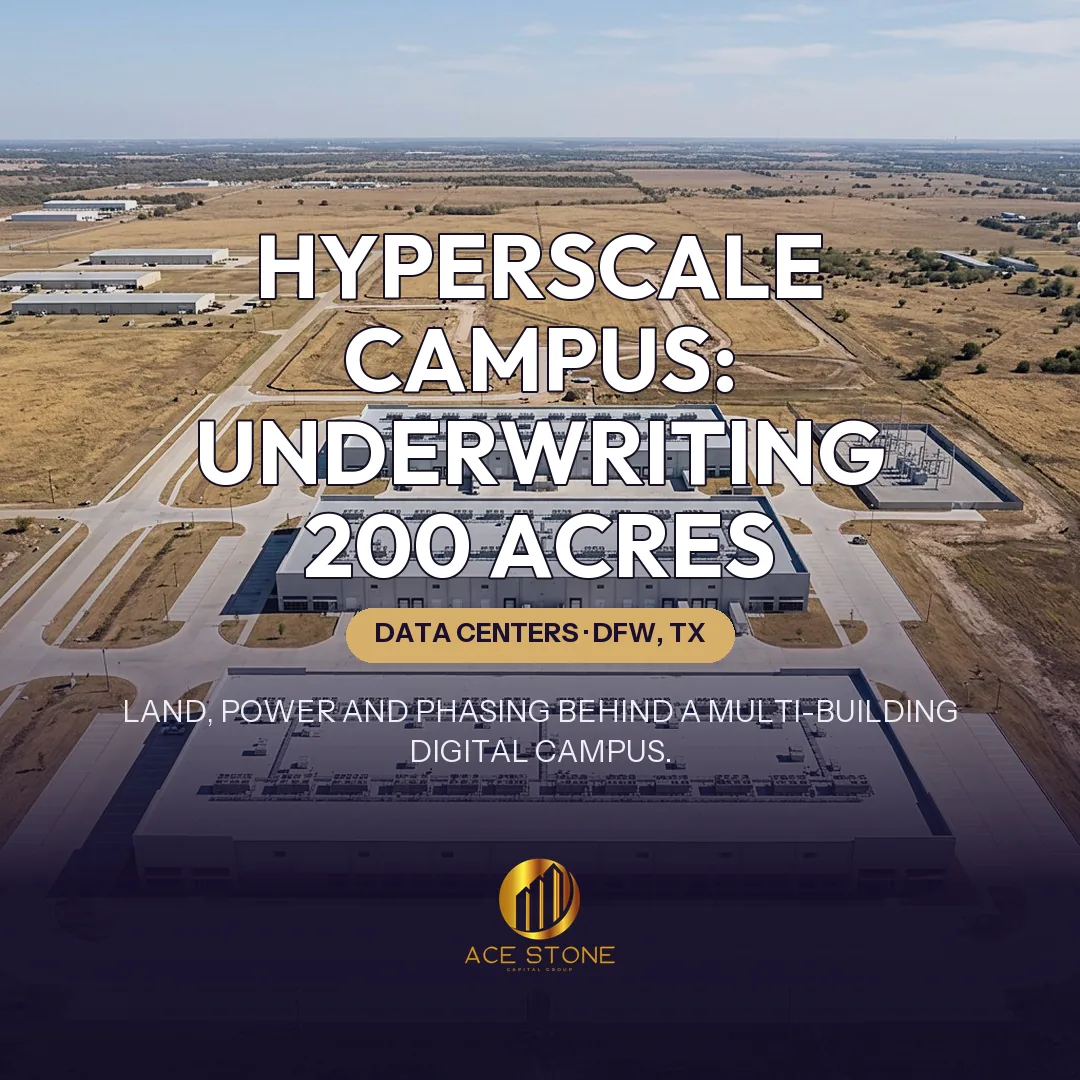
Representative imagery of the asset type and market — not a photograph of the subject property.
Case Context
This acquisition profile examines AceStone Capital Group's underwriting method for an asset of this type. Specific properties, counterparties, and pricing are not identified. The subject profile is a roughly 200-acre Dallas-Fort Worth tract of former agricultural land with highway access, being evaluated as a phased multi-building data-center campus. Tracts of this scale are frequently marketed as a single indivisible opportunity. Institutional underwriting treats them as a sequence of separately timed development parcels whose values differ substantially from one another.
Gross Acreage Versus Programmable Acreage
The first exercise converts gross acreage into acreage that can carry buildings. Deductions include the existing transmission easement crossing the northern boundary, floodplain along the drainage running through the site, required detention volume sized to the impervious cover a campus of this density creates, perimeter buffers against adjacent land uses, internal spine roads, the generator and fuel yards, the substation parcel and the electrical yards serving each building. The resulting programmable acreage — not the marketed 200 — becomes the denominator for every subsequent per-acre figure in the model.
The campus concept assumes a total critical load delivered progressively rather than at once. The analysis records what the serving utility and the regional transmission organization can confirm about existing capacity in the area, the studies a load of this magnitude would require, the historical duration of comparable study and interconnection processes in the territory, and whether the campus would be fed from an existing substation, an expansion, or a new on-site substation built for the project. Target power density per building drives the electrical room, yard and transformer footprint, which in turn drives the building envelope and the site plan.
Phased Energization Concept
Capacity for a campus of this size does not arrive in a single event. The analysis assumes a staged sequence in which an initial tranche supports the first building, a second tranche follows transmission or substation work, and the balance depends on network reinforcement whose schedule is outside the developer's control. Each tranche is modelled with its own study, procurement, construction and commissioning timeline. Long-lead transformers and switchgear are treated as schedule-defining items rather than as procurement details, because in most of these programmes they, not construction, set the critical path.
The analysis records the diameter, pressure and distance of the nearest water main, the capacity of the receiving sewer system, the length of any extension required and whether a lift station is needed, and what the local provider can confirm about capacity for a large user. Cooling strategy is then tested against that answer: an air-cooled or closed-loop design reduces water dependency at a cost in electrical efficiency and equipment footprint, while an evaporative design lowers power draw but creates a supply dependency that must be underwritten as carefully as electrical capacity.
Grading, Stormwater and Site Costs
Earthwork on 200 acres is a material line item. The analysis estimates cut and fill by phase, the probability of rock in the corridor, unsuitable soils requiring undercut and replacement, detention pond volume and outfall capacity, erosion control across long construction durations, and the cost of building the internal road and utility spine ahead of the first building. Phase I necessarily funds infrastructure that later phases use, so the model allocates that shared spend across the phases it serves rather than burying it in the first building's budget.
The analysis reviews the current zoning classification against data-center use, height limits against required clear heights, noise standards at the property line against generator testing and chiller operation, screening and landscaping requirements, and the platting sequence a phased campus requires. Surrounding land uses matter over the full development period: a tract bordered by industrial and agricultural land carries different entitlement risk than one where residential subdivisions are being platted on the far side of the road during the same years the campus is being built.
Fiber and Carrier Routing
Campus connectivity is planned as a permanent piece of infrastructure. The analysis identifies carriers with plant within practical reach, confirms whether two physically diverse routes can be constructed into the site, sizes the conduit and vault system for future capacity so later phases do not require re-trenching the spine, and prices the laterals and easements. Building the connectivity backbone at Phase I scale is more expensive initially and materially cheaper than serving three buildings with three separately negotiated builds.
Phase I, II and III
Phase I occupies the portion of the tract closest to the confirmed capacity path, on the flattest ground, and funds the substation parcel, the spine road, the primary stormwater system and the fiber backbone. Phase II uses the next tranche of capacity and benefits from the infrastructure already built, so its incremental cost per MW is lower but its start date depends on an event outside the buyer's control. Phase III sits behind network reinforcement with no schedule and is underwritten as an option rather than as a plan.
Why Later Phases Are Worth Less
A dollar of value delivered in year seven is worth a fraction of the same dollar in year two, and the discount compounds with uncertainty about whether the phase happens at all. The analysis therefore values Phase I on development economics, Phase II on probability-weighted economics with a schedule discount, and Phase III on the residual land value the acreage would command if the campus stopped after two buildings. Sellers of large tracts frequently price all 200 acres as though every acre were Phase I acreage. That gap is where most large-tract negotiations are actually decided.
Basis, Carry and Structure
The model carries land basis, property taxes across a long hold, insurance, engineering, entitlement and study costs, and the cost of capital through each phase gap. Structure is used to align payment with delivery: a takedown schedule tied to phase starts, options on the later acreage with defined strike pricing, and deposits contingent on utility milestones rather than on calendar dates. Where a seller will not accept a phased structure, the entire tract must be underwritten as though only Phase I is certain.
Risks and Sensitivities
Principal risks include capacity tranches slipping or being reallocated, transformer lead times extending, water or sewer capacity limiting cooling strategy, earthwork exceeding estimate after geotechnical work, entitlement conditions imposed as neighboring residential development advances, and demand-side change over a decade-long build-out. The model is stressed on each: a two-year slip in Phase II, a material increase in site costs, and a scenario where Phase III never energizes at all.
Exit Optionality
The tract retains value beyond the digital-infrastructure thesis. Alternatives include sale of the balance acreage to an industrial or logistics developer, sale of an entitled and powered Phase I pad to a developer or operator, or disposition of the whole tract with completed studies and entitlements as a materially de-risked position. Because the campus concept depends on events with multi-year horizons, the credibility of these alternatives is part of the acquisition decision rather than a footnote to it.
Key Takeaways
Ordinary industrial land is valued on acreage, access and zoning. Institutional-scale digital-infrastructure land is valued on deliverable megawatts, their timing and the infrastructure required to make each phase productive. On a 200-acre tract that distinction is not academic: it determines whether the buyer is purchasing one certain development parcel and two options, or paying for three certain parcels and receiving one.
What This Case Shows
A structured example of how AceStone Capital Group sources, underwrites, and structures off-market commercial acquisitions in Dallas-Fort Worth, TX. For broader context, see our active acquisition markets or initiate a direct-sale review for a similar property.
Have a Property to Sell?
Receive a written offer or a clear pass within 1–2 business days.