Power Before Land: Underwriting a 100 MW Data Center Site in Northern Virginia
A Northern Virginia development parcel underwritten on deliverable electrical capacity rather than price per acre — and why two similar tracts price differently.
This acquisition profile examines asset strategy, underwriting method, transaction structure, and value-creation considerations. Counterparty and pricing details are not disclosed.
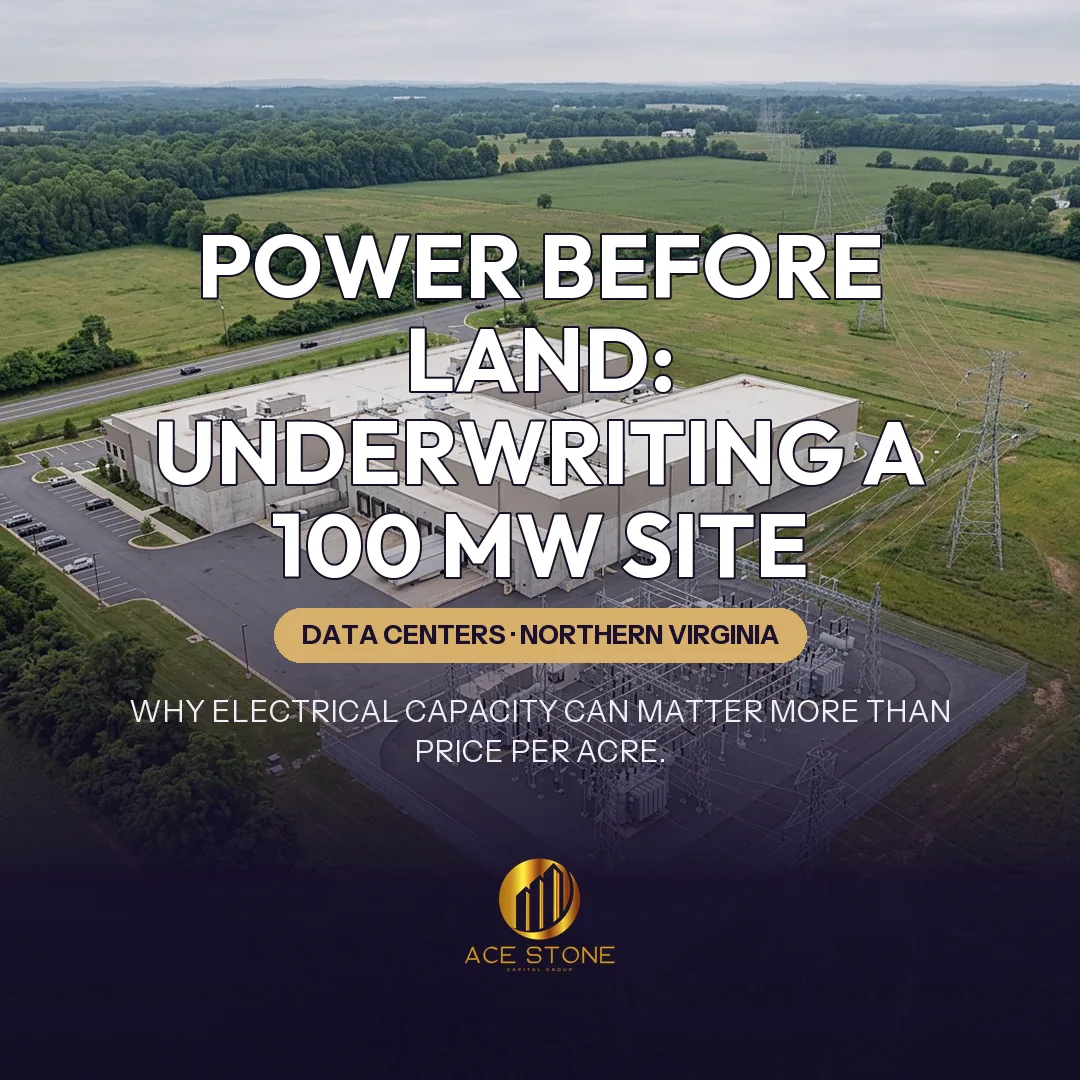
Representative imagery of the asset type and market — not a photograph of the subject property.
Case Context
This acquisition profile examines AceStone Capital Group's underwriting method for an asset of this type. Specific properties, counterparties, and pricing are not identified. The subject profile is a Northern Virginia development tract marketed to data-center developers on the strength of its size, road frontage and by-right industrial zoning. The seller's pricing guidance is expressed per acre and benchmarked against recent nearby land trades. The underwriting question is different: what quantity of electrical capacity can credibly be delivered to this parcel, on what schedule, and at what cost to the buyer.
The Requirement Defines the Asset
The programme assumed for this analysis is roughly 100 MW of critical IT load delivered across a small number of buildings. That requirement, not the acreage, sets every downstream constraint: the substation configuration, the number and voltage of feeders, the transformer lead times, the generator yard, the switchgear rooms, the fuel storage and the cooling plant. A parcel that cannot host the electrical infrastructure supporting the requirement is not a discounted data-center site; it is industrial land that happens to sit near data centers, and it should be priced as industrial land.
Before any land economics are modelled, the analysis establishes what the serving utility can say today. The relevant questions are narrow and factual: what capacity exists on the nearest transmission and distribution infrastructure, what studies would be required for a load of this size, what queue position a new request would take, what network upgrades a study of this type has historically triggered in this service territory, and whether capacity in the area has already been allocated to earlier requests. Any answer that begins with an assumption rather than a study result is treated as unpriced risk.
Substation and Transmission Geometry
Physical proximity to a substation is only the first indicator. The analysis records the substation's voltage class, its existing transformer capacity, the headroom actually uncommitted, whether an expansion bay exists, and how a new feed would be routed to the site — along which corridor, across whose property, and through how many crossings of roads, streams or rail. A parcel one mile from a constrained substation with no expansion room is materially worse than a parcel three miles from an uncongested one with a clear route and available bays. Distance is a cost input; capacity and routing are the value drivers.
Capacity that arrives late is capacity discounted heavily. The analysis models an energization sequence: study completion, agreement execution, equipment procurement with the long-lead transformer and switchgear items called out explicitly, utility construction, on-site electrical build and commissioning. Redundancy is modelled alongside it, because a single-feed configuration limits which occupant categories the finished facility can serve. Where dual, physically diverse feeds require additional corridor construction, that cost belongs in the acquisition model rather than in a later development budget where it quietly disappears.
Fiber and Carrier Diversity
Connectivity is underwritten as infrastructure, not amenity. The analysis identifies which carriers have physical plant within a practical build distance, whether at least two genuinely diverse routes can reach the parcel without sharing a single conduit bank, bridge or right-of-way pinch point, what construction and easement work each route requires, and what a lateral of that length has typically cost in the corridor. A site served by two logical circuits riding one physical path has one route, not two, and the analysis records it that way.
Gross acreage rarely survives contact with the site plan. The analysis deducts existing easements and transmission corridors, delineated wetlands and their buffers, floodplain, steep slope, required setbacks and screening buffers, stormwater management areas, internal roads, the generator yard and the utility parcel that may need to be conveyed to the serving utility. What remains is the acreage that can actually carry building footprint and yard. Price per gross acre and price per usable acre routinely diverge by a wide margin on tracts of this type, and only the second figure is meaningful.
Zoning, Entitlement and Community Constraints
By-right industrial zoning does not resolve the entitlement question by itself. The analysis reviews permitted use language for data-center occupancy, height limits against the clear heights a modern hall requires, setback and buffer requirements against adjacent residential uses, noise standards measured at the property line against generator testing and cooling equipment, lighting standards, and whether the jurisdiction has adopted or is considering additional review requirements for large-load users. Where a special exception or rezoning is likely, its duration and uncertainty are priced, not assumed away.
Site Development and Off-Site Infrastructure
Earthwork on a large tract is a significant and highly site-specific cost. The analysis estimates cut and fill balance, rock probability, unsuitable soils, stormwater detention volume and outfall availability, water and sewer capacity and the length of any main extension, and off-site road improvements a traffic study of this scale typically triggers. Each item is carried at a range rather than a point estimate, and the aggregate is expressed as a cost per usable acre so it can be compared directly against the land price the seller is asking.
Parcel A Versus Parcel B
The analysis compares two conceptually similar tracts. Parcel A is smaller, less attractive topographically and priced above the market on a per-acre basis, but sits behind a credible near-to-mid-term path to the required capacity with a defined route and an identified expansion bay. Parcel B is larger, flatter, cheaper per acre and visually the better piece of land, but its capacity path depends on network upgrades with no completion commitment. Under a cost-per-deliverable-MW framing, Parcel A is the cheaper asset despite the higher headline price, and by a margin that per-acre comparison never reveals.
Basis, Carry and Structure
Land basis is only the entry cost. The analysis adds property taxes over the assumed hold, insurance, maintenance, entitlement and study fees, engineering and legal costs, and the cost of capital across a carrying period measured in years rather than months. Structure is the primary mitigant: extended diligence periods, option agreements with capacity milestones, staged deposits that go hard only on defined utility outcomes, and price adjustments tied to confirmed usable acreage. The instrument used to control the land should mirror the uncertainty being carried.
Risks
The principal risks are capacity allocated to a competing request before this one advances; a study result that triggers network upgrades whose cost is assigned to the load; long-lead equipment schedules extending energization past the buyer's window; usable acreage falling below programme requirement after wetland delineation; entitlement conditions that constrain generator testing or building height; and demand-side change during a multi-year carrying period. Each is assigned a monitoring point and, where possible, a contractual off-ramp rather than a narrative reassurance.
Exit Optionality
A disciplined analysis identifies what the land is worth if the data-center programme never happens. Alternative outcomes include sale to an industrial or logistics developer at industrial pricing, a partial disposition retaining the parcel nearest the capacity path, or a long-dated hold if the corridor's constraint eventually clears. Where the alternative-use value approximates the acquisition basis, downside is contained. Where the pricing only works as a data-center site, the buyer holds a single-scenario position and must be paid for it in the entry price.
Decision Framework
The parcel is underwritten on cost per deliverable MW, adjusted for the probability and timing of delivery, with usable acreage as a secondary test and price per gross acre disregarded entirely as a valuation metric. Acquisition proceeds only where a documented utility path exists, where the option structure limits capital at risk until that path is confirmed, and where the alternative-use value supports a meaningful share of the basis.
Key Takeaways
Power before land. Electrical capacity is the scarce input in this asset class and land is the commodity wrapped around it, which is why two similar tracts can differ in value by a multiple that acreage comparison cannot explain. Deliverable capacity, its timing and its redundancy determine value; usable acreage constrains it; and the cost of every step between a study request and an energized building belongs in the acquisition price rather than in a later budget.
What This Case Shows
A structured example of how AceStone Capital Group sources, underwrites, and structures off-market commercial acquisitions in Northern Virginia. For broader context, see our active acquisition markets or initiate a direct-sale review for a similar property.
Have a Property to Sell?
Receive a written offer or a clear pass within 1–2 business days.