
Back
    Commercial Raleigh, NC August 2026

    Office Campus Redevelopment: When the Land Becomes More Valuable Than the Buildings

    A low-density Raleigh-Durham office campus with real income today and a land basis that may eventually justify replacing the buildings.

    This acquisition profile examines asset strategy, underwriting method, transaction structure, and value-creation considerations. Counterparty and pricing details are not disclosed.

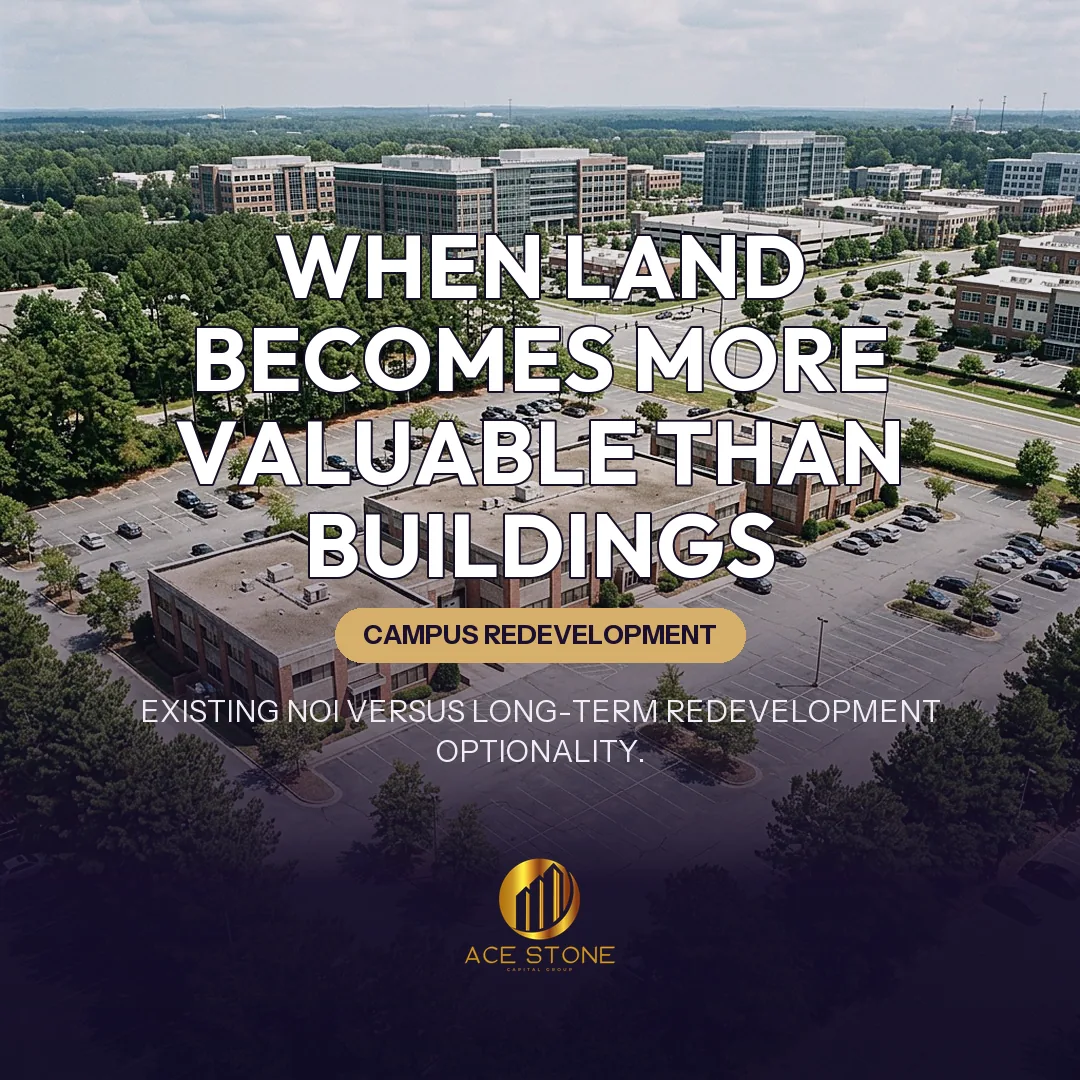
    Raleigh area low-density office campus with large parking fields.
    Representative imagery of the asset type and market — not a photograph of the subject property.

    Case Context

    This acquisition profile sets out AceStone Capital Group's acquisition method. Specific properties, counterparties, and pricing are not identified. The subject profile is an aging suburban office campus in the Raleigh-Durham area: several low-rise buildings of 1980s and 1990s vintage on a large parcel, surrounded by surface parking, partially leased and still producing income, with denser and newer development along the adjacent arterial. The question is not whether redevelopment is possible. It is whether redevelopment value, properly discounted, exceeds the value of the income the campus produces today.

    The Income Case

    The existing operation is underwritten first, on its own merits. Leases are abstracted, occupancy and expiration schedules mapped, rents compared with the submarket net of concessions, and expenses rebuilt with post-sale tax treatment, campus-wide maintenance, parking-field upkeep and management. A dated capital plan prices roofs, mechanical replacement, parking resurfacing, life-safety and accessibility work. Net operating income is then projected under realistic renewal probabilities for older suburban product. If the campus can carry itself and fund committed capital plan, the interim hold is self-financing, which is the single most important input into the redevelopment question.

    Applied exampleSee how this played out in The Value of Entitled Commercial Land in Tight Credit Cycles — a commercial acquisition in U.S. Growth Markets.

    The Land Case

    The land is valued independently of the improvements. That requires establishing parcel size and configuration, current zoning and permitted uses, achievable density under existing entitlements and under a plausible rezoning, height and setback constraints, utility and infrastructure capacity, stormwater and environmental conditions, road frontage and access points, and any dedication or improvement obligations a new project would trigger. Land value is then derived residually from what a developer could pay for a defined programme — residential, mixed-use, industrial, or a combination — after construction cost, soft cost, financing and required developer profit.

    Entitlement Path and Timing

    Where the target programme exceeds what current zoning permits, the analysis maps the approval process: applications required, public hearings, review timelines, the political posture of the jurisdiction toward density in that corridor, likely community conditions, and traffic or infrastructure studies. Each step is assigned a duration and a probability. Entitlement is not modelled as a fee; it is modelled as calendar time during which the property must be owned, insured, taxed and operated, with professional costs accruing and market conditions free to change.

    Applied exampleSee how this played out in Data Centers & Energy-Corridor Land Opportunities — a commercial acquisition in U.S. Growth Markets.

    Cost of Clearing the Site

    Redevelopment requires removing what exists. That cost includes lease buyouts or waiting out expirations, relocation of any tenants with rights, hazardous-materials survey and abatement in buildings of this vintage, demolition and disposal, utility disconnection and relocation, removal or reworking of extensive paving, grading and stormwater reconstruction, and any offsite improvements required by approval. Large surface parking fields are cheap to demolish but expensive to re-engineer for a denser programme, and the analysis prices the site work rather than assuming a flat, clean parcel.

    Interim Hold Economics

    Between acquisition and redevelopment the campus is an operating business. The plan defines a leasing policy consistent with the redevelopment horizon: shorter terms, demolition clauses, restrained improvement allowances, and a willingness to accept lower rents in exchange for flexibility. Each of those choices reduces interim income relative to a conventional leasing strategy, and the model reflects that reduction rather than assuming full-term leasing revenue alongside a near-term redevelopment start. The interim period is also where most of the plan's risk is carried, because the owner is exposed to both office fundamentals and the approval process simultaneously.

    Applied exampleSee how this played out in Suburban Office Land: Repricing, Not Extinction — a commercial acquisition in U.S. Growth Markets.

    Four Values, Compared Correctly

    The analysis produces four figures: the value of existing office income capitalized as an operating asset; the residual land value under a defined redevelopment programme; the value of the interim hold cash flow through the entitlement and clearance period; and the present value of the future redevelopment outcome after discounting. The critical discipline is that these are not additive. A property is worth the greater of its income value and its discounted redevelopment value — with interim income contributing to the latter path — never the sum of the two. Sellers frequently price campuses as though both could be realized at once.

    Discounting Optionality Honestly

    Redevelopment value is discounted for the time required to entitle and clear, the probability that approvals are denied or conditioned, construction-cost inflation over a multi-year horizon, financing availability at the time construction would begin, absorption risk for whatever product is built, and the possibility that the market that makes the programme attractive today cools before delivery. Applying a full development-land price to a parcel that is three to five years from a building permit, while also crediting today's office income, produces a price no disciplined buyer can pay.

    Risks and Decision Framework

    Principal risks are entitlement failure, prolonged approval timelines, office fundamentals deteriorating faster than the redevelopment path advances, tenant departures that turn a self-funding hold into a cash drain, cost inflation, and capital-market conditions at the point of construction financing. The decision framework is straightforward: acquire at or near the value supported by existing income and a self-funding interim hold, treat redevelopment as optionality obtained at low cost, and proceed to redevelopment only when entitlement, cost and market conditions all confirm the thesis. Paying today for a future entitlement transfers the developer's profit to the seller.

    Key Takeaways

    When land value approaches or exceeds improved value, the campus becomes a timing problem rather than a valuation problem. Underwrite the income so it carries the hold, value the land residually against a real programme, discount the optionality for time and approval risk, and never pay for both the building's income and the land's future in the same price. Owners of comparable Raleigh-area office campuses can review the firm's land and redevelopment acquisition criteria.

    What This Case Shows

    A structured example of how AceStone Capital Group sources, underwrites, and structures off-market commercial acquisitions in Raleigh, NC. For broader context, see our active acquisition markets or initiate a direct-sale review for a similar property.

    Have a Property to Sell?

    Receive a written offer or a clear pass within 1–2 business days.

    Request a Cash Offer