
Back
    Commercial Jacksonville, FL August 2026

    Office Sale-Leaseback: Acquiring a Corporate Headquarters with a New Long-Term Lease

    A Jacksonville headquarters sale-leaseback — underwriting the tenant, the lease and the underlying real estate as three separate propositions.

    This acquisition profile examines asset strategy, underwriting method, transaction structure, and value-creation considerations. Counterparty and pricing details are not disclosed.

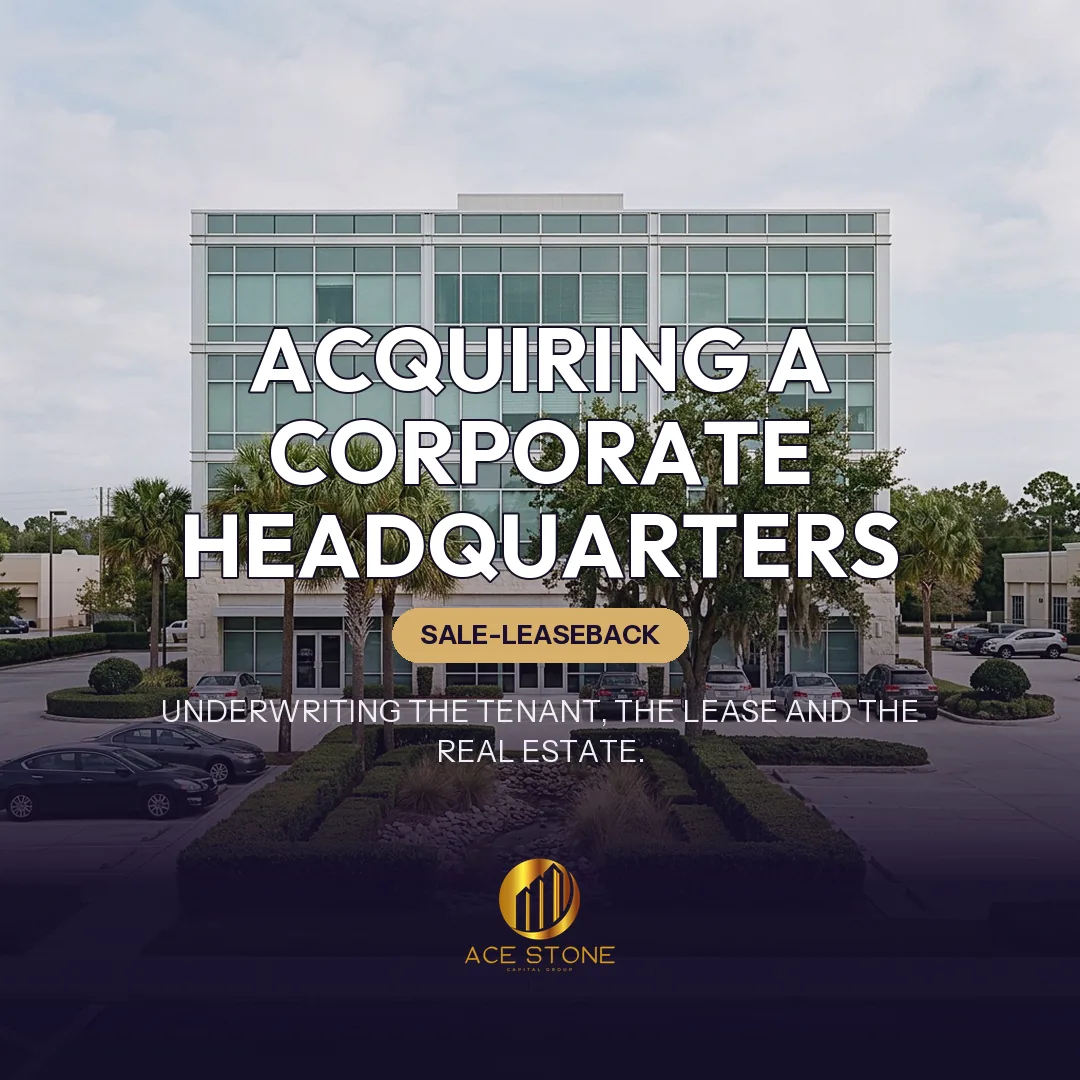
    Jacksonville corporate headquarters office building.
    Representative imagery of the asset type and market — not a photograph of the subject property.

    Case Context

    This acquisition profile examines AceStone Capital Group's underwriting method. Specific properties, counterparties, and pricing are not identified. The subject profile is a corporate headquarters in Jacksonville where the owner-occupier proposes to sell the building and simultaneously enter a new long-term lease, remaining in place as tenant. Sale-leasebacks present cleanly: full occupancy, long term, a motivated counterparty and an attractive headline capitalization rate. The rate is attractive precisely because the seller sets the rent, and rent set by the seller is a pricing decision disguised as an income stream.

    The Seller Sets Two Numbers at Once

    In a sale-leaseback the seller-tenant simultaneously determines the rent it will pay and the price it receives. Higher rent produces a higher sale price at any given capitalization rate. A company seeking maximum proceeds therefore has a direct incentive to set rent above market, and the buyer's yield is measured against a number the tenant may not be able to sustain at renewal — or that a replacement tenant would never pay. The first analytical step is to establish market rent for the building independently, then measure the proposed contract rent against it.

    Applied exampleSee how this played out in Retail Land in Secondary Markets: A Quiet Recovery Story — a commercial acquisition in U.S. Growth Markets.

    Rent-to-Market Analysis

    Market rent is derived from signed comparable leases for equivalent Jacksonville office space, adjusted for quality, location, parking and concessions, and expressed on an effective basis. Contract rent is then plotted against it over the lease term including escalations, so the overage or discount is visible at every year rather than only at commencement. Where contract rent exceeds market by a wide margin, the excess is treated as amortizing purchase consideration rather than as income, and the underwriting value is calculated using market rent, with the difference discounted for the credit risk of the overage.

    Tenant Credit and Coverage

    The lease is only as strong as the entity behind it. Credit review covers the contracting entity and any guarantor, financial condition and leverage, the business's exposure to cyclical or structural pressure, and — importantly for a headquarters — the rent's coverage relative to the company's earnings. A rent that consumes an outsized share of operating income is a candidate for renegotiation at the first difficult year, regardless of what the document says. Where financial information is limited, the analysis discounts the credit rather than assuming strength, and prices the lease accordingly.

    Applied exampleSee how this played out in Mixed-Use Development Sites in Live-Work Corridors — a commercial acquisition in U.S. Growth Markets.

    Lease Structure Details

    Terms that determine actual net cash flow are abstracted precisely: whether the structure is truly absolute net or leaves roof, structure or capital replacement with the landlord; who bears taxes, insurance and the risk of reassessment following the sale; casualty and condemnation provisions and whether the tenant may terminate; maintenance standards and surrender condition; renewal options and the mechanism for setting renewal rent; assignment and subletting rights, including whether the tenant can transfer the lease to a weaker credit; and any purchase option, right of first refusal or right of first offer that would cap the landlord's upside. In Florida the post-sale property-tax reassessment and windstorm insurance treatment are specific and material line items.

    The Real Estate Beneath the Lease

    Independent of the lease, the building is underwritten as real estate: location quality and access, land area and parking ratio, building age, systems condition and remaining useful life, floor plate flexibility, the degree to which improvements are specific to this occupant, and the cost to convert the building to multi-tenant use. Purpose-built elements — an executive floor, a corporate auditorium, a data centre, a cafeteria, specialized security — carry conversion cost rather than value. Replacement cost is calculated as a reference point, and the acquisition basis is compared with it to test whether the buyer is protected by physical value or exposed to a lease.

    Applied exampleSee how this played out in The Value of Entitled Commercial Land in Tight Credit Cycles — a commercial acquisition in U.S. Growth Markets.

    Residual and Reletting Analysis

    The controlling question is what happens at expiration or on an earlier default. The model identifies the realistic replacement tenant pool for a building of this size and configuration in this submarket, prices the demising and base-building work required to serve multiple tenants, applies a full second-generation improvement allowance, free rent and commissions, and assumes an absorption period drawn from local data. The resulting residual value, discounted to today, is the buyer's floor. If contract rent is above market, that floor sits well below the price implied by the going-in capitalization rate.

    Reading the Capitalization Rate Correctly

    A headline rate computed on above-market rent is not comparable to a rate computed on market rent. The analysis therefore reports both: the going-in rate on contract rent, and the effective rate on market rent — the figure a buyer would earn if the tenant left tomorrow and the space re-leased at market. The spread between them measures how much of the yield depends on the tenant's willingness and ability to keep paying above market. A wide spread is not necessarily disqualifying; it must simply be priced, disclosed to the capital behind the transaction, and reflected in the exit assumption.

    Exit Liquidity

    Net-lease buyers price on credit, term and rent-to-market. As term shortens, value converges toward the real estate rather than the lease, so a sale-leaseback bought at a tight rate with a long term should not be assumed to exit at the same rate with less term remaining. Where rent is above market, the exit buyer will apply the same discount this analysis applies, and the model reflects capitalization-rate expansion at exit rather than compression.

    Key Takeaways

    Underwrite three things separately: the tenant's credit, the lease's terms, and the building's value without the lease. A sale-leaseback is attractive when contract rent sits at or near market, the building is generic enough to relet, and the credit supports the term. It is dangerous when a strong headline yield rests on rent no replacement tenant would pay in a building no replacement tenant wants. Companies considering a headquarters sale-leaseback can review the firm's acquisition parameters.

    What This Case Shows

    A structured example of how AceStone Capital Group sources, underwrites, and structures off-market commercial acquisitions in Jacksonville, FL. For broader context, see our active acquisition markets or initiate a direct-sale review for a similar property.

    Have a Property to Sell?

    Receive a written offer or a clear pass within 1–2 business days.

    Request a Cash Offer