
Back
    Commercial Scottsdale, AZ August 2026

    Office Condo Exit: Underwriting Suite-Level Value in Scottsdale

    A Scottsdale professional office complex where individual suites may be worth more than the whole — and why the spread is not profit.

    This acquisition profile examines asset strategy, underwriting method, transaction structure, and value-creation considerations. Counterparty and pricing details are not disclosed.

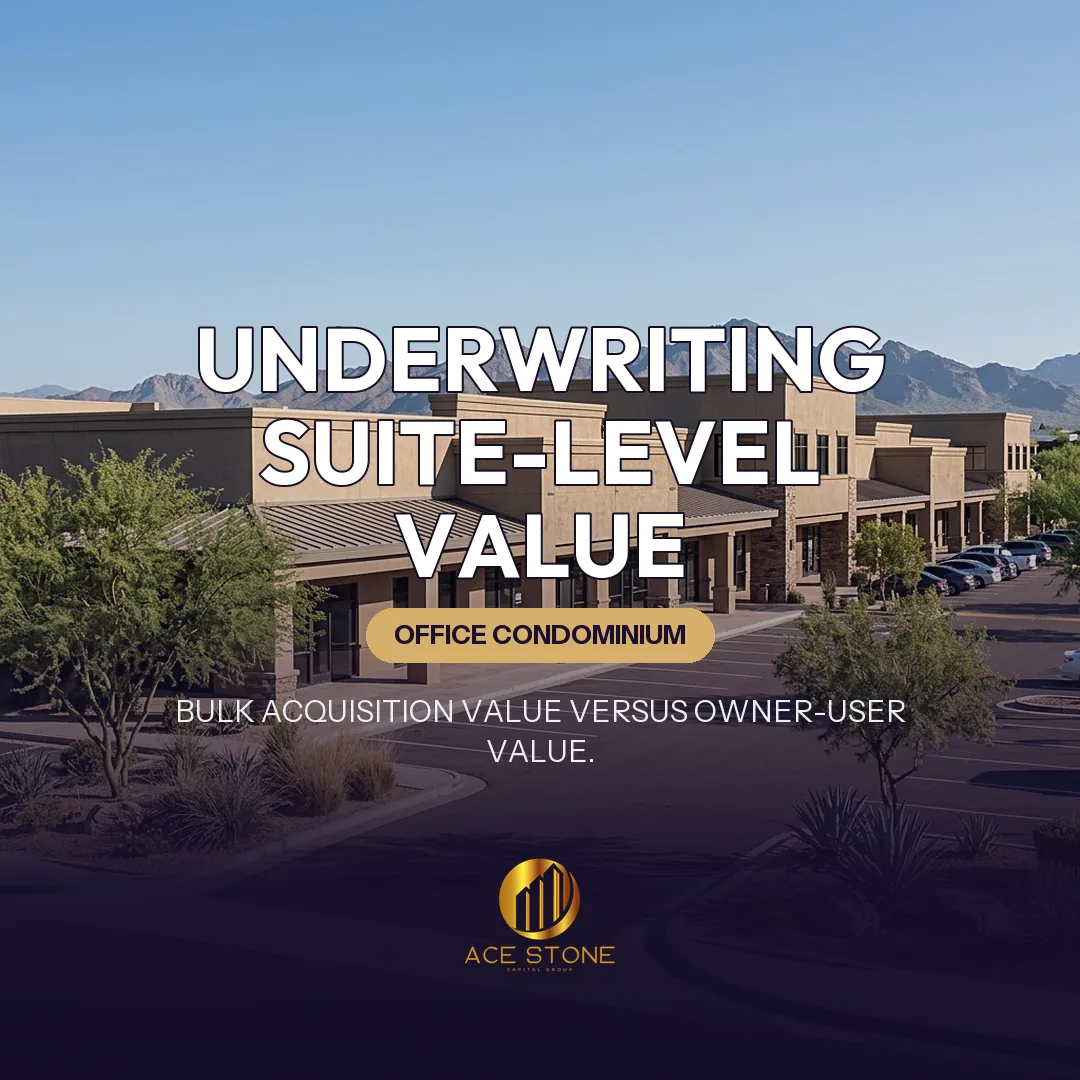
    Scottsdale low-rise professional office complex with multiple suite entrances.
    Representative imagery of the asset type and market — not a photograph of the subject property.

    Case Context

    This acquisition profile sets out AceStone Capital Group's acquisition method. Specific properties, counterparties, and pricing are not identified. The subject profile is a low-rise Scottsdale professional office complex with multiple separate suite entrances, currently held and operated as a single investment asset. Comparable individual suites in the submarket sell to owner-users at values that, when aggregated, exceed what the building is worth as an income property. That observation is the beginning of the analysis, not the conclusion.

    Two Valuations of the Same Asset

    The building is valued twice. As an investment, it is priced from abstracted leases, normalized expenses with a post-sale tax reassessment, a dated capital plan and a capitalization rate reflecting small multi-tenant suburban office. As a collection of saleable suites, it is priced from closed owner-user sales of comparable condominium suites, adjusted for size, condition, entrance configuration, parking allocation and floor level. The difference between the two figures is the gross spread, and it is routinely mistaken for the profit available from a condominium strategy.

    Applied exampleSee how this played out in Mixed-Use Development Sites in Live-Work Corridors — a commercial acquisition in U.S. Growth Markets.

    Legal and Structural Prerequisites

    Subdivision is a legal process before it is a sales process. It requires a condominium declaration and plat consistent with state and local requirements, defined unit boundaries and common elements, an owners' association with governing documents, budget and reserve study, allocation of parking and shared facilities, and typically municipal approval of the map. Existing leases, mortgages and any recorded restrictions must be addressed. Timing and cost of this process vary and are budgeted with professional fees and a contingency. Where the building's physical configuration does not permit separately metered, independently accessible units, the strategy fails before it begins.

    Physical Work Required

    Owner-users buy finished suites, not shells. The plan prices separate utility metering where it does not exist, demising walls and independent entries, HVAC separation so each unit controls and pays for its own conditioning, restroom access within or adjacent to each unit, accessibility compliance at each entrance, common-area upgrades that support a premium sale price, façade and landscape refresh, and parking restriping and allocation. Suites intended for sale in finished condition also require interior improvement budgets, and suites sold as shells sell for less. Both variants are modelled.

    Applied exampleSee how this played out in The Value of Entitled Commercial Land in Tight Credit Cycles — a commercial acquisition in U.S. Growth Markets.

    Association Economics

    The owners' association is part of the product being sold. Its budget covers exterior maintenance, roof and parking reserves, landscaping, common utilities, insurance, and management. Monthly assessments directly affect the price a user will pay, because the buyer underwrites total occupancy cost, not purchase price alone. An underfunded reserve schedule creates future special assessments that damage resale values and the sponsor's reputation while unsold inventory remains. The model therefore funds reserves properly and treats the resulting assessment level as a constraint on achievable suite pricing.

    Absorption, Carry and Selling Costs

    Suites sell one at a time. The model builds an absorption schedule from observed transaction velocity for comparable suites in the submarket, then carries every unsold unit through the period: taxes, insurance, association contributions on unsold inventory, utilities, maintenance, marketing and financing cost. Selling costs include brokerage commissions on each sale, title and escrow, transfer costs, legal fees and buyer concessions. Where existing tenants occupy suites, their leases either convey to buyers — narrowing the pool to investors — or must run off before an owner-user sale, adding time.

    Applied exampleSee how this played out in Data Centers & Energy-Corridor Land Opportunities — a commercial acquisition in U.S. Growth Markets.

    Buyer Depth and Financing

    The strategy depends on a continuing supply of small businesses and practices that want to own rather than lease in this specific location. Depth is tested against the profile of local professional and medical businesses, the historical pace of small commercial condominium sales in the area, and the availability of financing for small owner-occupied commercial purchases. Financing availability and any government-guaranteed programmes are lender-specific and change over time; nothing in this analysis should be read as a representation of eligibility. If credit tightens or rates move, absorption slows and carrying costs rise precisely when sale prices soften.

    The Spread That Actually Matters

    Net proceeds equal gross suite sales less subdivision cost, less physical work, less improvement budgets, less carrying cost over the absorption period, less selling costs, less the value of any inventory unsold at the planning horizon. That figure — not gross suite value — is compared with the acquisition basis plus the return required for a multi-year execution with sales risk. In many cases the apparently large gross spread compresses to a margin that does not justify the complexity, in which case buying and holding the building as an income asset, or not buying it at all, is the better decision.

    Downside and Partial Execution

    The downside case assumes absorption runs at half the projected pace, two or three suites remain unsold at the horizon, and the residual inventory must either be leased or sold in bulk at a discount. If the position still returns capital under that scenario, the basis is defensible. A useful discipline is to require the deal to work as an income asset first, treating the condominium exit as optionality rather than as the plan, so that a slow sales market delays profit rather than creating loss.

    Key Takeaways

    Aggregate suite value is a gross number that must survive subdivision, construction, association formation, carrying cost, sales cost and time before it becomes proceeds. Verify that the building can legally and physically be divided, fund the association honestly, model absorption conservatively, and underwrite the deal so that holding it as income is an acceptable outcome. Owners of comparable Scottsdale office complexes can review the firm's acquisition parameters.

    What This Case Shows

    A structured example of how AceStone Capital Group sources, underwrites, and structures off-market commercial acquisitions in Scottsdale, AZ. For broader context, see our active acquisition markets or initiate a direct-sale review for a similar property.

    Have a Property to Sell?

    Receive a written offer or a clear pass within 1–2 business days.

    Request a Cash Offer