
Back
    Commercial Scottsdale, AZ August 2026

    Luxury Mixed-Use Redevelopment: Retail, Residences, and Land Basis in Scottsdale

    A Scottsdale redevelopment underwriting — why an attractive finished project does not justify an aggressive land basis.

    This acquisition profile examines asset strategy, underwriting method, transaction structure, and value-creation considerations. Counterparty and pricing details are not disclosed.

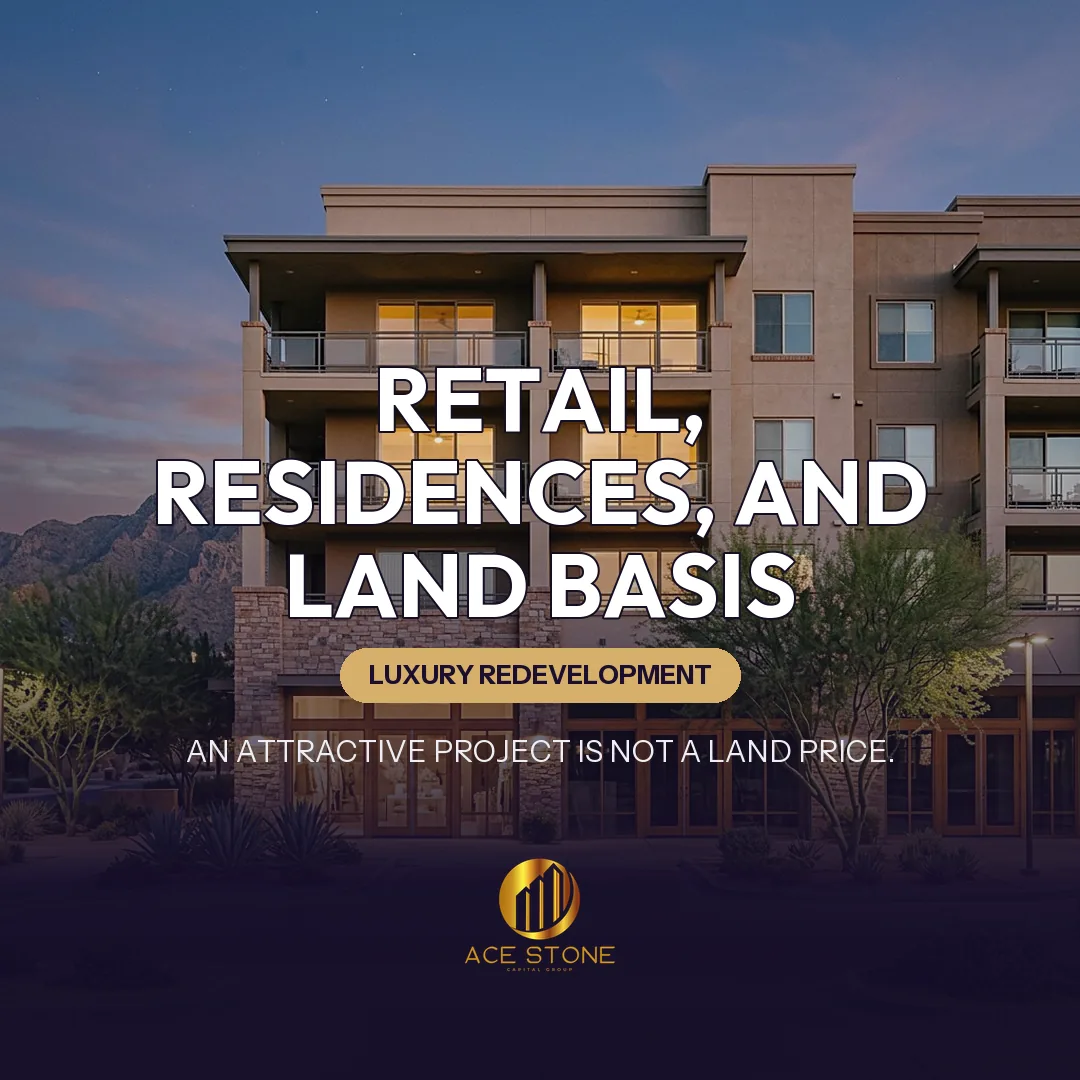
    Luxury Scottsdale mixed-use project at dusk with boutique retail below luxury residences.
    Representative imagery of the asset type and market — not a photograph of the subject property.

    Case Context

    This acquisition profile sets out AceStone Capital Group's redevelopment method. Specific properties, counterparties, and pricing are not identified. The subject profile is an underutilized commercial parcel in a high-income Scottsdale corridor, positioned for a boutique retail and luxury residential program. The finished product is easy to visualize and easy to over-value. The purpose of the analysis is to work backward from a defensible completed value to the only land price the project can actually support.

    Existing Property and Interim Income

    The site carries aging improvements generating limited income — a small commercial building, surface parking, or a marginal tenancy on a short-term basis. That income is characterized for what it is: interim carry, not a valuation input, and terminable so it never obstructs redevelopment. Existing structures are assessed for demolition cost including hazardous-materials survey and abatement, utility disconnection and any salvage credit. Any tenancy with a term extending past the planned start requires a buyout, and that number enters the land basis directly.

    Applied exampleSee how this played out in Mixed-Use Development Sites in Live-Work Corridors — a commercial acquisition in U.S. Growth Markets.

    Site Capacity and Development Rights

    Capacity is established from net usable area after right-of-way, easements and required setbacks; the zoning district and its permitted uses; height and floor-area limits; open-space and landscape requirements; parking ratios and whether shared or reduced parking is available for mixed use; and applicable design guidelines, which in Scottsdale meaningfully influence massing, materials and desert-appropriate landscape treatment. Where the intended program exceeds by-right capacity, the entitlement path — rezoning, development agreement, design review, public hearings — is defined with its timeline, cost and genuine risk of denial or conditioning.

    Program and Pricing Assumptions

    The conceptual program pairs boutique retail at grade with luxury residences above. Residential pricing is drawn from closed sales or achieved rents for genuinely comparable high-end Scottsdale product — same submarket, similar unit size, similar finish, similar view and amenity profile — rather than from aspirational marketing material. Retail rents are derived from executed leases in comparable luxury corridors, with the understanding that a boutique tenant pool is narrow and rent premiums track proven foot traffic. Absorption is modeled at a measured pace for both components, because luxury absorption is thin by definition and the model must survive a slower sales or lease-up curve.

    Applied exampleSee how this played out in The Value of Entitled Commercial Land in Tight Credit Cycles — a commercial acquisition in U.S. Growth Markets.

    Development Cost

    The cost model covers demolition and abatement, site work including grading, drainage and utilities, structured parking at current cost per stall — a decisive line item where surface parking cannot satisfy demand within a constrained footprint — vertical construction at luxury specification, high-end interior finishes, amenity spaces, landscape and hardscape, design and engineering, permits and impact fees, insurance and bonding, construction financing across the build period, marketing and sales or leasing cost, and contingency sized to the program's complexity. Cost escalation across a multi-year timeline is modeled explicitly rather than assumed flat.

    Residual Land Value and Required Margin

    Residual land value is the disciplined output: stabilized or aggregate completed value, less total development cost, less the developer profit margin the risk requires, less the cost of time. The margin requirement is not negotiable downward to make a land price work — that inversion is the mechanism by which developers overpay for land and then discover there is no return left to earn. The residual figure, less demolition, buyouts, entitlement cost and a risk allowance for approval uncertainty, is the maximum supportable acquisition price.

    Applied exampleSee how this played out in Data Centers & Energy-Corridor Land Opportunities — a commercial acquisition in U.S. Growth Markets.

    Sensitivity Analysis

    Residual land value is tested across ranges for construction cost, residential pricing, retail rent, absorption pace, exit capitalization rate, interest cost and entitlement duration. The characteristic result of this exercise is instructive: because land is the residual, it absorbs the full variance of every other input. A modest adverse move in two or three variables simultaneously can reduce supportable land value by a large fraction or eliminate it. Presenting a single-point land value from a base-case model is not underwriting; it is a projection dressed as a valuation.

    Acquisition Threshold and Structure

    The acquisition threshold is set from a conservative residual — not the base case — with entitlement risk addressed through structure rather than through optimism: a contract contingent on approvals, an extended and staged diligence period with option payments, or a closing that follows entitlement. Where a seller demands an unconditional closing at a price reflecting an approved project that has not been approved, the correct answer is to decline. Structure is the mechanism by which a redevelopment buyer avoids financing someone else's risk.

    Reasons to Proceed or Walk Away

    Proceed when the residual supports the ask with margin under conservative assumptions, when the entitlement path is defined and reasonably probable, when comparable luxury product is absorbing at the assumed pace today, and when the capital's timeline tolerates a multi-year hold. Walk away when the land price only clears at peak pricing and trough construction cost, when approvals are speculative and the contract is unconditional, when absorption evidence is thin, or when the parcel's shape and parking requirements make the program physically marginal. The finished renderings are always attractive; the land basis is where the return is won or lost.

    What This Case Shows

    A structured example of how AceStone Capital Group sources, underwrites, and structures off-market commercial acquisitions in Scottsdale, AZ. For broader context, see our active acquisition markets or initiate a direct-sale review for a similar property.

    Have a Property to Sell?

    Receive a written offer or a clear pass within 1–2 business days.

    Request a Cash Offer