
Back
    Commercial Cleveland, OH August 2026

    When the Ground-Floor Tenant Fails: Underwriting a Mixed-Use Acquisition in Cleveland

    A Cleveland building with stable apartments above and a failing ground-floor tenant below — pricing so the deal never depends on a fast re-lease.

    This acquisition profile examines asset strategy, underwriting method, transaction structure, and value-creation considerations. Counterparty and pricing details are not disclosed.

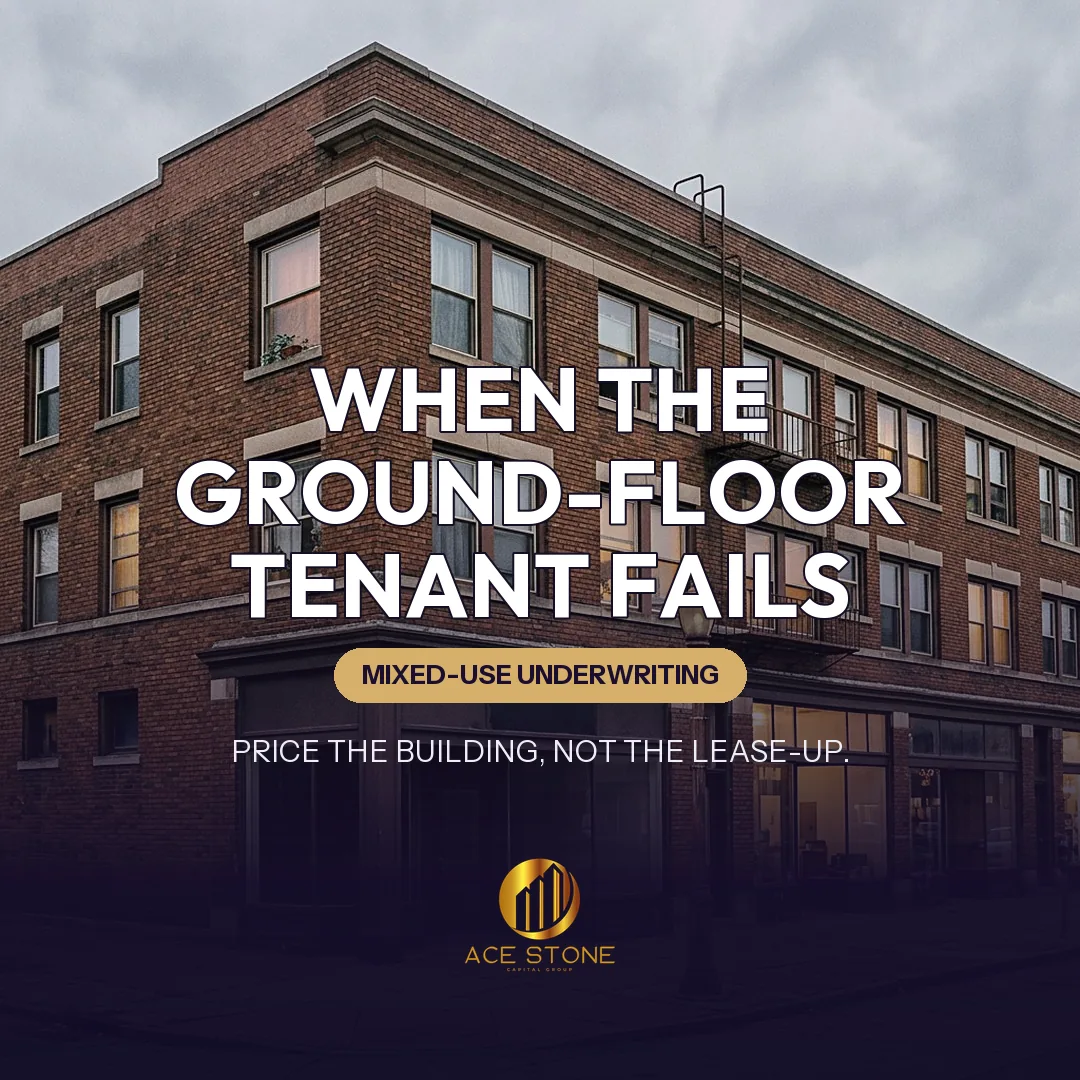
    Cleveland mixed-use building with occupied apartments above a dark vacant corner storefront.
    Representative imagery of the asset type and market — not a photograph of the subject property.

    Case Context

    This acquisition profile is modelled and educational; it does not describe a AceStone acquisition, an identified property, owner, tenant, price or lease outcome. The subject profile is an urban Cleveland mixed-use building where the residential floors are stable and well occupied while the principal ground-floor commercial tenant is failing, departing or already gone. Surrounding businesses continue to operate, so the corridor is not the problem. The question is what a building is worth when one of its two income streams has stopped and nobody can say precisely when it will restart.

    Residential Stability

    The residential component is examined first because it is what makes the position survivable. Review covers the rent roll, lease terms, in-place rents against comparable Cleveland submarket product, occupancy and turnover history, delinquency, average tenure and unit condition. Where occupancy has held steady through the commercial tenant's decline, that is direct evidence that the residential demand driver is independent of the storefront below — an important finding, because it means the vacancy is a commercial leasing problem rather than a symptom of neighborhood deterioration.

    Applied exampleSee how this played out in Retail Land in Secondary Markets: A Quiet Recovery Story — a commercial acquisition in U.S. Growth Markets.

    Commercial Lease Exposure

    The existing commercial lease is analyzed for what it can still deliver and what it can cost. Relevant items include remaining term and rent, security deposit and any letter of credit, personal or corporate guarantees and their enforceability, default and termination provisions, holdover terms, restoration obligations at surrender, and the tenant's condition and payment history. Where a tenant is failing, a lease that appears to run for years may in practice terminate through default or negotiated surrender, and underwriting assumes the space is vacant rather than crediting income from a payer that is visibly impaired.

    Replacement Rent and Downtime

    Achievable replacement rent is derived from closed comparable leases in the same corridor, adjusted for the subject's frontage, depth, ceiling height, service access and condition. It is frequently below the failing tenant's contract rent, particularly where the prior lease was signed in a different market or included buildout amortization. Downtime is measured from vacancy through marketing, negotiation, permitting, buildout and free-rent to the first cash payment — realistically three to four quarters for ordinary urban retail space, longer where the space needs specialized systems or has restrictive physical characteristics.

    Applied exampleSee how this played out in Mixed-Use Development Sites in Live-Work Corridors — a commercial acquisition in U.S. Growth Markets.

    Re-Tenanting Cost

    The cost of filling the space is itemized rather than estimated as a lump sum: restoration or demolition of the prior tenant's improvements, base-building repairs, tenant improvement allowance sized to the delivery condition and target use, landlord work if the space must be delivered in vanilla-box condition, leasing commissions across the full term to both brokers, legal cost for lease negotiation, and free rent. Alongside these, carrying costs on vacant square footage — taxes, insurance, heat sufficient to protect pipes, security and maintenance — accrue every month the space remains dark.

    Break-Even Occupancy

    Break-even analysis determines the occupancy and income level at which the property covers debt service, taxes, insurance, operating expenses and reserves. Where residential income alone clears break-even with margin, the commercial space is genuine upside and the owner can lease patiently, selecting a durable tenant rather than accepting the first offer. Where residential income does not clear break-even, every month of commercial vacancy consumes capital and forces bad leasing decisions under pressure. That single test, more than any other, determines whether this acquisition is prudent.

    Applied exampleSee how this played out in The Value of Entitled Commercial Land in Tight Credit Cycles — a commercial acquisition in U.S. Growth Markets.

    Acquisition Basis

    The basis is set by capitalizing residential net operating income at a market residential rate, adding the commercial component at a substantial discount to stabilized value, and subtracting the full re-tenanting budget, carrying cost through the projected downtime, and a return premium for taking leasing risk. Framed differently: the buyer pays close to residential-only value and treats the storefront as an option with a cost attached. A price that requires successful commercial lease-up to be justified is a price that pays the seller for the buyer's future work.

    Downside Scenario and Re-Leasing Strategy

    The downside case assumes the commercial space remains vacant for the entire projected hold, or leases at a discount to a weaker credit after prolonged marketing. If the position remains solvent and produces an acceptable, reduced return under that case, it is defensible. The re-leasing strategy accepts flexibility: dividing the space if configuration permits, considering non-retail uses appropriate to the corridor, offering shorter initial terms with renewal options to a promising local operator, or structuring a landlord-funded buildout in exchange for term and security. Tenant durability is prioritized over headline rent, because the second failure costs more than the first.

    Exit Considerations and Takeaways

    Once a credible operator is in place on a multi-year lease with a demonstrated payment history, the asset re-rates from a problem property to a stabilized mixed-use building and reaches a broader buyer pool. That re-rating is the return. The takeaways: underwrite the impaired stream at zero, prove the healthy stream covers break-even, itemize re-tenanting cost rather than estimating it, and never allow the purchase price to embed a leasing outcome the buyer does not yet control.

    What This Case Shows

    A structured example of how AceStone Capital Group sources, underwrites, and structures off-market commercial acquisitions in Cleveland, OH. For broader context, see our active acquisition markets or initiate a direct-sale review for a similar property.

    Have a Property to Sell?

    Receive a written offer or a clear pass within 1–2 business days.

    Request a Cash Offer