
Back
    Commercial Atlanta, GA August 2026

    Transit-Oriented Mixed-Use: Pricing Density Near a Major Atlanta Station

    A Atlanta transit-adjacent mixed-use position — separating value supported by today's operations from speculative future density.

    This acquisition profile examines asset strategy, underwriting method, transaction structure, and value-creation considerations. Counterparty and pricing details are not disclosed.

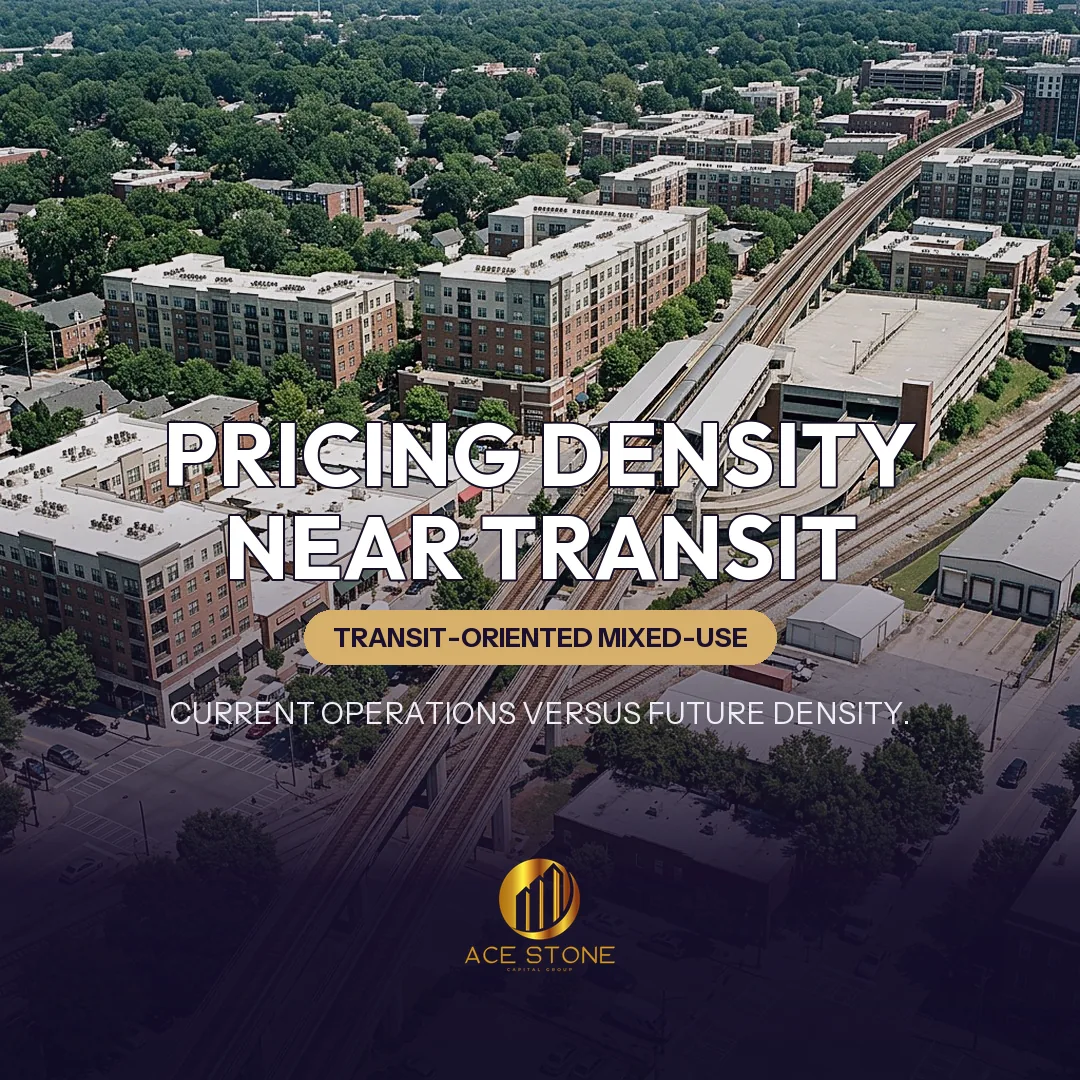
    Aerial view of Atlanta transit infrastructure surrounded by mid-rise mixed-use density.
    Representative imagery of the asset type and market — not a photograph of the subject property.

    Case Context

    This modelled analysis is educational and does not document a AceStone acquisition, an identified site, owner, tenant, price or entitlement outcome. The subject profile is a mixed-use property within walking distance of a major Atlanta transit station: modest existing improvements with retail and upper-floor space on a parcel whose location supports substantially more density than currently stands on it. Transit proximity is genuinely valuable and routinely overpaid for, because sellers price the story of future density while buyers must underwrite the reality of current income.

    Existing Improvements and Income

    The current asset is characterized honestly: building age and condition, leasable area by use, tenant roster with lease terms and expirations, in-place rents against corridor comparables, occupancy history and operating expenses. Transit-adjacent locations often show solid retail traffic and steady residential demand, which produces real income — and that income is the only part of the value that exists today. Improvements sized well below the site's permitted capacity are treated as interim: the model asks how long they can continue producing income and what maintaining them costs.

    Applied exampleSee how this played out in Why Industrial Land Is the New Core Asset — a commercial acquisition in U.S. Growth Markets.

    Walkability and Transit Value

    The location's contribution to value is examined concretely rather than rhetorically: distance and quality of the actual pedestrian route to the station, service frequency and connectivity, the density and income profile of population within walking distance, the presence of employment and retail anchors, and how far transit access measurably lifts residential rents and retail sales in comparable Atlanta submarkets. Where a station is close in distance but separated by an arterial road, a rail line or an unlit underpass, the practical benefit is smaller than the map suggests, and the model reflects the walk people will actually take.

    Zoning, Development Rights and Parking

    The regulatory capacity of the site is established: base zoning and permitted uses, floor-area ratio and height limits, any transit-oriented or special public interest district provisions, applicable parking minimums or reductions available near transit, affordability-linked density provisions where they exist, and setback and streetscape requirements. Reduced parking obligations near transit can materially improve feasibility by removing structured parking cost — one of the largest line items in urban development — but the reduction must be verified against the current code and any conditions attached, not assumed from general policy direction.

    Applied exampleSee how this played out in Retail Land in Secondary Markets: A Quiet Recovery Story — a commercial acquisition in U.S. Growth Markets.

    Assemblage Possibilities

    Transit-adjacent redevelopment frequently requires more land than a single parcel provides. Adjacent ownership, parcel configuration, existing improvements and the likelihood of neighboring owners transacting are reviewed to understand whether the subject is a complete site, an anchor for a future assemblage, or a fragment dependent on someone else's cooperation. A parcel that cannot support a viable program alone and depends on an unwilling neighbor is worth its income value and little more, however excellent its location.

    Two Valuations, Kept Separate

    The first valuation capitalizes current net operating income at a rate appropriate to the asset's age, condition and lease profile — the price justified by operations. The second is a residual land value derived from a conceptual higher-density program: completed value less total development cost less required developer margin. These are never blended into a single number. Their relationship is the negotiation: when residual land value substantially exceeds income value, redevelopment is the highest and best use and the seller will know it; when they are close, the buyer is being asked to pay for entitlement risk that has not been taken.

    Applied exampleSee how this played out in Mixed-Use Development Sites in Live-Work Corridors — a commercial acquisition in U.S. Growth Markets.

    Entitlement Uncertainty and Holding Period

    Density near transit is politically visible. Approvals may require rezoning, special use permits, community engagement, design review and negotiated commitments on affordability, streetscape or infrastructure, and each step consumes months with a real possibility of denial or of conditions that erode feasibility. The holding period is modeled from acquisition through entitlement, design, permitting, construction and lease-up, with existing income offsetting carry along the way. Time is priced explicitly: a multi-year entitlement path at prevailing capital costs consumes a substantial share of the theoretical residual.

    Acquisition Basis and Exit Scenarios

    The disciplined basis is anchored to income value with limited credit for density optionality, so the position is sound if entitlement never happens and materially profitable if it does. Three exits are contemplated: sell entitled land to a developer, capturing approval value without construction risk; develop and hold or sell a completed transit-oriented asset; or continue operating the interim improvements while the corridor matures. Retaining all three requires lease structures that stay short and terminable, and a basis low enough that patience remains affordable.

    Key Takeaways

    Transit adjacency is a durable locational advantage, not a valuation shortcut. Speculative density value belongs to whoever secures the approvals and funds the construction. The correct discipline is to buy the income, verify the capacity, preserve the flexibility, and let the entitlement decide whether the upside is ever realized — while never allowing the upside to justify the entry price.

    What This Case Shows

    A structured example of how AceStone Capital Group sources, underwrites, and structures off-market commercial acquisitions in Atlanta, GA. For broader context, see our active acquisition markets or initiate a direct-sale review for a similar property.

    Have a Property to Sell?

    Receive a written offer or a clear pass within 1–2 business days.

    Request a Cash Offer